Approach to a child with Down syndrome (trisomy 21) Quiz: Ace Your Exams
Get ready to dominate your medical and nursing exams by using our dynamic quizzes to elevate your knowledge and increase your confidence. Whether you're gearing up for the USMLE®, COMLEX®, or your next in-class assessment, Osmosis quizzes tackle key topics in pathology, diagnostics, and treatment approaches. By honing in on clinical readiness and decision-making, we make sure the knowledge you gain empowers you both in the classroom and in real-world practice. Jump in and supercharge your exam prep!
Learning videos
Flashcards
Expert reviewed
Spaced Repetition
Mobile app
Custom Quizzes
1 of 3
A 1-day old 3500-g (7.5-lb) newborn girl delivered at term to a 42-year-old primigravida is being evaluated in the nursery. The infant is having difficulty feeding and has had bilious emesis since birth. She does not have a fever, increased work of breathing, or abnormal movements. The infant's parent did not have any prenatal care. She did not drink alcohol or use other recreational substances during the pregnancy. Delivery was uncomplicated, but the infant was noted to have characteristic facial features. Temperature is 37�C (98.6�F), heart rate is 165/min, respirations are 25/min, blood pressure is 69/36 mmHg, and oxygen saturation is 98% on room air. On physical exam, the infant is noted to have a flat facial profile with almond-shaped eyes and a single palmar crease. The mucous membranes are moist. A prominent murmur is heard on cardiac exam. Pulmonary and abdominal examinations are normal. She has poor muscle tones and poor sucking. X-ray of the abdomen is shown below. Given the most like diagnosis, which of the following additional physical exam findings is most likely to be seen?
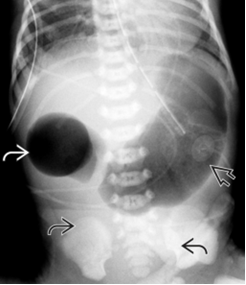
Reproduced from Statdx
Reproduced from Statdx
Elimination tool
0 XP
Press space to continue