Approach to complications of prematurity (late) Quiz: Ace Your Exams
Get ready to dominate your medical and nursing exams by using our dynamic quizzes to elevate your knowledge and increase your confidence. Whether you're gearing up for the USMLE®, COMLEX®, or your next in-class assessment, Osmosis quizzes tackle key topics in pathology, diagnostics, and treatment approaches. By honing in on clinical readiness and decision-making, we make sure the knowledge you gain empowers you both in the classroom and in real-world practice. Jump in and supercharge your exam prep!
Learning videos
Flashcards
Expert reviewed
Spaced Repetition
Mobile app
Custom Quizzes
1 of 3
A 3-month-old girl is in the Neonatal Intensive Care Unit (NICU) after premature delivery at 26 weeks’ gestation. The infant continues to have difficulty weaning from respiratory support. She was born via spontaneous vaginal delivery with an otherwise uncomplicated prenatal course. In addition to perinatal antibiotics, the mother received one dose of antenatal steroids the day before delivery. At delivery, the infant required immediate resuscitation and intubation and was placed on a mechanical ventilator. Two doses of surfactant were given on the first day of life. The patient remained intubated and mechanically ventilated for the first six weeks of life. Gradually, she improved and was extubated to nasal continuous positive airway pressure (CPAP) but is unable to wean to the nasal cannula without becoming tachypneic or hypoxemic. Temperature is 37°C (98.6°F) and is stable; pulse is 135/min, respirations are 35/min, blood pressure is 62/32 mm Hg, and oxygen saturation is 98% on nasal CPAP with 40% FiO2. On auscultation, diffuse rales are noted. Heart sounds are normal with no murmur. Abdominal exam is unremarkable. Chest radiograph is shown below. Which of the following is the most likely explanation for this patient’s persistent need for respiratory support? 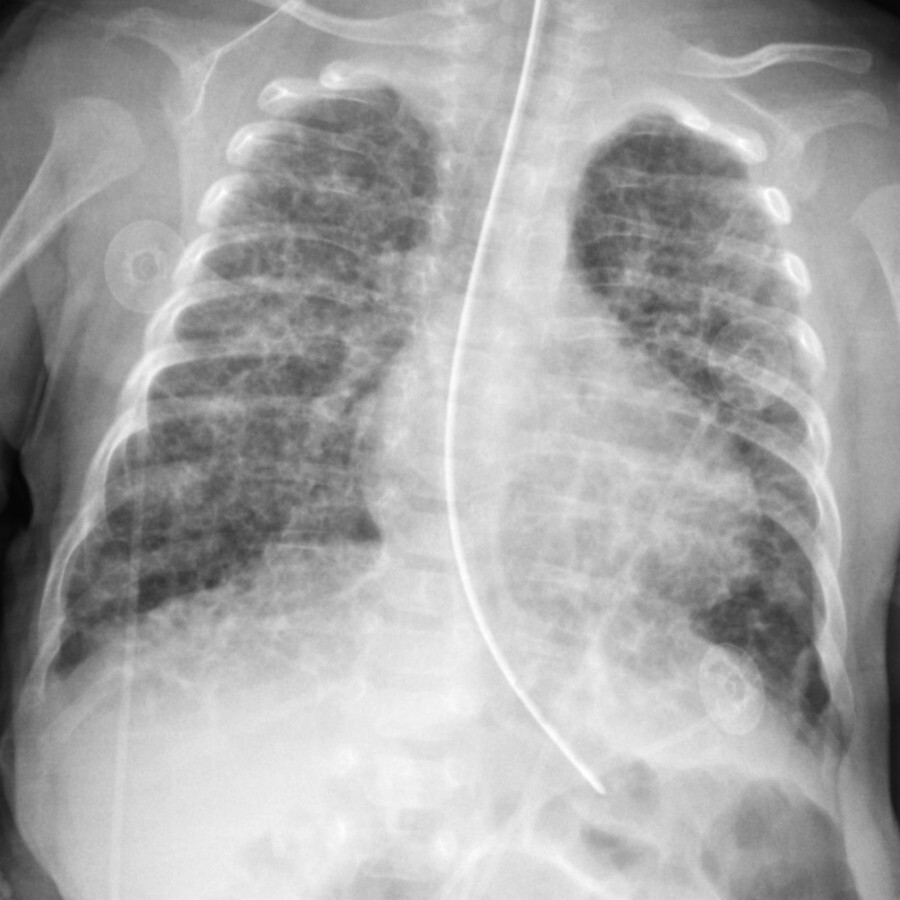 Reproduced from: Statdx
Reproduced from: Statdx Elimination tool
0 XP
Press space to continue