Approach to cyanosis (newborn) Quiz: Ace Your Exams
Get ready to dominate your medical and nursing exams by using our dynamic quizzes to elevate your knowledge and increase your confidence. Whether you're gearing up for the USMLE®, COMLEX®, or your next in-class assessment, Osmosis quizzes tackle key topics in pathology, diagnostics, and treatment approaches. By honing in on clinical readiness and decision-making, we make sure the knowledge you gain empowers you both in the classroom and in real-world practice. Jump in and supercharge your exam prep!
Learning videos
Flashcards
Expert reviewed
Spaced Repetition
Mobile app
Custom Quizzes
1 of 4
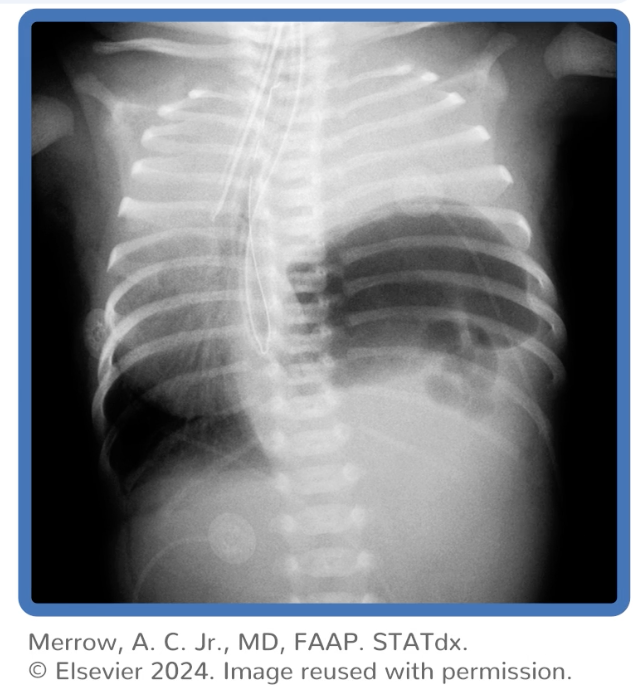
A newborn boy is born at 37 weeks estimated gestational age by spontaneous vaginal delivery and appears cyanotic at the delivery. The mother did not have prenatal care. Rupture of membranes was 12 hours before delivery, group B streptococcus (GBS) is negative, and amniotic fluid is clear. APGAR scores are 4 and 6 at 1 and 5 minutes respectively, and there is minimal respiratory effort initially. Temperature is 37°C (98.6°F), pulse is 190/min, respirations are 75/min, blood pressure is 65/39 mmHg, and oxygen saturation is 84% on room air. There is nasal flaring, and intercostal retractions are seen. No dysmorphic features are seen. Mucous membranes and the extremities are cyanotic. Cardiopulmonary exam is significant for normal heart sounds without murmurs and decreased air entry with bowel sounds heard over the left lung. The abdomen is scaphoid without hepatosplenomegaly. Femoral pulses are equal bilaterally. Chest X-ray is shown below. Which of the following is the best next step in management?
Elimination tool
0 XP
Press space to continue