Psoriatic arthritis Quiz: Ace Your Exams
Get ready to dominate your medical and nursing exams by using our dynamic quizzes to elevate your knowledge and increase your confidence. Whether you're gearing up for the USMLE®, COMLEX®, or your next in-class assessment, Osmosis quizzes tackle key topics in pathology, diagnostics, and treatment approaches. By honing in on clinical readiness and decision-making, we make sure the knowledge you gain empowers you both in the classroom and in real-world practice. Jump in and supercharge your exam prep!
Learning videos
Flashcards
Expert reviewed
Spaced Repetition
Mobile app
Custom Quizzes
1 of 3
A 49-year-old man presents to the clinic with a 6-month history of joint pain. The pain is localized to his fingers and toes, and he has no history of trauma to the areas. The pain is worse in the morning and is associated with swelling. He says he is able to perform his job on the computer, but he is limited to approximately an hour each morning. He has a 7-year history of psoriasis. Temperature is 37°C (98.7°F), pulse is 70/min, and blood pressure is 117/75 mmHg. Physical examination shows swelling of 5 distal and proximal joints of the fingers and 3 distal and proximal joints of the toes with tenderness to palpation without deformities. Nail findings are shown in the image below. Skin exam is significant for multiple erythematous and scaly plaques on both elbows and the buttocks. Laboratory studies reveal C-reactive protein (CRP) of 6 mg/L (normal <8 mg/L) and erythrocyte sedimentation rate (ESR) of 22 mm/hr (normal = 0-15 mm/hr). Radiographic findings show joint space narrowing in 3 distal interphalangeal joints of the fingers without evidence of pencil-in-cup deformities. Which of the following is the most appropriate initial treatment?
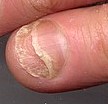
Image taken from Wikimedia
Image taken from Wikimedia
Elimination tool
0 XP
Press space to continue