
Perichondrium · What Is It, Location, Function, Most Important Facts, and More

Published: Mar 04, 2025
Author: Ali Syed, PharmD
Editor: Ahaana Singh
Editor: Lisa Miklush, PhD, RN, CNS
Illustrator: Jillian Dunbar
7-day free trial

Go deeper with Osmosis

Osmosis is a learning platform with videos, questions, and AI tools to help you master topics like this.

4.8 · 12,000+ reviews
Watch quick, visual videos
Practice with Qbank-style questions
Use AI to explain, quiz, and review
Study anytime with the mobile app
Start free trial

No credit card · Cancel anytime

What is perichondrium?

The perichondrium is a dense layer of connective tissue that covers the external surface of most of the body’s cartilage (i.e., strong, flexible, and semi-rigid tissue found throughout the body). Perichondrium is mainly found on the surfaces of elastic and hyaline cartilage, which can be found in multiple locations of the body, such as in the ears, nose, joints and ribs.

Damage to the perichondrium is known as perichondritis, and can result from cartilage injuries. This often occurs from microtraumas such as piercings, insect bites, or burns to the perichondrium tissue, leading to inflammation and, sometimes, infection. Symptoms can include pain, redness, and swelling, which may require medical treatment. Serious ear trauma leading to diminished blood flow from the perichondrium to the cartilage can lead to a puffy, cauliflower-like appearance, and is commonly referred to as cauliflower ear. This condition may require medical treatment, including antibiotics or minor surgical procedures.


Learn deeper with Osmosis

Master this topic faster with videos, questions, and AI.

Used by 8M+ healthcare learners.

Start free trial

No credit card · Cancel anytime

What type of connective tissue makes up the perichondrium?

The perichondrium is an irregular connective tissue that is composed of two layers: the outer fibrous layer and the inner chondrogenic layer. The outer fibrous layer contains fibroblasts, which produce collagenous fibers that provide the skin with structure and strengthen bones. This layer also contains blood vessels which supply the cartilage with nutrients and oxygen. The inner chondrogenic layer consists of chondroblasts, a type of cell that plays an important role in the formation of new cartilage. 

What is the function of the perichondrium?

The main functions of the perichondrium are to protect bones from injury, nourish cartilage, and facilitate cartilage growth. 

The perichondrium protects bones from injury and long-term damage by reducing friction and providing elasticity in parts of the body, as well as by resisting outward expansion when cartilage is compressed. The fibrous perichondrium also contains blood vessels that strengthen and nourish cartilage by long range diffusion, encouraging cell renewal and reducing recovery time from damage. 

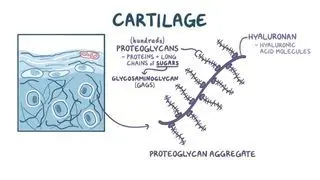
Additionally, the inner layer of the perichondrium contains cartilage-producing cells, known as chondroblasts, which enable cartilage to grow. Chondroblasts secrete a substance called the extracellular matrix, which contains various components that provide structure and strength to cartilage. In addition, chondroblasts mature into chondrocytes, which make up the cellular component of cartilage. 

What is the difference between the perichondrium and the periosteum?

The perichondrium is a dense layer of fibrous connective tissue that covers many types of cartilage in the body, whereas the periosteum is a thin layer of membranous connective tissue that covers all bones in the body. In doing so, the periosteum promotes the development and growth of the bones, while the perichondrium promotes the development and growth of cartilage. The periosteum assists bone growth by facilitating the supply of blood and nutrients to bone tissue. Both types of tissue also provide protection from bone injury, although through different means. 

What are the most important facts to know about perichondrium?

The perichondrium is a dense layer of fibrous connective tissue that covers the surface of most of the cartilage in the body. The perichondrium consists of an outer fibrous layer that contains fibroblasts and an inner chondrogenic layer that contains chondroblasts. The main functions of the perichondrium are to protect bones from injury and damage, nourish cartilage through blood vessels, and facilitate cartilage growth. Damage to the perichondrium may lead to conditions such as perichondritis or cauliflower ear. The perichondrium and periosteum are two different types of connective tissue that differ in main function and relative location. However, they both serve as a means of protecting the bones.
Students say Osmosis is 100% worth it

Because Osmosis saves them time. Lowers stress. And actually helps them remember when it counts.

I used Osmosis to prepare for my first medical school licensing exam! Super helpful and interactive for people who may not do great with just pages of text info!

Cecilia Ruiz

Cecilia Ruiz

MD student

Sayan Misra

I have used Osmosis for about four years. Best thing I have ever used for my medical studies.

Sayan Misra

Sayan Misra

Med student

Osmosis videos are superior because they define simple concepts, tell a story with a clear progression, and provide context.

Jay Pate

Jay Pate

Dental student

References


Animal tissues. Cartilage. (2020). In Atlas of Plant and Animal Histology. Retrieved December 01, 2020, from https://mmegias.webs.uvigo.es/02-english/guiada_a_cartilaginoso.php


Laor, T. & Jaramillo, D. (2019). It’s time to recognize the perichondrium. Pediatric Radiology, 50(2): 153-160. DOI: 10.1007/s00247-019-04534-x


Marieb, E. N. & Hoehn, K. (2012). Human Anatomy & Physiology (9 edition). USA: Pearson Education, Inc.


Pawlina, W. & Ross, M. H. (2018). Histology: A Text and Atlas: With Correlated Cell and Molecular Biology (8 edition). Philadelphia: Lippincott Williams & Wilkins. 


Paxton, S., Peckham, M., & Knibbs, A. (n.d.). The Leeds Histology Guide. Retrieved December 1, 2020, from https://www.histology.leeds.ac.uk/bone/cartilage.php


Pescatore, R. (2017). Perichondritis: Not Just Simple Cellulitis. In REBEL EM blog. Retrieved December 1, 2020, from https://rebelem.com/perichondritis-not-just-simple-cellulitis/


Samanthi. (2019). Difference Between Perichondrium and Periosteum. In DifferenceBetween.com. Retrieved December 1, 2020, from https://www.differencebetween.com/difference-between-perichondrium-and-periosteum/