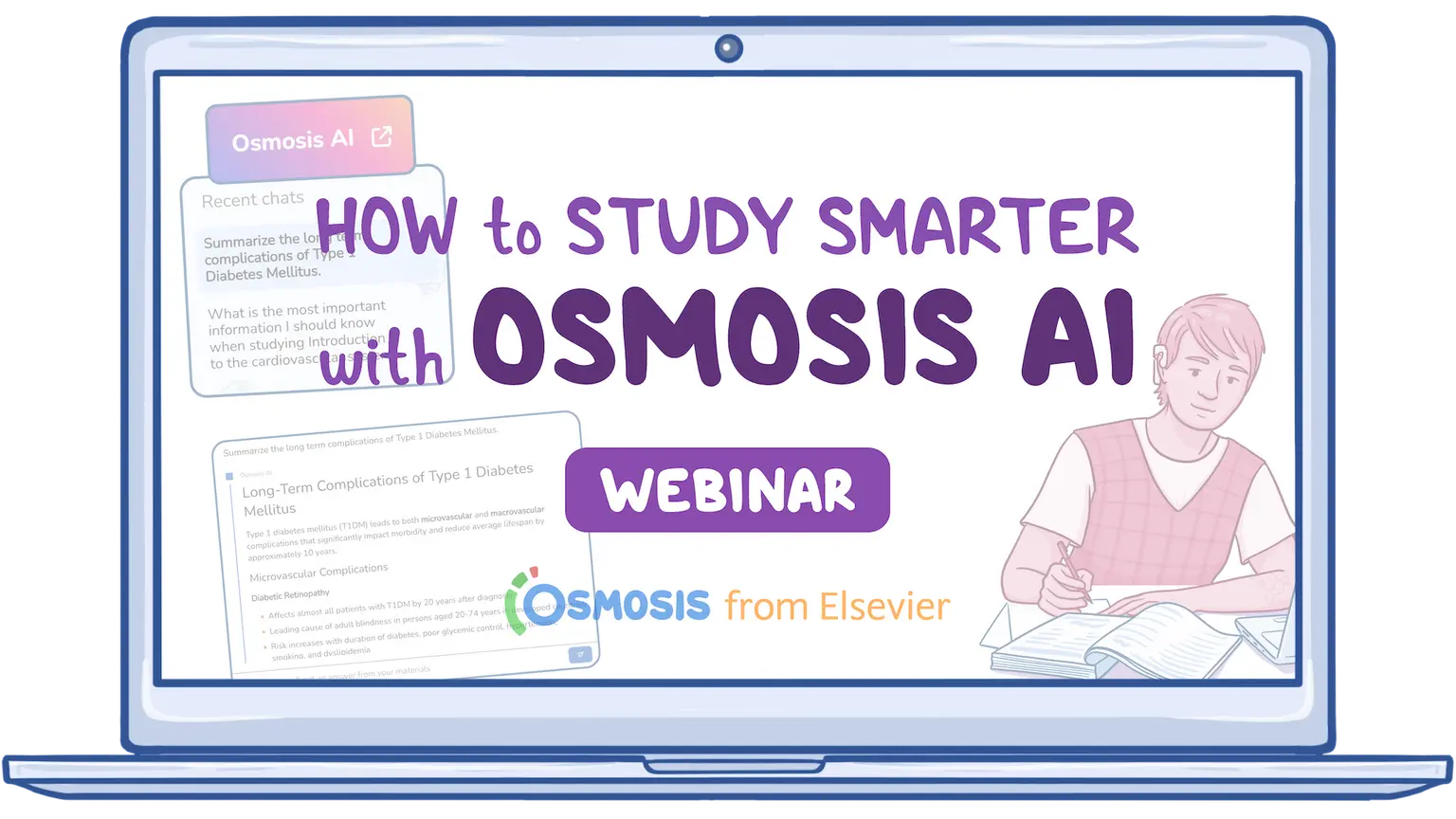
Welcome to todays webinar: How to Study Smarter with Osmosis AI. We will spend about 30 minutes on the features and safe workflows and leave time at the end for Q?A. By the end, you will have a clear way to use Osmosis AI safely, plus copy and paste prompts that you can take with you. A few housekeeping announcements: please note that we do not share presentation slides. However, this webinar is being recorded and will be posted on the Osmosis events page (osmosis.org/events) early next week. Please submit your questions in the chat throughout the webinar, and we will do our best to reply to all of them by the end of the presentation, so please be patient with us. I am Heidi Hildebrandt from Atlanta, Georgia, senior product manager here at Osmosis, which I joined about nine years ago, and I will show the feature and how to use it. Joining me is Dr. Maddie Caterine from Hamilton, Ontario, Canada, our Senior Director of Medical Education, who joined about seven years ago; she will cover best practices to get the speed of AI without losing your reasoning skills. Quick poll: we already asked what exams you are studying for, which helps us tailor examples. If you have not already, please add your exam in the chat; it helps us understand the audience. While results are coming in, we would also love to know who has an exam in the next week, so please share an emoji and we will wish you good luck. What are we seeing, Maddie? We are seeing some pre-Step 1 and general medical school exams right now, and earlier we also saw USMLE Step 1 studying, as well as some from other health professions like pharmacy. Awesome, I think this will all apply well. This next poll asks: do you use AI to learn, never, sometimes, or often? The poll is live. No judgment here; we are all optimizing time. It looks like we have 50 percent saying sometimes and 50 percent saying often. That is great, so leaning toward frequent use. If you have used generic AI, today you will see what is different about Osmosis AI and how to use it safely so you can move faster without sacrificing accuracy. To start us off, as a reminder, Osmosis is a medical education learning platform from Elsevier that helps students learn complex topics with approachable, engaging whiteboard style videos. It also includes board style questions, paired notes, decision making trees, and a study scheduling tool to help organize your studying. The reason we are here is that we just launched Osmosis AI, which we are introducing today. We have all experienced this: I will just look it up, and then 12 tabs later you are still not sure; the real issue is context switching and conflicting explanations. Generic AI can be fast, but it is often unsighted and sometimes confidently wrong, which is dangerous for learning. Osmosis AI helps you cut through the noise with clear, high yield explanations, structured outputs, and next steps so you keep moving. Here is the simple learning loop we use: learn, where you clarify, get explanations, and ask questions; assess, using active recall, flashcards, and questions; and apply, using cases. Osmosis AI fits inside this loop so you can gain speed and keep your reasoning sharp. Three things to notice: first, visual and video first related content is right there, including Osmosis videos and trusted textbook images; second, trusted evidence, where you will see citations so you can verify; and third, guided follow ups, the blue prompts that help you dig deeper, practice, and apply, with no prompt engineering needed, just ask for a study output and use the follow ups. Now I will pass it to Maddie to take a closer look. Taking a closer look, in medical school we need sources we can verify and trust, and Osmosis AI is grounded in Elsevier backed medical education content, including core textbooks, not just open web pages. This is what differentiates Osmosis AI from generic AI tools. As a learner, you get consistent, clinically relevant explanations and can go to citations and references to verify and feel confident in the information or dig deeper to clarify further. For example, I asked about ulnar nerve injury based on anatomical location and received strong evidence sources like Cecil Essentials of Medicine and Netters Clinical Anatomy, and more; knowing I can trust that content is key. In addition, Osmosis emphasizes visual learning, providing directly related videos and textbook images that you can click to explore further. Now let us do a quick preview. I start on the Type 1 Diabetes learn page, and when I click Osmosis AI, I launch into a preset prompt: What is the most important thing I need to know about this topic? Osmosis AI understands the context of the video you were watching and gives you an organized, high yield summary instantly. A pro tip: when the chat is primed on the topic, follow ups are easier and faster. Notice the citations and related videos and images for instant verification and visual learning; you can watch a video right from the chat or jump to a chapter related to your question. Then I tap practice questions, and you can see how follow ups remove the need for perfect prompts. That is the teaser, and we will do deeper demos on learn, assess, and apply. Maddie, over to you. Thanks, Heidi; it is an incredible tool, but as medical educators we need to discuss concerns around AI and how to use it while still developing clinical reasoning skills. A major issue right now is the lack of structured AI training, and unstructured use can lead to skill erosion: deskilling, where you lose skills by offloading too much to AI; misskilling, where you internalize AI errors; and never skilling, where you fail to build core competencies. There is also automation bias, where we trust confident outputs too quickly. The bottom line is to use AI as a coach, not a crutch. Two models are proposed: the cyborg model, where AI and learners are interdependent, and the centaur model, where the learner drives the thinking and AI supports; we recommend the centaur model, especially for early learners. The workflow is to reason first and commit to your answer, consult AI, verify citations, evaluate and accept, reject, or modify using your own reasoning, and then end with active learning like questions, flashcards, and cases. The good news is you do not need perfect prompts; start with your goal, topic, and one or two constraints. Common prompt types include explanations, mechanisms and why questions, comparison tables, and active recall or clinical management, and the blue follow ups help you do all of these. Let us demo diabetes in three steps: learn, assess, and apply. For learn, I ask to explain the pathophysiology of Type 1 diabetes step by step, and you get a clean explanation plus videos, sources, and follow ups. For assess, I generate flashcards, which appear in a side panel with rationale on the back, reinforcing concepts through retrieval practice. For apply, I ask for a USMLE Step 2 style clinical vignette, and it generates a case with vitals, exam findings, and follow up questions; you should commit to your answer first, then compare with AI, following the centaur workflow. Quick recap: Osmosis AI is a study companion grounded in trusted medical content with citations and integrated videos; it helps you get unstuck, organize information, and convert learning into practice; and you should use it by reasoning first, asking with constraints, using follow ups, and always verifying and self-testing. If you remember one thing, end every session with active recall. We will now open for questions and thank you for joining todays webinar; we are offering a 15 percent discount code for attendees. One question is whether Osmosis AI is only available for the MD subscription; currently yes, but expansion is coming soon. Another question is how it personalizes learning; you can specify your level in prompts, such as Step 1 or Step 2. It can simulate clinical scenarios and patient cases, and you can tailor the format through prompts. Currently, it uses textbook based sources rather than journal articles, and document uploads are not yet supported. Content is regularly updated to reflect the latest textbook editions, and Osmosis AI is included in the subscription rather than requiring a separate purchase. Thank you again for joining today, and we look forward to supporting your learning.