Respiratory distress syndrome Quiz: Ace Your Exams
Get ready to dominate your medical and nursing exams by using our dynamic quizzes to elevate your knowledge and increase your confidence. Whether you're gearing up for the USMLE®, COMLEX®, or your next in-class assessment, Osmosis quizzes tackle key topics in pathology, diagnostics, and treatment approaches. By honing in on clinical readiness and decision-making, we make sure the knowledge you gain empowers you both in the classroom and in real-world practice. Jump in and supercharge your exam prep!
Learning videos
Flashcards
Expert reviewed
Spaced Repetition
Mobile app
Custom Quizzes
1 of 8
A 62-year-old man is brought to the intensive care unit due to prolonged hypoxemic respiratory failure and sepsis due to perforated diverticulitis. He is intubated and undergoes rigid bronchoscopy with biopsy. A chest x-ray shows bilateral interstitial infiltrates. His echocardiography demonstrates a normal ejection fraction. The bronchoscopy specimen reveals hyaline membrane formation and diffuse alveolar damage, as demonstrated below:
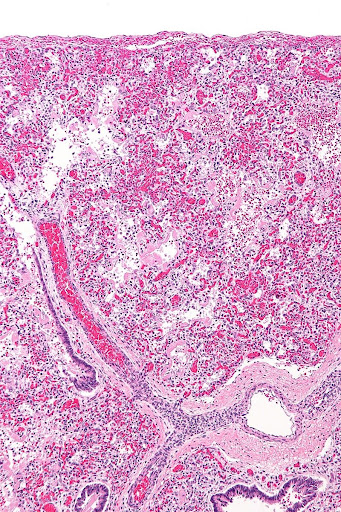
Which of the following best describes the pathophysiology of this disease process?
Reproduced from: Wikipedia
Which of the following best describes the pathophysiology of this disease process?
Elimination tool
0 XP
Press space to continue