Assessment - Culture: Nursing
Introduction0:00–0:32
Culture is a complex phenomenon that includes the ever-changing attitudes, beliefs, self-definitions, norms, roles, values, and communication styles a person develops throughout life.
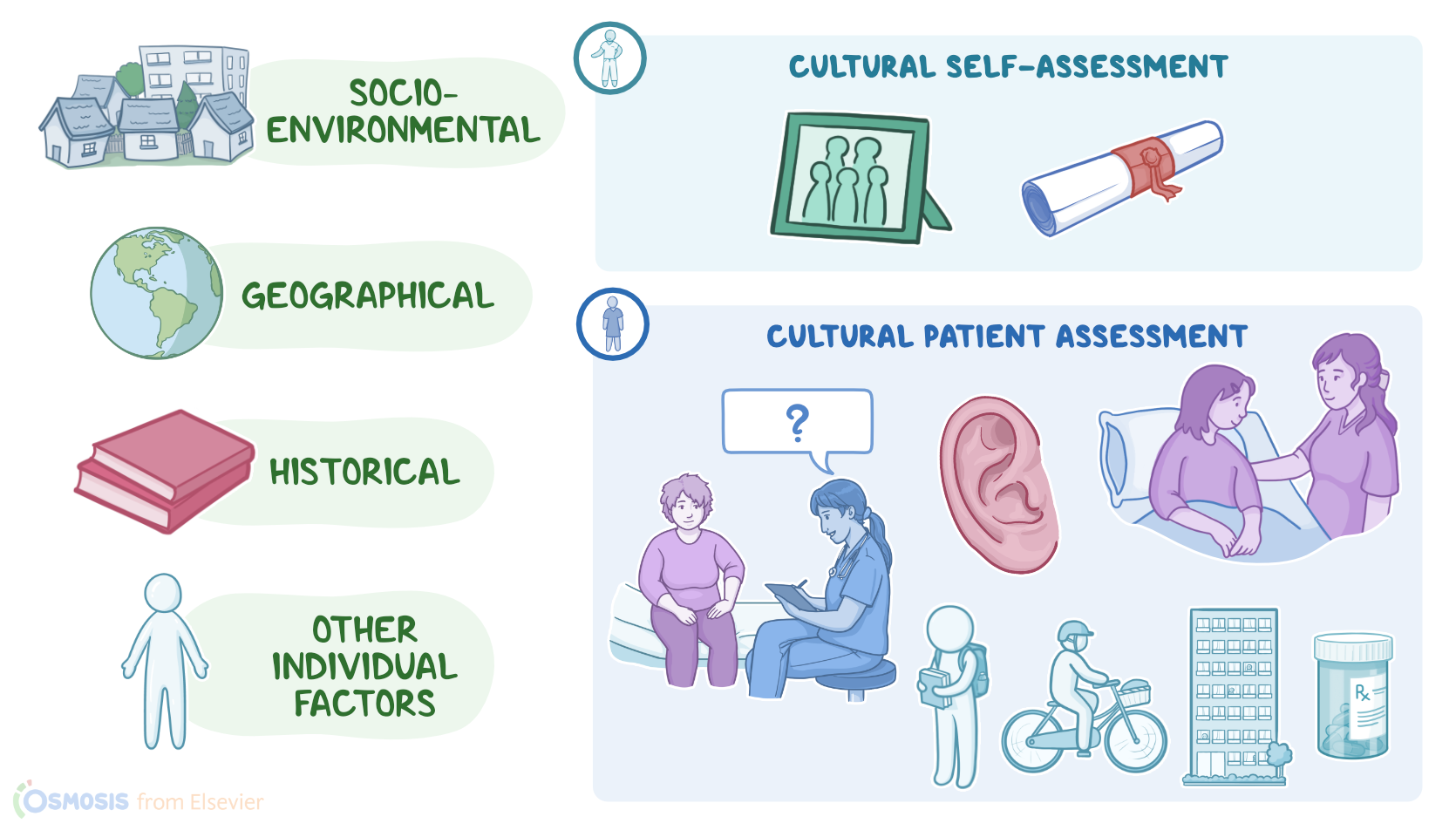
When performing a cultural assessment, you’ll use a relational approach that accounts for the socio-environmental, geographical, historical, and other individual factors involved in your patient’s response to health and illness.
Completing a cultural self-assessment will support a relational approach by clarifying your own background and values, and by building self-awareness and accountability for any biases or prejudices you may have.
Cultural Self-Assessment0:32–1:06
To perform a cultural self-assessment, consider how your own social and cultural heritage could impact your beliefs about health and illness and how you relate to your patients.
You can also think about how your decision to become a nurse and your professional experiences can influence the assumptions you make and the care you provide for your patients.
When assessing your patient’s culture, you’ll use clinical practice guidelines that support a relational approach, which include building trust, engaging through listening, conveying respect, and paying attention to context.
Cultural Patient Assessment1:06–3:10
During your initial interview, work on building trust by asking questions in a nonjudgmental way. For example, when gathering information about your patient’s presenting health concerns, you could ask them “What do you think might be causing you to feel this way?” You can build trust by conveying interest in their life context.
So, if your patient has recently moved to your city, ask them about where they moved from or what language they are most comfortable speaking.
Once trust is established, your patient will often be more willing to share more sensitive information. As you ask questions, engage with your patient through listening to their responses about their background, identity, and values, as well as their health beliefs and practices.
Be sure to ask only one question at a time and remember to pause and allow ample time for them to answer and show them you’re listening by nodding as they speak and asking follow-up questions.
Also, avoid using medical jargon. For example, you could say “kidney” instead of “renal” or “belly pain” instead of “gastrointestinal distress.” As you learn more about your patient, convey respect for any values that differ from your own, or non-traditional beliefs or practices they may have.
Be attentive to avoid expressing nonverbal cues that could communicate negative judgment, and show interest in learning about any treatments, medications, or healing methods that have been helpful to them in the past.
Lastly, pay attention to the context, or the social and economic circumstances in your patient’s life that can affect their health, including how they are managing basics of life such as transportation, housing, and childcare; whether they have support from family or friends; or if they’re able to access medications or assistive devices, as needed.
Alright, as a quick recap…Culture is a complex phenomenon that includes the ever-changing attitudes, beliefs, self-definitions, norms, roles, values, and communication styles a person develops throughout life.
Review3:10–3:48
When performing a cultural assessment, you’ll use a relational approach that accounts for the socio-environmental, geographical, historical, and other individual factors involved in your patient’s response to health and illness.
You'll complete a self-assessment, build trust, engage your patients through listening, convey respect, and pay attention
| ASSESSMENT - CULTURE | ||
| KEY POINTS | NOTES | |
| DEFINITION |
| |
| CULTURAL SELF-ASSESSMENT |
| |
| CULTURAL PATIENT ASSESSMENT |
| |
- "Seidel’s guide to physical examination. (10th ed)" Elsevier (2023)
- "Physical examination and health assessment. (8th ed.)" Elsevier (2020)
- "Physical examination and health assessment. (3rd ed.)" Elsevier (2019)
- "Health assessment for nursing practice. (7th ed.)" Elsevier (2022)
No notes for this video yet
Try adding a note below