Case study - Acute pain: Nursing
Introduction0:00–0:31
Nurse Nadia works on an orthopedic unit and is caring for Brian, a 51-year-old male with a history of degenerative joint disease, who was recently admitted for intractable back pain.
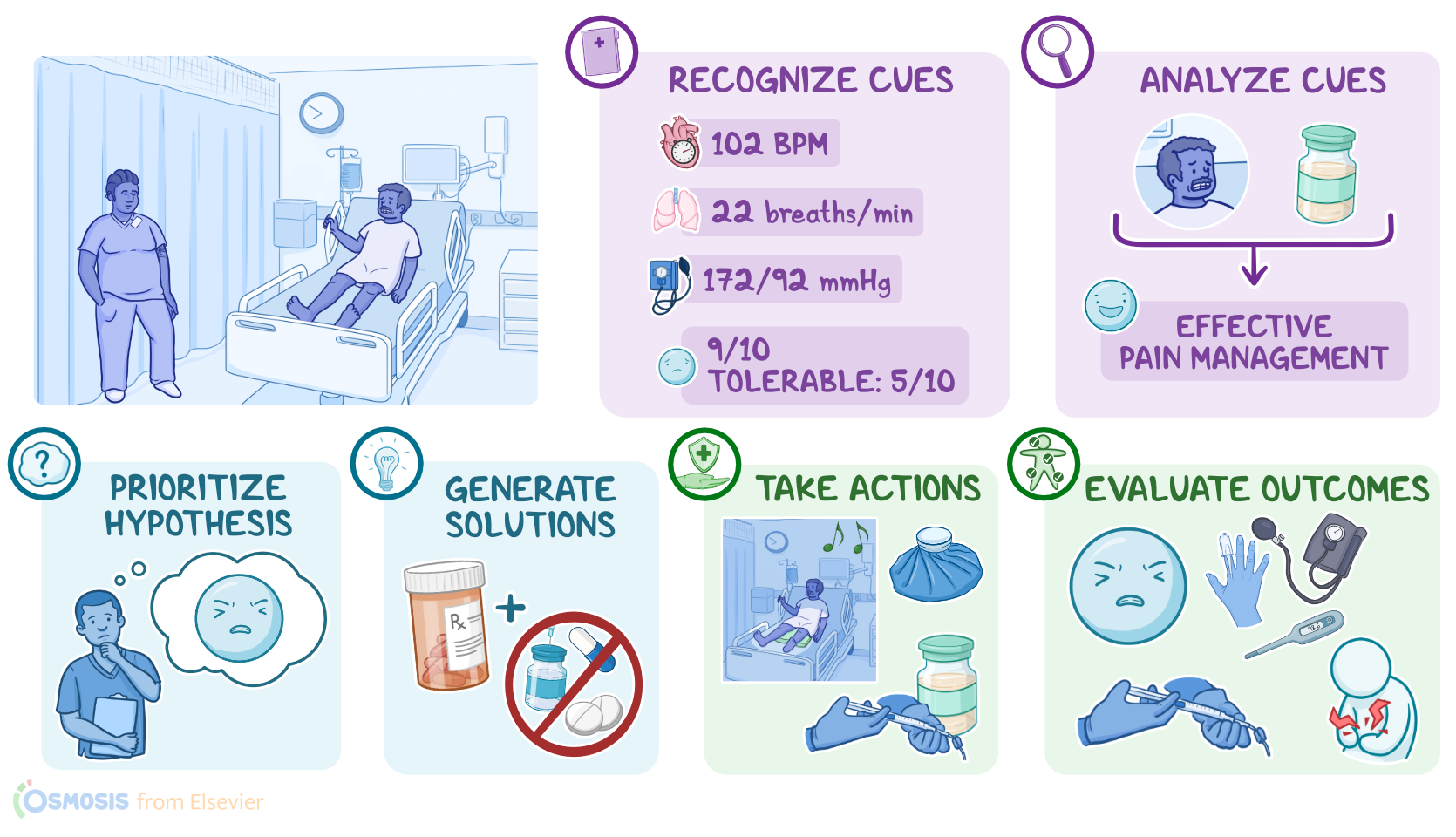
After settling Brian in his room, Nurse Nadia goes through the steps of the Clinical Judgment Measurement Model to make clinical decisions about Brian’s care by recognizing and analyzing cues, prioritizing hypotheses, generating solutions, taking action, and evaluating outcomes.
Recognizing and analyzing cues0:31–1:24
First, Nurse Nadia recognizes important cues, including Brian’s vital signs, which are blood pressure 172/92 mmHg, heart rate 102 per minute, and respirations 22 per minute.
She also notices Brian is gripping the side rails and clenching his jaw. When asked about his pain, he reports a current pain level of 9 out of 10, and that his tolerable level of pain is 5 out of 10.
Next, Nurse Nadia analyzes these cues. She reviews the electronic health record, or EHR, and notes that Brian is prescribed 0.5 mg of IV hydromorphone every three hours PRN, and he received his last dose in the emergency department one hour ago.
Nurse Nadia realizes Brian needs effective pain management. Now, using the information she has gathered, along with Brian’s medical history, Nurse Nadia chooses a priority hypothesis of acute pain.
Prioritizing hypotheses, generating solutions, and taking action1:24–3:51
Then, she generates solutions to address Brian’s pain that will include pharmacologic and nonpharmacologic pain management interventions; and she establishes the expected outcome that after intervening, Brian will report a pain level of 5 or less out of 10 within two hours.
Nurse Nadia then takes action to implement these solutions. She knows that since Brian’s most recent dose of pain medication was one hour ago, he can't receive his next dose for two more hours.
Since Brian is in severe pain, she verifies that Brian isn’t allergic to any medications and then calls the provider, reporting Brian’s current pain assessment and vital signs.
The provider prescribes a one-time dose of IV ketorolac 30 mg now. While waiting for the pharmacist to approve this new medication order, Nurse Nadia dims the lights in Brian’s room, plays relaxing music from the television, and applies a cold pack to his lower back.
Then, she delegates to the assistive personnel to help elevate Brian’s legs on pillows. Once the pharmacist approves the ketorolac medication order, Nurse Nadia prepares the dose and re-enters Brian’s room.
Nurse Nadia: The health care provider prescribed a dose of ketorolac for your pain. Brian: I’ve never taken ketorolac, what is it?
Nurse Nadia: It’s an anti-inflammatory pain medication, like ibuprofen, but instead of a pill, it can be given through your IV.
Brian: But I just had pain medicine through my IV, isn’t it too soon? Nurse Nadia: In the emergency department you were given an opioid medication called hydromorphone.
Since you aren’t due for another dose of that yet, the provider prescribed you ketorolac in the meantime for your pain. It’s safe to take along with the medication you received in the emergency department.
She informs Brian that she’ll allow him to rest for a while and places his call-bell at the bedside. Thirty minutes later, Nurse Nadia enters the room to evaluate the outcome of her actions.
Evaluating outcomes3:51–5:40
She takes Brian’s vital signs and reassesses his pain. His blood pressure is 121/83 mmHg, heart rate is 88 per minute, respirations are 18 per minute, and pain is 6 out of 10.
Brian appears more comfortable and is no longer grimacing or clutching the side rails. Since ketorolac can lead to stomach ulcers, Nurse Nadia also confirms that Brian is not feeling any gastrointestinal symptoms, like stomach pain, nausea, or heartburn.
Although Brian’s vital signs have returned to normal, he’s still reporting moderate pain. Nurse Nadia recognizes the expected outcome of a pain rating of 5 or less out of 10 hasn’t been met so she’ll revise the plan of care accordingly.
She asks Brian what she can do to address his pain more thoroughly. Brian: I feel better, but I’m still uncomfortable.
The ice, music, and medicine really seemed to help, but I keep waking up from the noises in the hallway and people coming in and out of my room.
Nurse Nadia documents Brian’s response to the pharmacologic and nonpharmacologic pain interventions and notes that the noise disruptions in the hallway impaired Brian’s comfort and relaxation.
Then, she freshens and reapplies Brian’s ice pack, provides him with ear plugs, and closes the door to his room. She places a sign on the door that says, “Please see the nurse before entering.” When Brian’s hydromorphone is due in one hour, Nurse Nadia will reassess his pain, vital signs, and check for gastrointestinal side effects, and then administer the pain medication.
Review5:40–6:10
Alright, as a quick recap… Nurse Nadia recognized and analyzed cues related to Brian’s intractable back pain and prioritized hypotheses and generated solutions to address this problem.
Nurse Nadia then implemented pharmacologic and nonpharmacologic pain measures and evaluated Brian’s outcomes and compared them to the expected outcome.
Since Brian’s pain remained 6 out of 10 following interventions, Nurse Nadia revised the plan of care to minimize noise and disruptions to promote Brian’s rest and relaxation.
| CASE STUDY - ACUTE PAIN | ||
| KEY POINTS | NOTES | |
| INTRODUCTION |
| |
| RECOGNIZING AND ANALYZING CUES |
| |
| PRIORITIZING HYPOTHESES, GENERATING SOLUTIONS, AND TAKING ACTIONS |
| |
| EVALUATING OUTCOMES |
| |
- "Fundamentals of nursing (11th ed.) " Elsevier (2023)
- "Fundamentals of nursing: Active learning for collaborative practice (3rd ed.)" Elsevier (2022)
No notes for this video yet
Try adding a note below