Case study - Cerebral palsy: Nursing
Introduction0:00–0:30
Nurse Jamie works as a nurse navigator at a pediatric neurology clinic and is caring for Lily, a 9-month-old with a history of cerebral palsy.
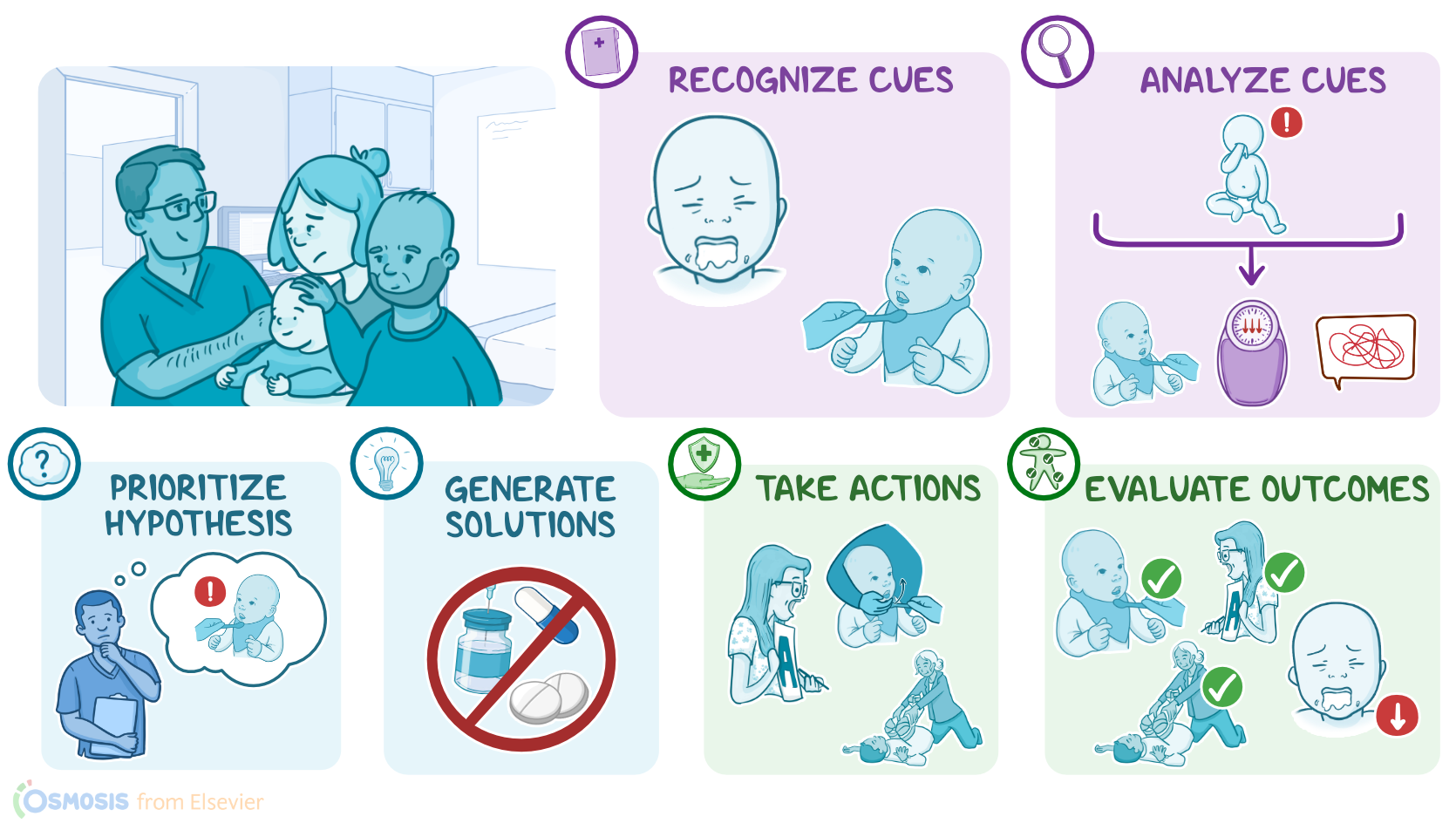
Nurse Jamie goes through the steps of the Clinical Judgment Measurement Model to make clinical decisions about Lily's care by recognizing and analyzing cues, prioritizing hypotheses, generating solutions, taking action, and evaluating outcomes.
First, Nurse Jamie recognizes important cues including Lily’s vital signs, which are temperature of 99 F, or 37.2 C, heart rate 115 beats per minute, respirations 32 breaths per minute, and oxygen saturation 95% on room air.
Recognizing and Analyzing Cues0:30–2:01
Lily’s weight is stable when compared to her last visit. Nurse Jamie also speaks with Lily’s caregiver, Linda, who reports that during feedings at home, Lily frequently gags and doesn't swallow her food.
When Nurse Jamie attempts to feed Lily a spoonful of baby food, he notices Lily produces a tongue thrust, which moves the food out of Lily’s mouth.
Next, Nurse Jamie analyzes these cues. He reviews the electronic health record, or EHR, and sees that Lily has a history of delayed oral-motor skills and poor jaw control when feeding from a bottle.
He remembers that children with cerebral palsy often have issues with oral-motor skills that can result in difficulty feeding, weight loss, and speech delays.
He also notes that coughing and choking while eating can predispose children with cerebral palsy to aspiration and other respiratory problems.
Nurse Jamie realizes that Lily needs effective management of care from a multidisciplinary team to support her activities of daily living, or ADLs, such as feeding.
Prioritizing Hypotheses, Generating Solutions, and Taking Action2:01–3:20
Now, using the information she's gathered, along with Lily’s medical history, Nurse Jamie chooses a priority hypothesis of impaired oral intake.
Then, he generates solutions to address Lily’s impaired oral intake that will include nonpharmacologic interventions; and he establishes the expected outcome that after intervening, Lily will show improvement in feeding at her one-month follow-up appointment.
Nurse Jamie then takes action to implement these solutions. He obtains a referral for a speech-language pathologist and an occupational therapist to ensure timely assessment and intervention for Lily.
Nurse Jamie teaches Linda about techniques he can use in the meantime to improve Lily’s ability to swallow. For example, he explains that reclining Lily during meals can cause neck hyperextension which can interfere with swallowing, so keeping Lily in an upright feeding position will help Lily’s neck to be less extended.
Nurse Jamie also shows Linda how to stabilize Lily’s jaw while feeding to allow her greater control when swallowing by using one hand to feed Lily and placing the other hand under and around Lily’s jaw while slightly tipping it upward.
One month later, during the follow-up appointment, Nurse Jamie evaluates the outcome of his actions. Nurse Jaime: Hi Linda.
Evaluating Outcomes3:20–4:27
How has Lily been doing with her feedings since her last appointment? Were you able to take her to her appointments with the speech-language pathologist and occupational therapist?
Linda: Yes, and she’s doing great! Both therapists are so helpful.
They worked with us to make a feeding program for Lily and even sent out a home health nurse to help me feed her. Nurse Jamie: That's wonderful.
What improvements in Lily’s feeding and swallowing have you noticed? Linda: She hardly ever gags when feeding, unless we give her something she just doesn’t like, like broccoli.
Nurse Jamie: What foods have you found that she enjoys the most? Linda: She really likes peas and carrots and recently she has shown an interest in fruit, especially peaches.
Nurse Jamie: Good. Continue feeding her food she enjoys.
And based on our weight check today, her weight remains stable. Linda: I’m sure she won’t complain about eating more of her favorite foods!
Nurse Jamie: I bet! Please contact us if you have any further concerns or questions.
Alright, as a quick recap...Nurse Jamie recognized and analyzed cues related to Lily’s impaired feeding and prioritized hypotheses and generated solutions to address this problem.
Review4:27–4:56
Nurse Jamie then worked with a multidisciplinary team to implement nonpharmacologic measures and evaluated Lily’s outcomes and compared them to the expected outcome.
Since Lily’s feeding improved by the follow-up appointment, Nurse Jamie determined that the plan of care was successful.
| CASE STUDY - CEREBRAL PALSY | ||
| KEY POINTS | NOTES | |
| INTRODUCTION |
| |
| RECOGNIZING AND ANALYZING CUES |
| |
| PRIORITIZING HYPOTHESES, GENERATING SOLUTIONS, AND TAKING ACTIONS |
| |
| EVALUATING OUTCOMES |
| |
- "Wong’s essentials of pediatrics. (11th ed.)" Elsevier (2022)
- "Wong’s nursing care for infants and children. (11th ed.)" Elsevier (2019)
No notes for this video yet
Try adding a note below