Case study - Hypovolemic shock: Nursing
Introduction0:00–0:32
Nurse Edwin works night shift at the emergency department and is caring for José, a 67-year-old male with a history of liver cirrhosis and hepatic encephalopathy.
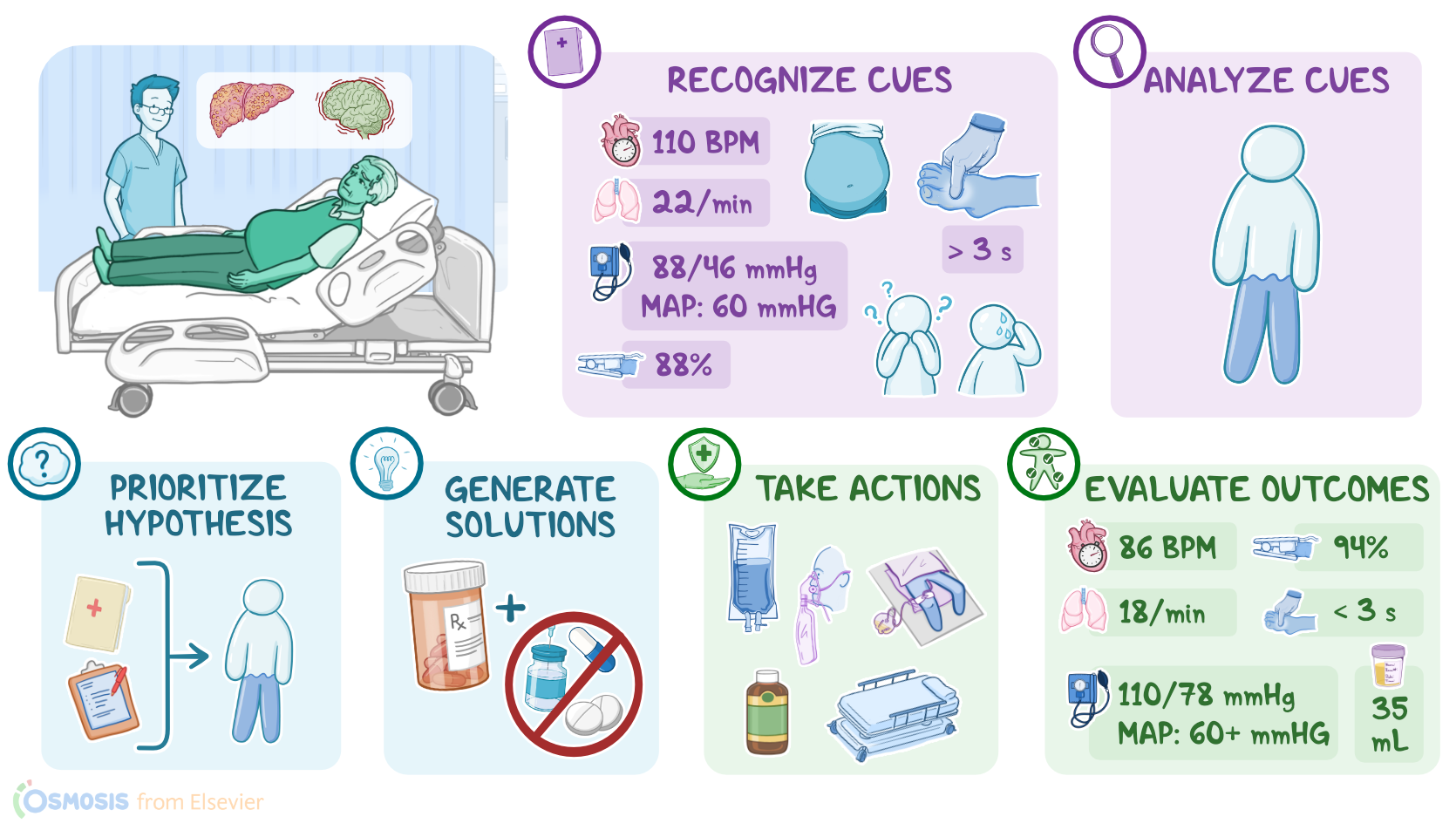
After settling José in his room, Nurse Edwin goes through the steps of the Clinical Judgment Measurement Model to make clinical decisions about José’s care by recognizing and analyzing cues, prioritizing hypotheses, generating solutions, taking action, and evaluating outcomes.
First, Nurse Edwin recognizes important cues, including José’s vital signs, which are blood pressure 88/46 mmHg, mean arterial pressure, or MAP of 60 mmHg, heart rate of 110 beats per minute and regular, peripheral pulses are weak and thready, and respirations 22 breaths per minute.
Recognizing and Analyzing Cues0:32–1:38
Pulse oximetry is 88 percent on room air. He's also confused and doesn’t know why he’s in the hospital.
Nurse Edwin also notices that José appears pale, diaphoretic, and has a capillary refill of more than 3 seconds in his lower extremities.
He also notes that José’s abdomen is round and distended. Next, Nurse Edwin analyzes these cues.
He collaborates with the health care provider, who determines that José is in the early decompensated stage of hypovolemic shock, due to third spacing.
Nurse Edwin realizes José needs effective tissue perfusion. Now, using the information he's gathered, along with José’s medical history, Nurse Edwin chooses a priority hypothesis of fluid volume deficit.
Prioritizing Hypotheses, Generating Solutions, and Taking Action1:38–3:47
Then, he generates solutions to address José’s fluid and perfusion status with pharmacological and nonpharmacological interventions; and he establishes the expected outcome that after intervening, José’s MAP will be above 60 mmHg within one hour.
Nurse Edwin then takes action to implement these solutions. He receives orders from the health care provider for IV fluids and albumin, oxygen at 10 liters per minute via non-rebreather mask, and insertion of an indwelling urinary catheter.
Then, he obtains the necessary supplies from the supply room. On the way back to José’s room, Nurse Edwin passes the charge nurse, Cheryl, in the hallway.
Nurse Edwin: Nurse Cheryl, I want to update you on my patient. I’m concerned he could progress to decompensated hypovolemic shock.
I’ve already spoken to the health care provider and I’m going to be giving some fluids and albumin. I’m going to be busy with him for the next hour or so, until I know he’s improving.
Do you mind monitoring my other patients for the next hour? Nurse Cheryl: It sounds like you’ve done everything right so far, Nurse Edwin.
I will watch your other patients for you, and please let me know if you need any help with anything. Nurse Edwin: Will do, thanks.
Then, he inserts the urinary catheter to measure José’s urine output. One hour later, Nurse Edwin then takes a set of vital signs and finds José’s blood pressure is 110/78 mmHg, and his MAP is now above 60 mmHg.
Evaluating Outcomes3:47–4:19
José’s heart rate is 86 beats per minute, respirations are 18 breaths per minute, oxygen saturation is 94 percent on 10 liters non-rebreather; capillary refill is less than 3 seconds, and urine output for the past hour was 35 mL.
Nurse Edwin then transfers José to the ICU. Alright, as a quick recap… Nurse Edwin recognized and analyzed cues related to José’s deficient fluid volume and generated solutions to address this problem.
Review4:19–4:45
Nurse Edwin then implemented pharmacologic and nonpharmacologic measures to address this problem, and evaluated José’s outcomes, comparing them to the expected outcomes.
Since José’s MAP was over 60 mmHg one hour following interventions, Nurse Edwin determined that the plan of care was successful.
| CASE STUDY - HYPOVOLEMIC SHOCK | ||
| KEY POINTS | NOTES | |
| INTRODUCTION |
| |
| RECOGNIZING AND ANALYZING CUES |
| |
| PRIORITIZING HYPOTHESES, GENERATING SOLUTIONS, AND TAKING ACTIONS |
| |
| EVALUATING OUTCOMES |
| |
- "Lewis's medical-surgical nursing: Assessment and management of clinical problems. (12th ed.). ISBN: 978-0323792325" Elsevier. (2022)
- "Medical-surgical nursing: Concepts for interprofessional and collaborative care. (10th ed.). ISBN: 978-0323654050" Elsevier. (2021)
- "Shock Etiologies and Fluid Management in Liver Failure. 39(5), 538–545. " Seminars in respiratory and critical care medicine, (2018)
No notes for this video yet
Try adding a note below