Charge nurse as a leader: Nursing
Introduction0:00–1:04
Nurse Jeehae is the charge nurse during night shift on a respiratory unit. Around midnight, Nurse Jeehae receives a call from Nurse Henry in the Emergency Department who says, “I’ll be sending up three admissions to you in 30 minutes.
I’m sorry but we need to clear beds to make room for more clients.” Nurse Jeehae says, “I understand; we’ll make it work.” After ending the call, Nurse Jeehae informs the staff nurses who will be taking the new client admissions and learns that these rooms haven’t been cleaned and aren’t ready for new clients yet.
Just as Nurse Jeehae is about to call the housekeeper, she sees one of the newly admitted clients already being wheeled into the unit by a nursing assistant.
The client’s family member appears angry and states, “I demand to speak to the manager of this unit. We’ve been in the ED for 6 hours and my brother’s IV is bleeding!” Nurse Jeehae recognizes that there are several issues requiring her immediate attention, therefore, she’ll use her leadership skills to manage this situation as the charge nurse.
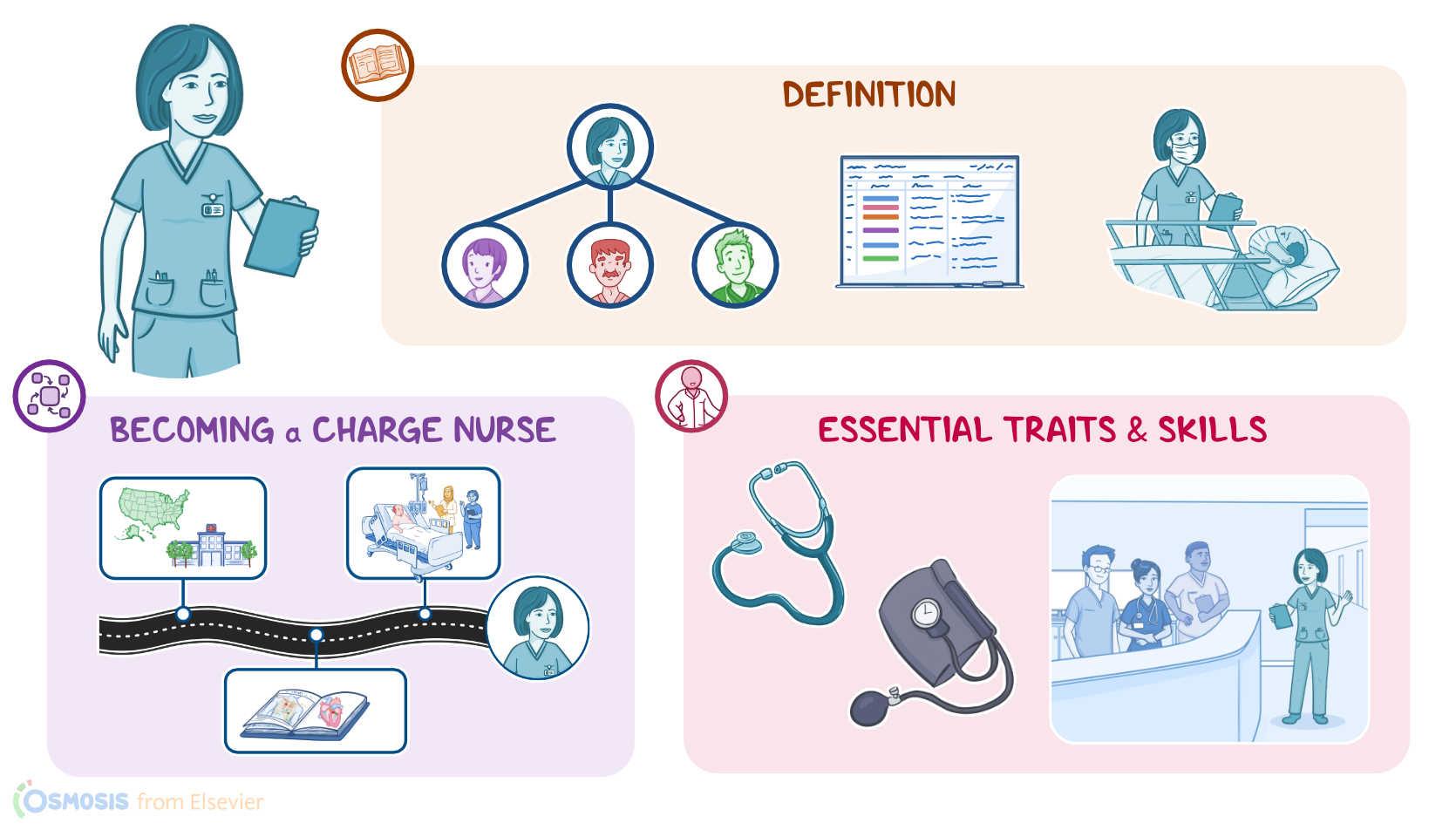
A charge nurse is a nurse who is responsible for the management and leadership of a group of staff during a specified period of time or a shift.
Defining the Charge Nurse Role1:04–3:04
The charge nurse oversees operations on their unit such as supporting and training staff in their area, organizing nurse-client assignments, and resolving conflict.
If there’s an issue the charge nurse can’t resolve, they'll bring it to the nurse manager. In some cases, the charge nurse also provides direct care to clients in addition to the other charge nurse duties.
Another important responsibility for charge nurses is collaboration. The charge nurse collaborates with a variety of individuals within the healthcare environment to facilitate safe client care and unit processes.
First, the charge nurse interacts with nurses and may serve as a role model or resource for them, especially novice nurses.
The charge nurse may also act as a liaison between the staff and the nurse manager by communicating unit issues and concerns the nurse manager may not witness first hand.
The charge nurse may also coordinate communication between nurses and interdisciplinary healthcare team members, such as physicians, social workers, and case managers, as well as charge nurses on other units.
Finally, the charge nurse may need to answer questions posed by clients and their family members as well as resolve conflicts between clients, family members, and their healthcare providers.
Now, the charge nurse role differs from the nurse manager’s role. The nurse manager is the formal leader of a nursing care area who has responsibilities which don’t usually include direct client care.
Nurse manager duties may include budgeting, attending organizational meetings, and hiring and interviewing staff. The nurse manager is responsible for overseeing the unit or facility at all times, whereas the charge nurse focuses on leading staff during a limited period of time, such as a Nurse Jeehae on this particular night shift.
So now that you understand the charge nurse’s role, let’s take a look at how to become a charge nurse. The road to becoming a charge nurse differs depending on which state and facility you work in.
Becoming a Charge Nurse3:04–3:42
Although there’s no set time requirement on how long someone must work as a nurse prior to becoming a charge nurse, they should generally be experienced on the unit they’ll be leading.
The training to become a charge nurse isn’t a universal process, but can include a mixture of formal and informal components, such as one-on-one training with an existing charge nurse, taking courses offered by the healthcare institution, and partaking in simulations and case studies.
Regardless of the training a charge nurse receives, there are traits and skills that are essential to the charge nurse role.
Okay, so the charge nurse should have expertise in two main areas in order to do their job successfully: clinical and leadership skills.
Traits and Skills Essential to the Charge Nurse3:42–5:37
First, the charge nurse should have a solid set of clinical nursing skills, which are capabilities essential to nursing practice, such as physical assessment or measuring blood pressure.
Although the charge nurse doesn’t need to have more clinical skills than a staff nurse, the charge nurse should be proficient in the nursing skills which are frequently used on their unit since the charge nurse is often used as a resource for the other nurses.
For example, Nurse Jeehae is in charge of a respiratory unit, so she should be experienced in setting up and managing a chest tube drainage system.
In addition to clinical skills, the charge nurse must be able to lead and manage employees including nurses and ancillary staff.
In order to do this, the charge nurse should possess leadership skills such as confidence, integrity, respect, and effective communication.
These traits will allow the charge nurse to resolve conflict, facilitate teamwork, and collaborate with various members of the healthcare team.
Now let’s check back in with Nurse Jeehae who has wheeled the newly admitted client and his brother into a private space.
She applies a new dressing to the client’s IV as it was leaking, but is still functional. The client’s brother says, “Thank you.
I’m sorry I lashed out, I’m just stressed.” Nurse Jeehae smiles and says, “That’s OK. I’m sorry you were in the ED for so long.” In the meantime, Nurse Jeehae asks the unit housekeeper to clean the room for the client as well as request additional housekeepers to clean the two other rooms.
Nurse Jeehae calls Nurse Henry in the Emergency Department and says, “I know you’re busy, but the rooms aren’t clean. Could you wait 15 minutes before sending the next two admissions?” Nurse Henry agrees saying, “Sure, I’ll wait.” After ending the call, Nurse Jeehae takes a moment to breathe a sigh of relief then prepares for the next two client admissions from the ED.
All right, as a quick recap….The charge nurse is a nurse who’s responsible for the management and leadership of a group of staff during a specified period of time.
Summary5:37–6:28
Although both the charge nurse and nurse manager are leaders, they have different roles and responsibilities. The training to become a charge nurse isn’t a universal process, but can include a mixture of formal and informal components and differs depending on the facility and state they work in.
The charge nurse should have expertise in two main areas in order to do their job successfully: clinical expertise and leadership skills.
The charge nurse collaborates with many members in the healthcare environment like nurses, managers, healthcare providers, other charge nurses, clients and their families.
The charge nurse is an important member of the healthcare team who works to support staff as well as ensure positive client outcomes.
| CHARGE NURSE AS A LEADER | ||
| KEY POINTS | NOTES | |
| INTRODUCTION |
| |
| DEFINING THE CHARGE NURSE ROLE |
| |
| BECOMING A CHARGE NURSE |
| |
| TRAITS AND SKILLS ESSENTIAL TO THE CHARGE NURSE |
| |
No notes for this video yet
Try adding a note below