Delegation and supervision: Nursing
Introduction0:00–0:40
Nurse Kai works at a long-term care facility and is assigned to care for 10 clients on the evening shift. There are two unlicensed assistive personnel, or UAPs, also working this shift: Nursing Assistant Sarah and Nursing Assistant Jamal.
One client needs to be bathed, another needs help eating his dinner, a third client needs his blood glucose checked every hour, and a fourth who needs a respiratory assessment every four hours to see if the client needs a PRN nebulizer treatment.
Nurse Kai knows that it will be impossible to meet the needs of all his clients without help and so, Nurse Kai will use delegation skills to make sure all the tasks are completed.Client-centered care means meeting all of the physical, mental, and emotional needs for each client.
Defining Delegation0:40–1:56
This can be a lot of work when you are caring for multiple clients. To help make sure all your client’s needs are met in a safe and timely manner, you will need to use delegation skills.
Delegation is when the nurse assigns tasks to another individual while maintaining accountability for the activity. Being accountable means that you are answerable to others as well as yourself for the actions you do and the judgments you make.
In delegation, you will remain accountable for a task even if you are not the one performing the task. So, when Nurse Kai plans to delegate the task of blood glucose checks, he knows that even though he may not physically perform the task, he is responsible for making sure the task is completed safely.
Delegation is an important tool for nurses because it helps maintain efficiency, enhances the care of clients, improves client safety, and even provides opportunities for staff training.
Now, it is important to understand that different facilities will have their own guidelines for delegation, so it’s important to be familiar with your institutional practice guidelines before delegating care.
Okay, so there are two primary roles in delegation, the delegator and the delegatee. The delegator is the person who assigns tasks to another person.
Roles in Delegation1:56–2:42
The delegatee is the person who accepts responsibility for the task. There are rules to who can be the delegator and who can be the delegatee in a professional relationship.
So, as a nurse, it’s important to understand who you are allowed to delegate to, or accept tasks from. For example, while nurses can delegate a task to a UAP or a licensed practical nurse, or LPN, they cannot delegate a task to a nurse practitioner.
However, the nurse practitioner is able to delegate to both the nurse and the UAP. Usually, roles with more extensive training will have greater delegation responsibilities.
Rights of Delegation2:42–8:07
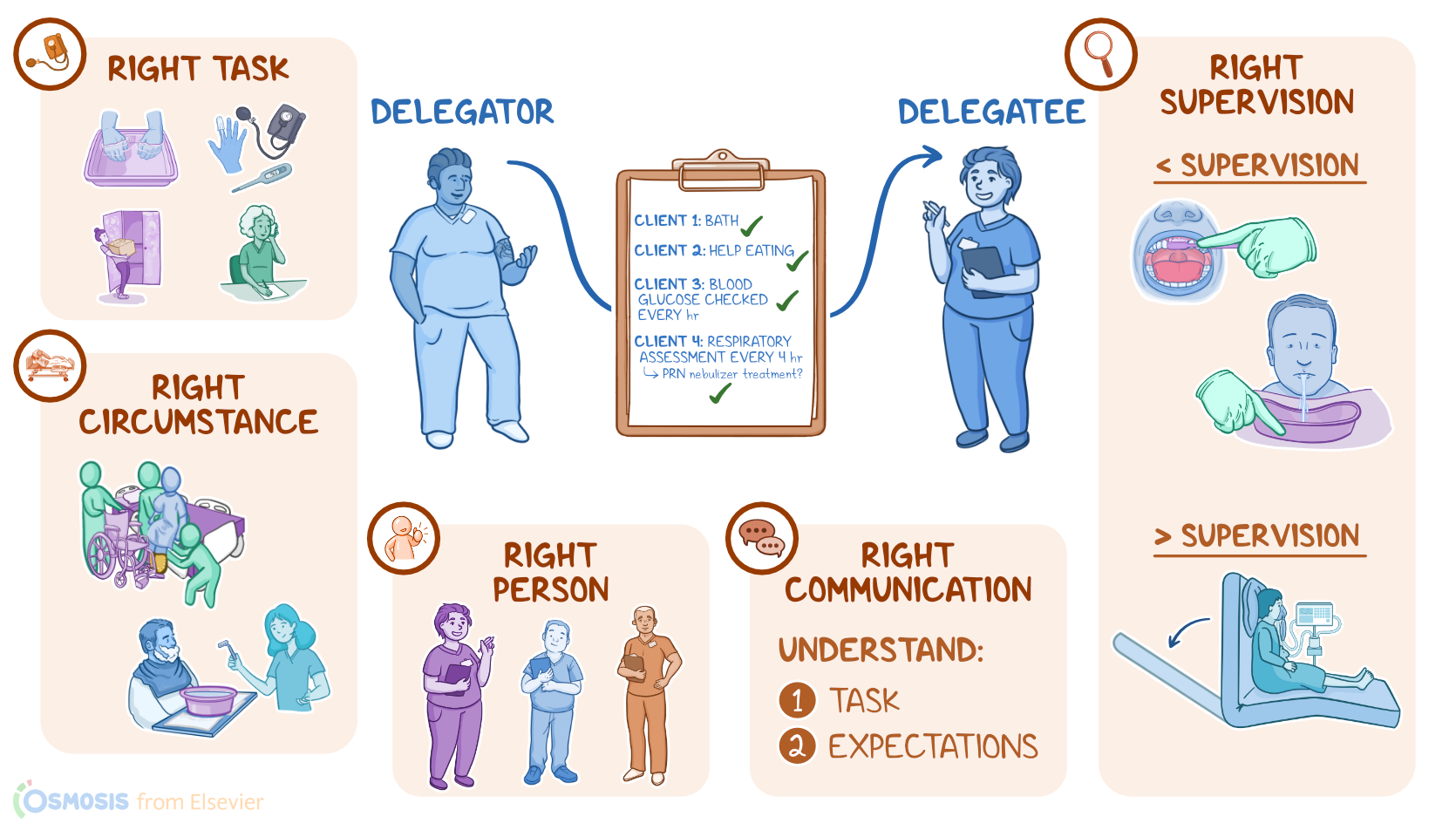
When preparing to delegate a task, you should follow the five rights of delegation: Right Task, Right Circumstance, Right Person, Right Communication, and Right Supervision.
First is the right task. Before you delegate, you must decide if the task is appropriate for delegation.
There are two types of tasks that can be delegated: direct care activities and indirect care activities. Direct care activities involve client care and include things like feeding, bathing, vital signs, or testing blood sugars.
On the other hand, indirect care activities include things that help support the team but do not involve client care such as restocking supply cabinets, or even clerical activities like answering the phone.
There are also some things that should never be delegated. For example, nurses cannot delegate a task that involves clinical decision making or nursing judgment.
This would include any task that can be considered part of the nursing process of assessment, diagnosis, planning, implementation, and evaluation.
Additionally, nursing tasks like client education, interprofessional communication, or the documentation of assessments cannot be delegated.Okay, so Nurse Kai begins by taking inventory of the tasks that could be appropriate for delegation, including bathing a client, assisting a client with eating their dinner, checking a client’s blood glucose level, and assessing a client’s respiratory status.
He decides that the bathing, feeding, and glucose check are direct care activities and are appropriate for delegation, because they do not involve clinical decision making or nursing judgment.
On the other hand, he knows that the respiratory assessment should not be delegated, because assessment involves clinical decision making and nursing judgment.
The right circumstance is another important right. This requires you to assess if the situation is appropriate for task delegation.
There are a couple of questions you can ask when evaluating the right circumstance.First, “Are the appropriate resources available to the delegatee to achieve the task?” Resources can refer to staff or equipment needed to complete a task.
As an example, it wouldn’t make sense to delegate transferring a client from bed to their chair if you know that three people are required in this circumstance to safely complete the task and only two are available.
The second question you should ask yourself is, “Is the client condition favorable for task delegation?” This requires the nurse to assess the client to determine if there are any safety concerns or obstacles to performing care prior to delegating tasks.
For example, if you were to delegate shaving a client’s beard to the Nursing Assistant, that would be an appropriate task.
However, if you know the client is at a high risk for bleeding due to taking an anticoagulant medication, delegating that task may no longer be appropriate.
In Nurse Kai’s case, he noted that the client who needs a bath is alert and oriented, the client who requires hourly blood glucose checks is pleasant and cooperative with stable vital signs, but his client who needs help with feeding appears confused and agitated.
Given these circumstances, Nurse Kai decides the bathing and blood glucose can still be delegated but he thinks that the client who requires feeding could be at high risk for aspiration and that feeding this client should not be delegated.
Next, you should consider who is the right person for this task.By understanding the abilities, training, and limitations of the different roles within your organization, you can avoid delegating tasks to an individual who lacks the appropriate skills and knowledge.
When considering someone for task delegation, some things you could consider include how familiar you are with the person and their work ethic, their job title or role, and if they have encountered problems when performing the task in the past.
Also, consider if the person has any special skills or training that might make them a good candidate for a particular task.
Nurse Kai knows that Nursing Assistant Jamal has experience using the glucometer and has completed all the necessary training so, he assigns Jamal to take the hourly blood glucose checks.Nursing Assistant Sarah is newer to the unit, but bathing a client is within her scope of care; so Nurse Kai decides this would be an appropriate task to delegate to her.
Now, using the right communication is important, when delegating, so you can make sure that the delegatee understands the task and expectations.
So, you will need to speak clearly and concisely to the delegatee, being sure to share important details about the task, the client, the expected timeframe, and desired outcomes.
Before accepting responsibility for a task, the delegatee must clearly understand all expectations and should be able to repeat back what they are doing, why they are doing it, the expected timeframe for completion, and the expectations for reporting back to the delegator once the task is completed.
Finally, the delegatee must communicate their acceptance of the task. Next, you should provide the right supervision, which is the level of supervision required for the task.
For example, the delegation of simple tasks for a stable client, like helping to brush the teeth of an alert and oriented client, would require less supervision than repositioning a ventilated client.
All right, so after you have implemented the five rights of delegation, next comes evaluating the outcomes of the delegation.
Evaluation8:07–8:48
Evaluation is a necessary part of delegation, where the delegator determines if the delegated task was completed correctly, safely, and in the established timeframe.
At the end of the shift, Nurse Kai checks in with Nursing Assistant Jamal and Nursing Assistant Sarah. Nursing Assistant Jamal has been checking in with Nurse Kai every hour to report the blood glucose results and confirms the client is resting comfortably.
Sarah reports she completed bathing the client and helped him into his pajamas. Delegation can be a great tool to help ensure all your client’s needs are met in a safe and timely manner but, there are a few barriers to look out for when delegating.
Barriers to Delegation8:48–9:38
These barriers can lead to unsuccessful delegation and potentially unsafe client care. First, under delegation, which is when the nurse does not delegate tasks to assistive personnel because they don’t have confidence in others, don’t have the time to engage in meaningful delegation, or they are worried about losing control over the care of their clients.
Next, over delegation is where the nurse assigns too much of their workload to others, leading to fragmented or unsafe client care.
And finally, improper delegation occurs when the nurse delegates tasks to individuals who lack the appropriate training or when the nurse fails to properly assess client status before delegating.
Review9:38–11:25
All right, as a quick recap… Delegation is when you assign tasks to another individual while maintaining accountability for the activity.
Delegation is an important tool because it helps maintain efficiency, improve the care of clients, improve client safety, and even provide opportunities for staff training.
There are two primary roles in delegation, the delegator and the delegatee. The delegator is the person who assigns tasks to another person, and is accountable for the outcome of the delegated task.
The delegatee is the person who accepts responsibility for the task. When preparing to delegate a task, you can follow the five rights of delegation: the right task, right circumstance, right person, right communication, and right supervision.First is the right task, where you determine if a task is appropriate for delegation.
The second right is the right circumstance, which requires you to assess if the situation is appropriate for task delegation.
Next, you'll consider who is the right person for this task. As a nurse, you will most often delegate tasks to LPNs or UAPs, like nursing assistants or patient care assistants.
Using the right communication ensures that the delegatee understands the task and expectations. You will also need to ensure that the delegatee has the right supervision required for the task.
Finally, evaluation is a necessary part of delegation where the delegator assesses if the delegated task was completed correctly, safely, and in the established timeframe.
Barriers to delegation might include under delegation, over delegation, or improper delegation. Any of these can compromise
| DELEGATION AND SUPERVISION | ||
| KEY POINTS | NOTES | |
| INTRODUCTION |
| |
| DEFINITION |
| |
| ROLES IN DELEGATION |
| |
| RIGHTS OF DELEGATION |
| |
| EVALUATION |
| |
| BARRIERS TO DELEGATION |
| |
No notes for this video yet
Try adding a note below