Genomics - DNA structure: Nursing
Introduction0:00–0:43
Genetics is the study of biological inheritance, or what attributes you inherit from your parents. This can be things like eye color, hair color, or even a predisposition to different diseases.
Genes are considered to be the most basic unit of inheritance that determine our traits. These genes can be found in the 23 pairs of chromosomes contained in the nucleus of our cells.
There are hundreds to thousands of genes that make up each chromosome. When we take a closer look at a gene, we find that they are made up of precisely sequenced segments of deoxyribonucleic acid, called DNA.Let’s take a closer look at the structure of DNA.
DNA Structure0:43–3:12
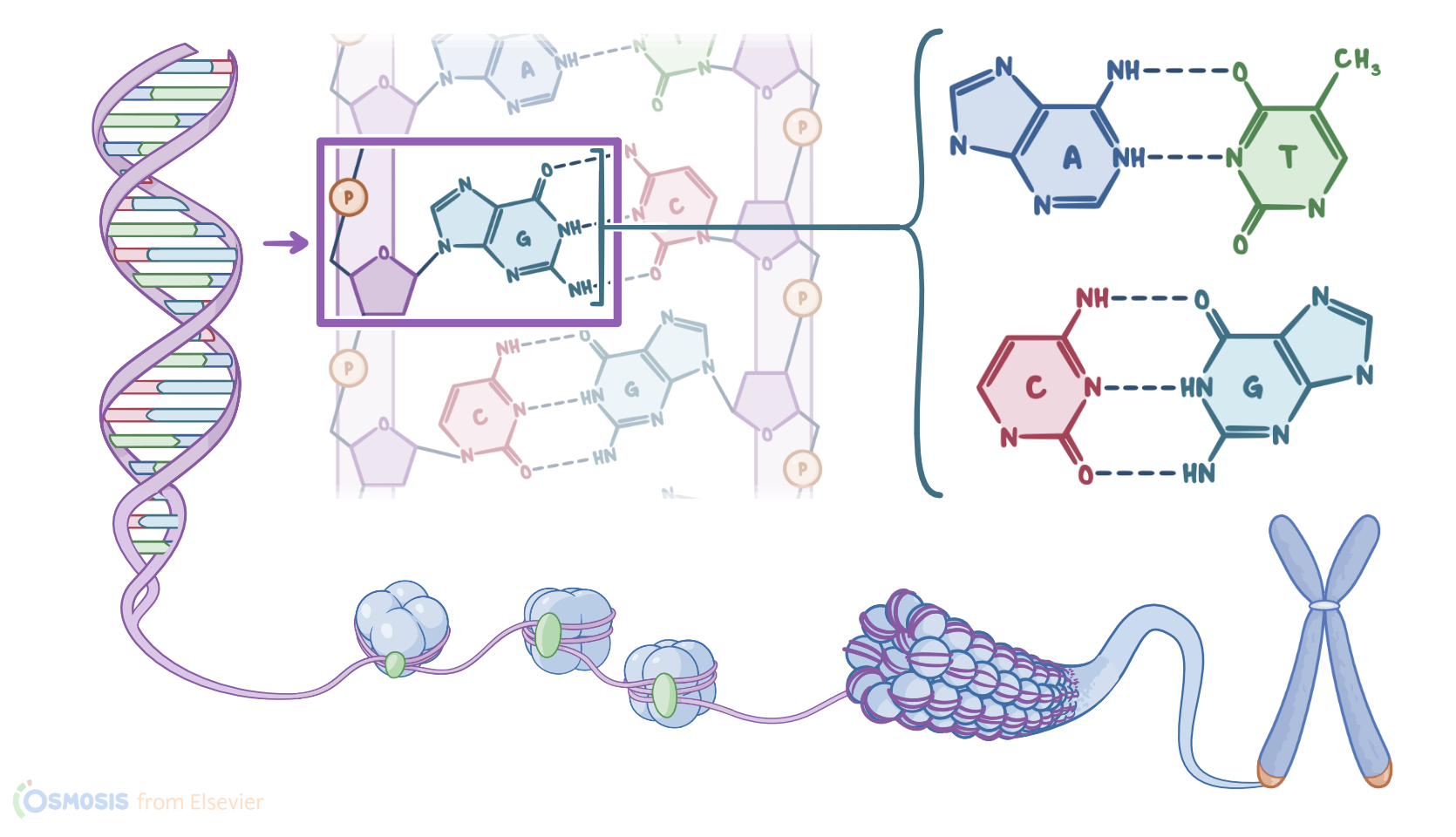
DNA has three basic components that make up a sub-unit, or piece of DNA, called a nucleotide: deoxyribose, a five-carbon sugar molecule; a phosphate molecule; and a nitrogenous base also called a nucleobase - or, simply, a “base”.
There are four nucleotide bases that make up and give DNA nucleotides their name - adenine, or A, thymine, or T, cytosine, or C, and guanine, or G.
Bases form bonds according to the rule of “complementary base pairing” - which states that in DNA, A always pairs with T, by means of two hydrogen bonds, while C always pairs with G, through three hydrogen bonds.Now, these DNA subunits come together in two strands that are spiraled around one another in what is known as a double helix.
The helix has the appearance of a twisted ladder. When thinking about DNA as a ladder, the deoxyribose and phosphate molecules alternate in a linear pattern to make up each side rail of the ladder.
The paired nucleotide bases span across the side rails to make the rungs. While we might think of DNA as being small, it’s actually incredibly long - over 2 meters long when fully stretched out.
So how do 46 DNA molecules, one for each chromosome, fit into the tiny nucleus of a cell? Well, there are a few tricks.First, there are histones, which are a type of specialty protein.
Histones are able to attract the DNA because they have opposite electrical charges. The DNA then tightly wraps around the histone, keeping it organized and helping the DNA strand to take up less space.
This process of DNA wrapping around the histone forms what is known as a nucleosome. Nucleosomes look a bit like beads on a string.
In this arrangement, they can snuggle closer together and be further packaged as chromatin fibers which make up our chromosomes.Now, chromatin comes in two flavors - euchromatin and heterochromatin.
With euchromatin, nucleosomes are more loosely packed, because it contains the genes - or regions of DNA - that the cell frequently uses to make proteins that help the cell perform its day to day job.
With heterochromatin, on the other hand, nucleosomes are more densely packed, because they contain genes that the cell rarely or never uses.All right, as a quick recap… Deoxyribonucleic acid, or DNA, makes up our genes.
Review3:12–4:17
DNA has three basic components that make up a sub-unit, or piece of DNA: deoxyribose; a phosphate molecule; and a nitrogenous base also called a nucleobase or a “base”.
There are four nucleobases that make up and give DNA nucleotides their name - adenine, or A, thymine, or T, cytosine, or C, and guanine, or G.
According to the rule of “complementary base pairing”, A always pairs with T, while C always pairs with G. DNA subunits come together in two strands that are spiraled around one another in what is known as a double helix.
DNA is actually quite long, so it tightly wraps around the histone, keeping it organized and helping the DNA strand to take up less space.
This process of DNA wrapping around the histone forms what is known as a nucleosome. Nucleosomes can group together closely
| GENOMICS - DNA STRUCTURE | ||
| KEY POINTS | NOTES | |
| DEFINITION |
| |
| DNA STRUCTURE |
| |
No notes for this video yet
Try adding a note below