Geriatric considerations - Medications: Nursing
Introduction0:00–0:21
Medication considerations in the geriatric population refers to the fact that as we age, the body undergoes changes as a result, medications must be used with caution, taking into account both age related and client specific changes.
All right. Now, when a medication is administered to the body, the body reacts to that drug in various manners.
Pharmacokinetics0:21–2:38
And the study of these reactions is called pharmacokinetics. Pharmacokinetics includes four main elements, absorption, distribution, metabolism and elimination, absorption describes how a medication moves from the site of administration to the blood.
Whereas distribution is the movement of the medication from the blood to body tissues. Conversely, metabolism deals with the biotransformation of medications which happens mainly in the liver.
On the other hand, elimination studies, how the body gets rid of the medication or its metabolites, which typically happens in the kidneys.
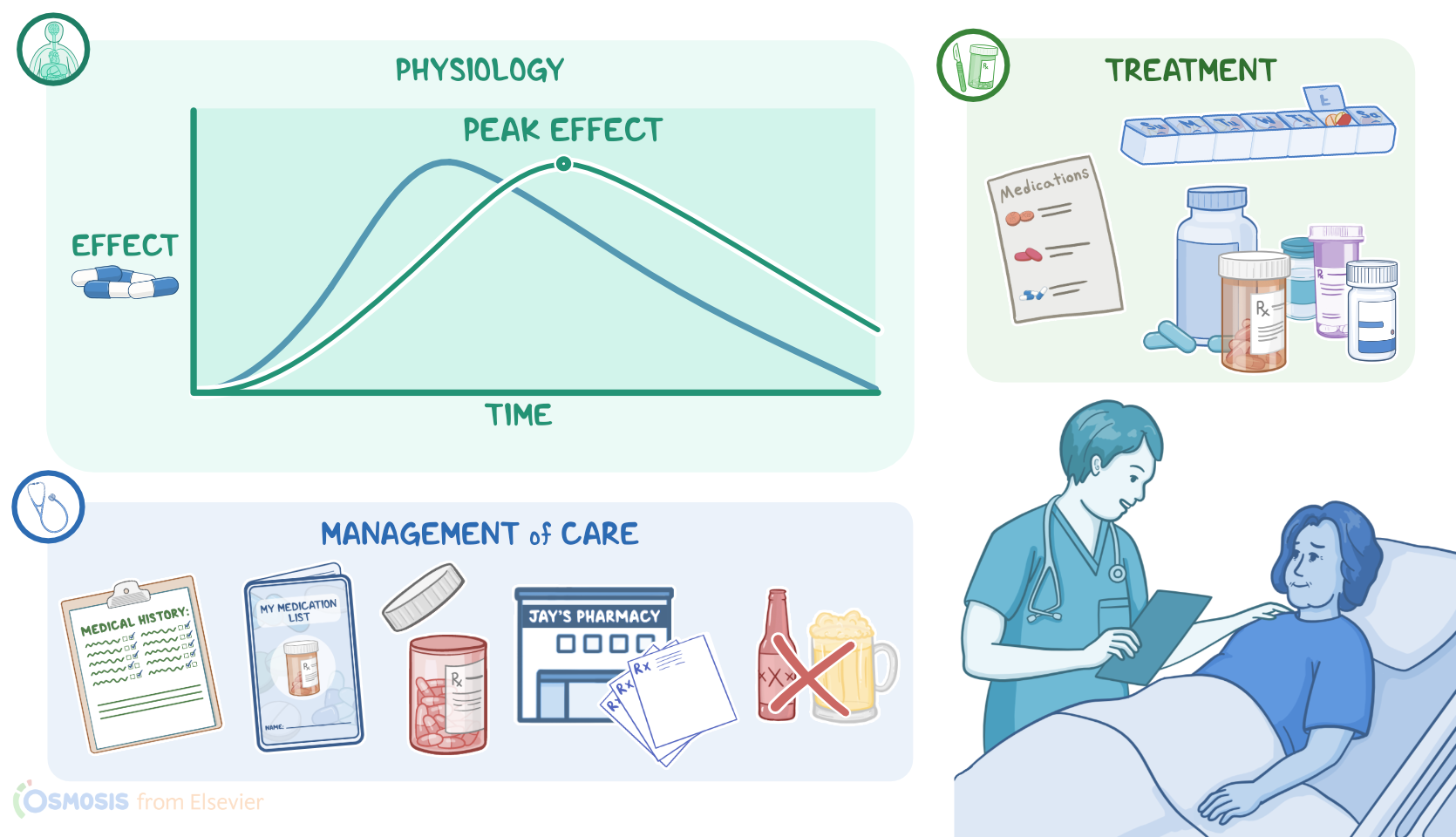
Now, pharmacodynamics involves how a medication affects the body, including the timing of the medications onset peak effect and duration as well as interactions with certain receptors.
Now, aging affects each of these elements differently. For example, the rate of absorption in older clients is slower due to decreased blood flow to the stomach, slower gastric emptying and decreased acid production as well as a decrease in the surface area of the small bowel.
This means that medications need more time to reach their peak effect. The bioavailability though, which is the percentage of medication that reaches the blood doesn't differ with age.
As for distribution with age body water serum albumin along with lean body mass tend to decrease. In contrast with fat storage, which generally goes up.
This causes water soluble medications to have lower volume of distribution and fat soluble medications to have higher volume of distribution.
In addition to high proportion of free or active metabolites of the medication. When it comes to metabolism, geriatric clients have decreased hepatic blood flow and size as well as decreased activity of cytochrome P 450 enzymes.
These changes impair metabolism of medications in the liver elimination is typically also slower in older clients. And that's mainly due to their reduced kidney size and blood flow to the kidneys which causes a drop in the glomerular filtration rate or GFR for short.
Ok. When it comes to pharmacodynamics, age related changes to receptor sites can result in a loss of receptor sensitivity to certain medications which can result in a reduced response.
Pharmacodynamics2:38–3:05
On the other hand, due to increased permeability of the blood brain barrier, elderly clients can experience increased central nervous system effects of some medications which may result in dizziness, sedation and confusion.
Now, elderly clients often have one or more chronic disorders. So they may need to take multiple medications.
Polypharmacy3:05–3:38
This results in polypharmacy which is defined as regular use of at least five medications. Use of multiple medications can lead to problems like poor adherence and increased risk of harmful interactions between medications as well as adverse effects such as weight loss, urinary incontinence, a decline in functional status, cognitive impairment, increased risk of falls and even increased mortality.
All right now, to improve the safety of medication administration in older clients. Beer's criteria is typically used.
Treatment3:38–4:22
This is a tool that was created by the American Geriatric Society or AGS for short and aims at optimizing safe medication use in the geriatric population.
Specifically, beer's criteria have been designed to reduce medication related issues such as exposure to inappropriate medications, interactions between various medications and medications that need extra caution in older individuals.
The Beer's criteria groups, medications into three categories, medications to avoid in older clients, medications to avoid in older clients with certain conditions and medications that should be used with caution in older clients.
All right. Now, let's talk about some medication considerations for geriatric clients.
Management of care4:22–5:39
The goal of care is to promote medication safety. Start by reviewing your client's current health record including renal and liver function tests, then carefully reconcile home medications with your client preferably by having them show you the pill bottles for the medications they take.
Remember to ask about medications prescribed from other healthcare providers or following any recent hospitalization. Also review if they are taking any over the counter medications or supplements because these can have interactions with common medications.
Be sure to consult with the pharmacist and health care provider to determine if adjustments in the client's medication should be made or if additional monitoring is needed.
Next, evaluate your client for age related physiological changes that can contribute to unsafe medication administration or adherence like visual impairment, hearing loss, memory impairment such as dementia changes in speech or swallowing, ability or other physical limitations.
Finally, remember to investigate if they are having problems with affording their prescriptions and work with your unit, social services to enroll your client in a compassionate care program as needed.
All right, moving on to client and family teaching, provide your client with a complete list of their medications and supplements and teach them to keep copies available in a wallet or purse as well as on the refrigerator or in the medicine cabinet.
General client & family teaching5:39–7:09
Explain that the list includes the name of each medication, the healthcare provider who prescribed it, the reason it was prescribed the dose and the frequency and remind them to keep this list updated following any hospitalization or routine healthcare appointment with medication changes to promote adherence, provide easy to read, written medication instructions and then ask them to teach back what they learned in their own words, to demonstrate understanding of their medication regimen including the prescribed dose time.
And if they need to take the medication with food or on an empty stomach. Encourage them to use a memory aid to take their medications on time, such as a chart calendar or pillbox.
Also, if your client is visually or physically impaired, remind them to ask for easy to open bottles or larger print on the bottle label, provide general safety information about medications such as checking expiration dates, avoiding mixing alcohol and their medications and avoiding sharing medications with others.
Recommend they use one pharmacy for all prescriptions to reduce the potential for medication errors and interactions emphasize the importance of contacting their health care provider right away if they experience adverse effects of their medication.
All right. As a quick recap.
Review7:09–8:28
Medication considerations in the geriatric population refers to age related changes that may affect the pharmacokinetics and pharmacodynamics.
Pharmacokinetics include absorption, distribution, metabolism and elimination of medications when it comes to pharmacodynamics.
Age related changes to receptor sites can result in a reduced response to certain medications. On the other hand, due to increased permeability of the blood brain barrier, elderly clients can experience increased central nervous system effects of some medications which may result in dizziness, sedation and confusion.
Now, elderly clients often need to take multiple medications known as polypharmacy, which can lead to problems like poor medication adherence and increased risk of harmful interactions between medications as well as adverse effects to improve the safety of medication administration.
In older clients. The beers criteria groups, medication into three categories, medications to avoid in older clients, medications to avoid in older clients with certain conditions and medications that should be used with caution in older clients.
The priority goal of nursing care is focused on promoting medication safety. While client and family teaching is focused on reinforcing medication adherence and safe medication, self administration.
| GERIATRIC CONSIDERATIONS - MEDICATIONS | ||
| KEY POINTS | NOTES | |
| DEFINITION |
| |
| PHARMACOKINETICS |
| |
| PHARMACODYNAMICS |
| |
| POLYPHARMACY |
| |
| TREATMENT |
| |
| MANAGEMENT OF CARE |
| |
| PATIENT AND FAMILY TEACHING |
| |
No notes for this video yet
Try adding a note below