Health literacy: Nursing
Introduction0:00–1:13
Nurse Jerome works in an outpatient surgical center and is performing the intake assessment for a client named Julie who is scheduled for a colonoscopy.
Nurse Jerome asks Julie, “When was the last time you ate?” Julie responds, “I just stopped to get a breakfast sandwich on the way here.” Nurse Jerome is confused since all clients scheduled for this procedure are instructed to ingest nothing but clear liquids after midnight the night before.
He also notes that Julie has left several areas on her client forms blank and some spots have inappropriate information.
Nurse Jerome says, “Julie, were you able to read through the colonoscopy preparation paperwork we sent you home with two weeks ago?” Julie bites her lip and looks around nervously, stating, “I did, but I guess I didn’t understand them too well, I’m sorry.” Nurse Jerome responds, “You don’t need to be sorry.
Although you won’t be able to go for your colonoscopy today, let’s make sure you understand everything for next time.” Julie smiles and sighs a breath of relief.
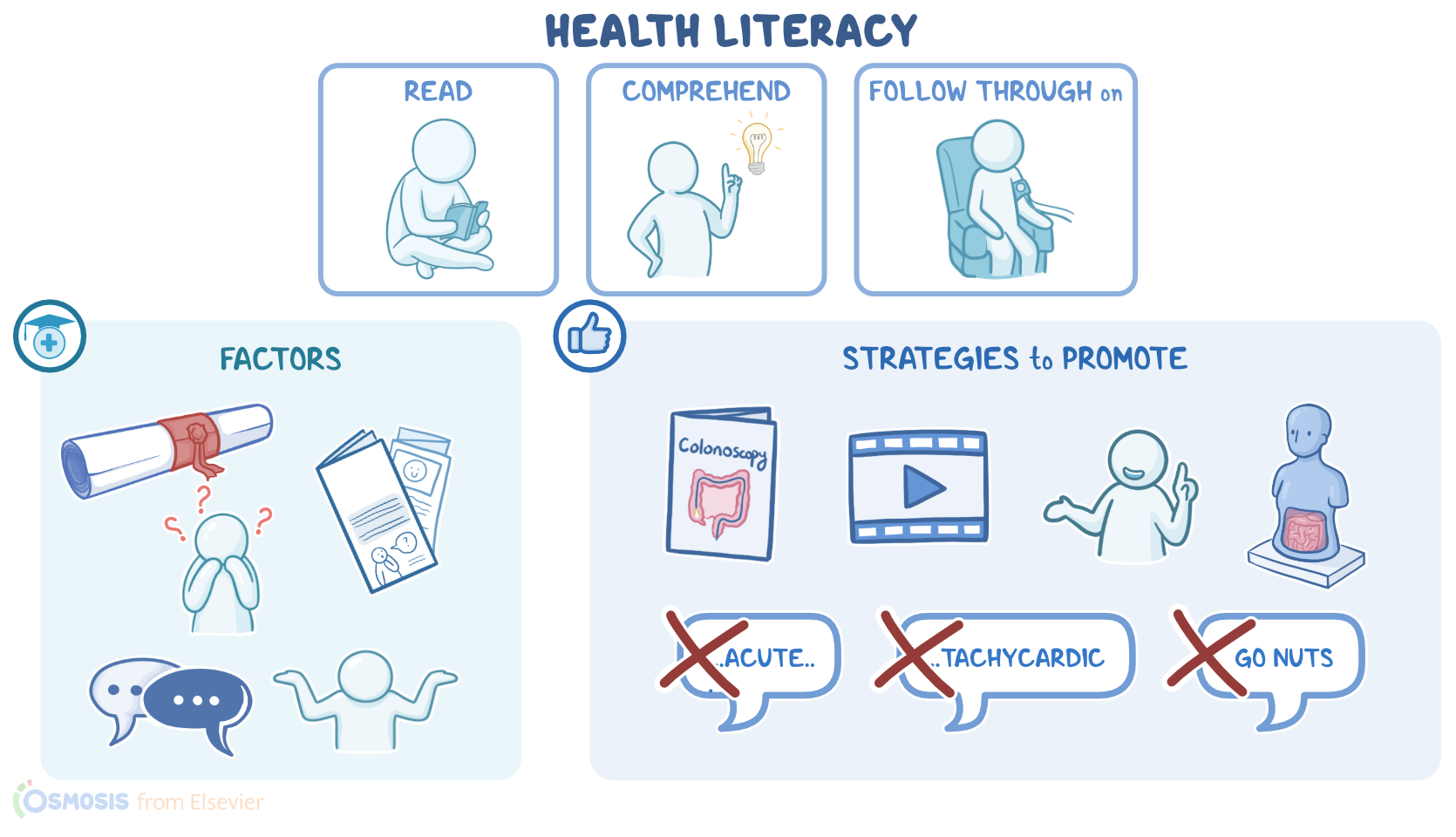
Nurse Jerome suspects Julie has low health literacy, so he’ll use what he knows about this topic to educate and support her.Now, health literacy is the capacity to read, comprehend, and follow through on health-related information, so those who have low literacy skills are unlikely to properly understand the health-related information they need.
Understanding Health Literacy1:13–2:14
Factors that can impact health literacy include the educational level of the client, as well as with the difficulty level of the reading material, since any client education material above the client’s reading comprehension level will lead to confusion and misunderstanding.
Another factor is the native language of the client, so if educational materials aren’t written in the client’s native language, it can contribute to lower health literacy even if the client has overall high literacy in their primary language.
It’s also important to keep in mind that even people with good literacy skills may find it challenging to understand healthcare information, because they may not understand medical terminology or even the basic concepts of health and medicine, such as how the body works or how to navigate the healthcare system.Alright, health literacy is a major issue that can impact the health and well-being of clients.
The Impact of Health Literacy2:14–3:20
In fact, in a national assessment of health literacy skills of United States adults, 36% were identified as having serious limitations in health literacy.
Studies have shown that high health literacy is associated with better client outcomes, whereas low health literacy can lead to worse overall health outcomes.
This is because health literacy can impact a client’s ability to make health-related decisions regarding things like following prescription and treatment regimens, like when Julie misunderstood how to prepare for her colonoscopy.
Clients with low health literacy tend to have more overall hospitalizations and visits to the emergency department than clients with high health literacy.
In addition, clients with low health literacy are less likely to partake in illness prevention strategies such as obtaining a yearly flu shot or undergoing screening for breast cancer through mammography.
In older adult clients, low health literacy is associated with higher mortality rates when compared to those with high health literacy.
So since health literacy has such a significant impact on health outcomes, assessing a client’s health literacy can help you to plan their care and education.
Assessing Health Literacy3:20–4:52
There are several screening tools that can be used to assess health literacy, such as the Wide Range Achievement Test, or WRAT 3, the Rapid Estimate of Adult Literacy in Medicine, or REALM, and the Cloze test.
All three tests require the client to read instructions pertaining to medications or procedures and then answer simple questions.
The nurse should keep in mind that those with low literacy skills may already feel stigmatized and fear exposure to their inability to read, so sensitivity on the part of the nurse is essential when assessing health literacy.Now, if you don't have access to these tests, you can simply ask a client to read a medication label out loud to you or explain something to the client and then ask them to retell you in their own words what you discussed with them.
Like with Julie, Nurse Jerome can go over the instructions for the colonoscopy preparation with her and then ask her to summarize the steps.
This is called the teach back method because the client is teaching back what they learned. It is also helpful for you to know some of the common signs of low health literacy, such as frequently missed appointments, incomplete registration forms, improper adherence to prescription medication regimens, and lack of follow through on medical tests or referrals.
Clients might also try to hide their low literacy by asking few or no questions following a teaching session. So there are helpful strategies you can implement to promote health literacy.
Teaching Strategies to Improve Health Literacy4:52–6:09
These strategies include simplifying health-related materials by writing information at a 5th grade reading level or lower.
And whenever possible, written materials should be presented in the client’s preferred language and without medical jargon, such as words like acute or tachycardic; and colloquialisms, such as “go nuts” should be avoided since they can be confusing.
You can also use illustrations and infographics, as well as non-printed teaching materials, such as videos, audio clips, demonstrations, models, and other visuals.
Lastly, you should reinforce the education you provide by following up with clients via telephone or scheduling a home health visit as needed to promote understanding.Okay let’s check back in with Nurse Jerome who is educating Julie on the preparation for her colonoscopy.
He prints out a handout written at the third grade reading level which includes pictures of the procedure as well as labels of the medications she should take prior to the procedure.
After reviewing this information with Julie, Nurse Jerome asks her to “teach back” the information in her own words. At the end of the appointment, Julie thanks Nurse Jerome for his help and reschedules her colonoscopy.
Alright, as a quick recap…Health literacy is the capacity to read, comprehend and follow through on health related information which can impact health outcomes.
Review6:09–7:08
Factors that affect health literacy are the client’s educational level and native language as well as the reading comprehension level of materials.
There are several screening tools that can be used to assess health literacy, however, if you don't have access to these tests, you can simply ask the client to read a medication label out loud.
Strategies to promote health literacy include simplifying health-related materials, limiting use of medical jargon and colloquialisms, providing instructions in the client’s native language, and reinforcing client teaching.
The nurse can also use non-printed teaching materials, such as videotapes, audiotapes, demonstrations, models, pictograms, and other visuals.
All members of the healthcare team are responsible for promoting health literacy in order to properly educate and instruct clients.
| HEALTH LITERACY | ||
| KEY POINTS | NOTES | |
| UNDERSTANDING HEALTH LITERACY |
| |
| THE IMPACT OF HEALTH LITERACY |
| |
| ASSESSING HEALTH LITERACY |
| |
| TEACHING STRATEGIES TO IMPROVE HEALTH LITERACY |
| |
No notes for this video yet
Try adding a note below