Hygiene - Ostomy care: Nursing skills
Introduction0:00–0:46
The stoma is connected to a pouching system also called an appliance that's composed of a skin barrier or adhesive wafer that attaches to the skin and a pouch where stool and flatus collect.
These ostomies can be permanent or temporary and can be necessary because of conditions like an intestinal tumor, bowel trauma or inflammatory bowel disease or to allow the bowel to rest and heal after surgery.
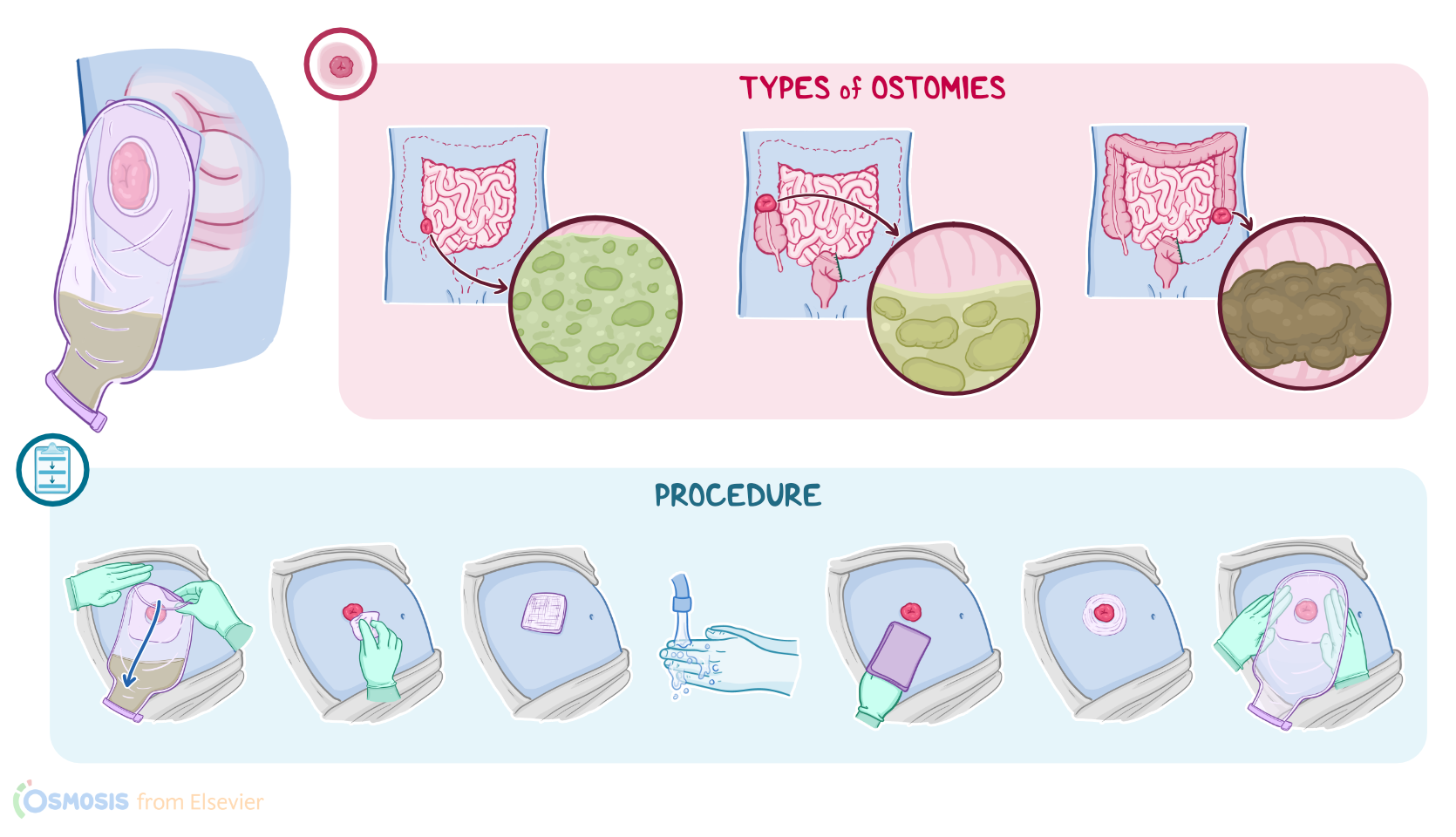
Now, an ostomy can be either an ileostomy or a colostomy depending on its location within the intestines. An ileostomy involves part of the small intestine called the ileum.
Types of ostomies0:46–1:47
Whereas a colostomy involves part of the large intestine or colon. Keep in mind that normally in the small intestine, the stool is mostly liquid because the majority of water is normally reabsorbed in the large intestine.
So, if the colostomy is located near the beginning of the colon, like in the ascending colon, the stool is typically watery and loose.
Well, if the colostomy is located near the end of the colon, like in the descending colon, the stool will be more solid.
Ok. Let's move on and discuss the types of pouching systems.
There are drainable or open ended pouches which are sealed with a clip or velcro type system at the bottom. So they can be drained and reused.
Types of ostomy appliances1:47–2:39
Then there are closed ended or disposable pouches which can be removed and replaced when full. Additionally, some pouching systems have precut skin barriers.
So they come in different sizes to match various stoma sizes for other types. You'll need to cut out the opening yourself.
Another variation refers to whether or not a skin barrier is attached to the pouch. If it is, it's a one piece, if not, is a two piece.
Now, no matter the type of ostomy, there are some common care tips to keep in mind while providing ostomy care. Before beginning, identify your patient, inform them about the procedure and answer any questions they may have related to the procedure, close the door, draw the bed curtains and keep them covered as much as possible to maintain privacy.
You can perform ostomy care when your patient is standing or sitting or it can be done in the bathroom or while they are lying in bed for colostomies.
Common care tips2:39–4:08
So care should be taken to keep it clean. Remember to always use warm water for ostomy care and you can make sure its a comfortable temperature by testing it with the inside of your wrist.
Now, if youre using a pre cut pouching system, the opening should match the size of the stoma. If you cut the opening yourself, measure the stoma using a measuring guide and trace the measurement on the skin barrier, then cut the opening a little larger than the stoma to avoid putting pressure on it.
Now, to provide ostomy care, you'll need two pairs of clean gloves, a towel or bed protector, a bedpan, a wash basin filled with warm water washcloths, adhesive remover if needed.
And a clean pouching system in order to care for a patient with a precut one piece disposable pouching system first, raise the bed to a comfortable working height, position your patient.
So you have access to the stoma and place a towel or bed protector under them to remove the soiled pouching system. Use one hand to loosen the edge of the skin barrier and slowly lift it while using your other hand to press down on the skin near the skin barriers, sticky backing.
Once you've loosened the skin barrier, gently pull it from the top to the bottom. If needed, you can use warm water or adhesive remover to remove the adhesive more easily place the soiled pouching system in the bedpan.
Routine ostomy care procedure4:08–7:03
This is also a good time to observe the stoma which should be reddish pink and moist and the peristomal skin should be intact.
Sometimes the stoma can bleed a bit when you are providing care, but thats considered normal. Next.
Remove the backing from the skin barrier on the new pouching system and center it over the stoma with the end pointing down, press the edges onto the skin and make sure there's a good seal to prevent leakage.
Finally remove the bed protector, check your patient's clothing, gown and bed linens to ensure they're clean and dry, remove your gloves and perform hand hygiene.
Adjust your patients clothing to cover the pouch, assist them to a comfortable position and lower the bed to its original position when providing ostomy care.
There are a few things you should look for such as a bluish or black stoma, signs of skin breakdown, excessive bleeding from or around the stoma, a significant change in the stool.
Or if your patient experienced any pain or discomfort during the procedure. If you observe any of these, make sure to take the appropriate steps for your patients situation, document the date and time, the type of care you provided and the type of pouching system you used also document the color and consistency of the stool.
Any abnormal observations or changes from baseline, any actions taken and how your patient tolerated the procedure. Finally, remember that ostomy care can be a challenging skill for a patient to learn.
And in some cases, they may have a lot of anxiety and concern about how they'll care for a new ostomy at home. Its important to provide emotional support and allow your patient to be involved in the care of their ostomy since this is a great opportunity for patient education.
Ostomies in the abdominal wall can be either an ileostomy, which involves part of the small intestine called the ileum or a colostomy, which involves part of the large intestine or colon ostomy care is done to check the state of the stoma, replace the soiled pouching system and clean the skin around the stoma.
Finally, remember to document your observations along with the care you
Nursing Implications7:03–7:52
Review7:52–6:57
| HYGIENE - OSTOMY CARE | ||
| KEY POINTS | NOTES | |
| DEFINITION |
| |
| TYPES OF OSTOMIES |
| |
| TYPES OF OSTOMY POUCHING SYSTEMS |
| |
| COMMON CARE TIPS |
| |
| OSTOMY CARE PROCEDURE |
| |
| CLINICAL IMPLICATIONS |
| |
- "Fundamentals of nursing (11th ed.). ISBN: 9780323749619 " Elsevier (2025)
- "Clinical nursing skills & techniques (11th ed.). ISBN 978-0-443-10718-4 " Elsevier (2025)
No notes for this video yet
Try adding a note below