Medication administration - Insulin: Nursing pharmacology
Introduction0:00–1:03
Insulin is a hormone secreted by beta cells in the pancreas that helps glucose enter the body’s cells, so it can be used for energy.
In diabetes mellitus, insulin is either not produced at all, like in type I diabetes; or cells are resistant to insulin, like in type II diabetes.
In either type, glucose can't be utilized by the body’s cells, so it builds up in the bloodstream. Exogenous insulin, or synthetic insulin, can be administered to help regulate glucose levels, and is most often administered by subcutaneous, or SUBQ injection.
It’s a commonly used, high-alert medication, meaning there’s an increased risk of patient harm if administered in error.
This is because insulin can cause potentially dangerous hypoglycemia, or low blood glucose levels. Alright, so insulin typically comes in either a vial or a pen.
Subcutaneous Insulin Preparations1:03–2:38
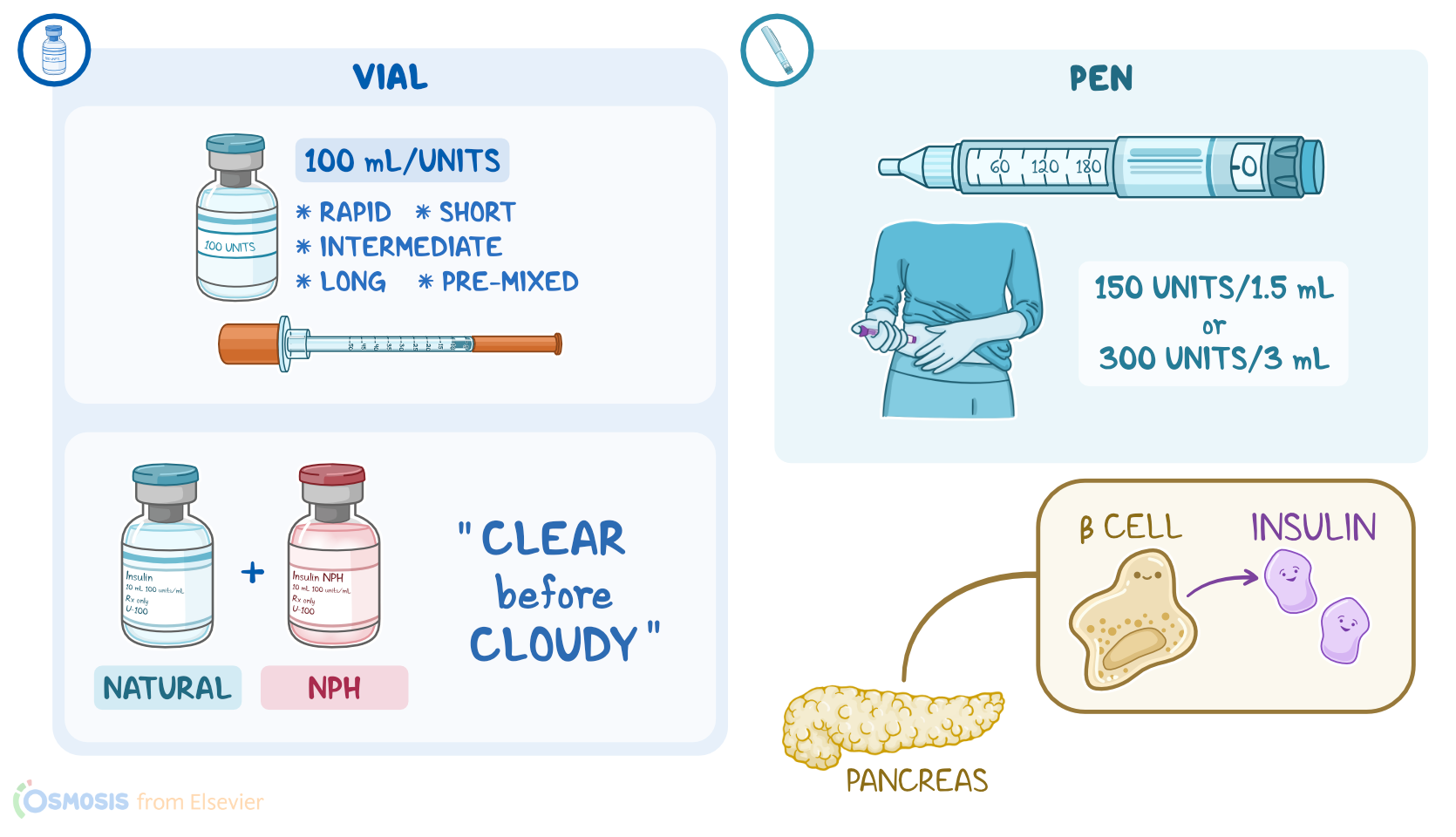
Most insulin vials contain a concentration of 100 units of insulin per milliliter. It’s important to note that insulin doses are prescribed and measured in units, not milliliters so you’ll always use an insulin syringe, which measures increments of insulin in units.
Insulin vials can include rapid-, short-, intermediate-, or long-acting insulins as well as pre-mixed solutions like 70/30 preparations, which contain 70 percent intermediate-acting insulin and 30 percent rapid-acting insulin.
There are also pre-filled insulin pens, which contain either 150 units of insulin per 1.5 milliliters or 300 units of insulin per 3 milliliters.
These devices can be used for multiple injections for one patient. Before administering the insulin, a small disposable needle is placed on the end of the pen and the indicator dial is turned to the correct insulin dose.
Following administration, the dose indicator returns to zero and the needle is removed from the skin and discarded. Now, let’s review some calculations for subcutaneous insulin using a vial and syringe.
Example 1 - Vial and Syringe2:38–4:05
Nurse Nathan works in a long-term care facility and is caring for Alice, an 89-year-old woman with type 2 diabetes. Nurse Nathan checks the electronic health record, or EHR, and sees that Alice is ordered a sliding scale of insulin aspart for subcutaneous injection.
He also sees that 10 minutes ago Alice’s blood glucose was 289 mg/dL. According to the sliding scale, Nathan will administer 8 units of insulin aspart.
Now, let’s look at an example where you’ll mix two types of insulin. Nurse Ben is a home health nurse caring for Chris, a 37-year-old patient with type 1 diabetes.
Example 2 - Mixing Insulins4:05–5:41
Nurse Ben checks the medication order which reads: Insulin regular 5 units and insulin NPH 5 units SUBQ once at 1400. Next, Nurse Ben checks the insulin vials and sees that both insulins contain a concentration of 100 units per milliliter and the regular insulin has a clear appearance while the NPH insulin appears cloudy.
He also checks the drug handbook to confirm that these two types of insulins can safely be mixed in one syringe.Nurse Ben knows that when drawing up two types of insulins in one syringe, he will always draw up regular insulin prior to NPH insulin; or CLEAR before CLOUDY.
This is to prevent accidental injection of NPH into the vial containing regular insulin. So first, Nurse Ben injects 5 units of air into the NPH vial.
Then he injects 5 units of air into the regular insulin vial and withdraws 5 units of the clear, regular insulin. With the same syringe, he withdraws 5 units of cloudy NPH insulin.
Now let’s look at how to administer insulin using an insulin pen. Nurse Josie is working on a telemetry unit and caring for Holly, a 62-year-woman with type 2 diabetes.
Example 3 - Insulin Pen5:41–6:38
Nurse Josie checks the electronic health record, or EHR, and sees that Holly is ordered 3 units of insulin lispro subcutaneously three times daily before meals.
Alright, as a quick recap...Insulin is a hormone normally produced by the beta cells in the pancreas. Exogenous insulin, or synthetic insulin, is most often administered subcutaneously.
Review6:38–7:00
Insulin for subcutaneous injection can be prepared in a vial or pen. All insulin doses are measured in units,
| MEDICATION ADMINISTRATION - INSULIN | ||
| KEY POINTS | NOTES | |
| DEFINITION |
| |
| SUBCUTANEOUS INSULIN PREPARATIONS |
| |
| EXAMPLE 1 - VIAL AND SYRINGE |
| |
| EXAMPLE 2 - MIXING INSULINS |
| |
| EXAMPLE 3 - INSULIN PEN |
| |
- "Calculate with confidence. (8th ed.)" Elsevier (2022)
- "Calculation of drug dosages: A work text. (12th ed.)" Elsevier (2023)
- "Clinical calculations: With applications to general and specialty areas. (10th ed.)" Elsevier (2022)
- "Gray Morris's calculate with confidence, Canadian edition. (2nd ed.)" Elsevier (2022)
- "Mulholland's: The nurse, the math, the meds. (5th ed.)" Elsevier (2023)
No notes for this video yet
Try adding a note below