Medication administration - Parenteral: Nursing pharmacology
Introduction0:00–0:24
Parenteral medications bypass the gastrointestinal system and can be administered through injection or the intravenous route.
Four types of parenteral routes are intradermal, or ID; subcutaneous, or SubQ; intramuscular, or IM; and intravenous, or IV.
Now, parenteral medications come in vials, ampules, or premixed IV bags. Vials are single- or multi-dose containers that are sealed with a rubber top through which a dose is drawn up with a needle and syringe.
Preparations0:24–1:22
Another type of vial is the mix-o-vial, where a powdered medication and solvent are stored in separate compartments of the same vial and are mixed by pushing a plunger and releasing the stopper that separates them.
Then, ampules are single-dose glass containers designed to break open by snapping along a scored line on the narrowed portion of the ampule’s neck.
As the nurse, you’ll choose an appropriate syringe and needle to administer medication, so let’s review the types and parts of a syringe first.
Syringes1:22–2:43
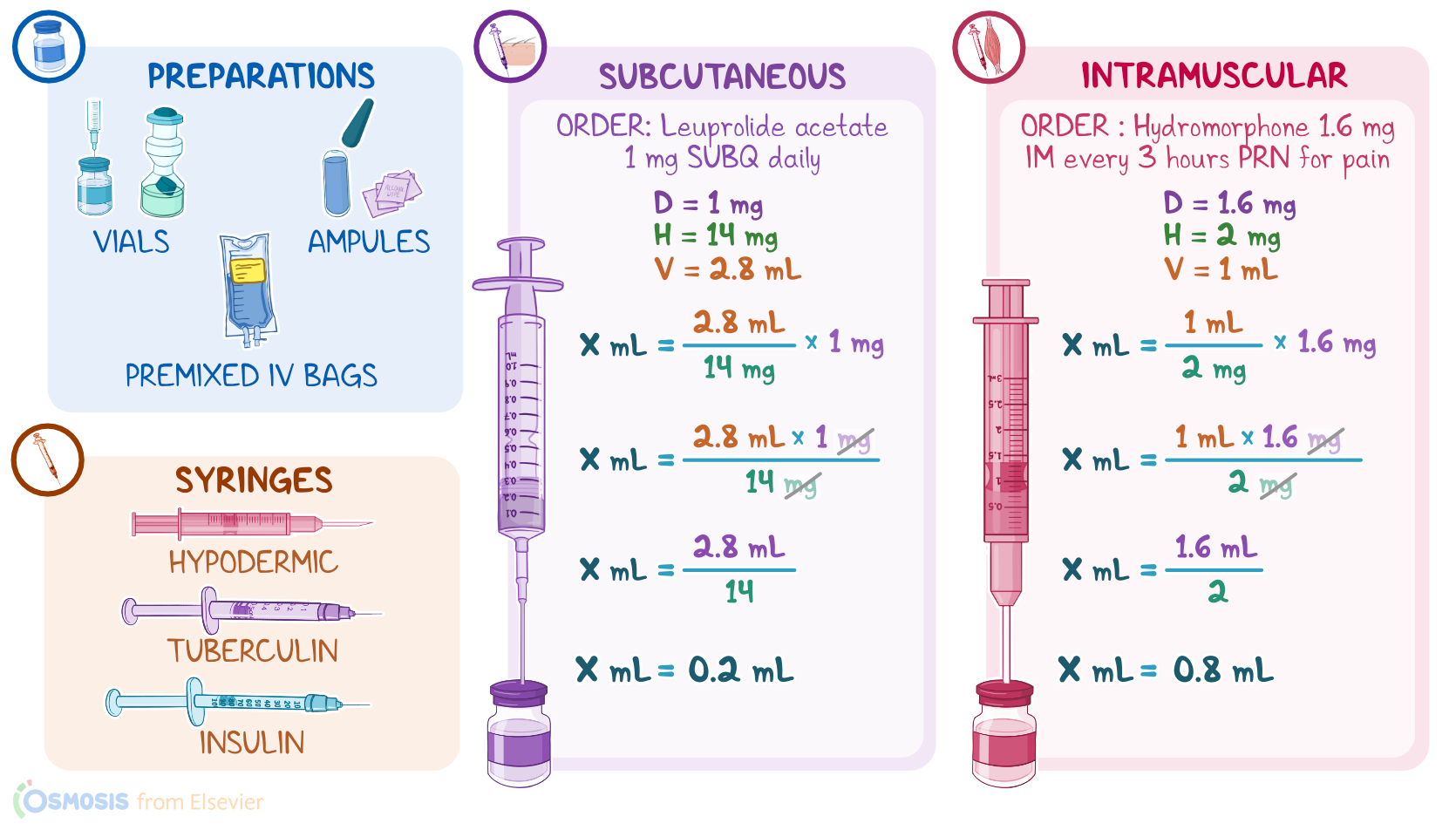
The three syringe types are hypodermic, tuberculin, and insulin. Hypodermic syringes come in a variety of sizes, with the 3 mL and 5 mL syringes typically used for injectable medication volumes between 0.5 mL and 5 mL, whereas tuberculin syringes are 0.5 mL or 1 mL in size and used when the volume of medication administered is less than 1 mL, like tuberculin skin tests.
Then, there are insulin syringes, which are marked in units instead of milliliters and should only be used to administer insulin.
They typically can hold up to 100 units. So, all syringes have three main parts.
The barrel, which is the outer shell that holds the medication, and the tip, which is also called a hub, is the end where the needle attaches.
Lastly, the plunger is the inner part that fits inside the barrel and can move to withdraw and inject the medication. When drawing up a medication, you’ll align the rubber stopper’s outer edge closest to the tip with the gradation of the volume prescribed.
Moving on to needles, like the syringe, each needle has three parts. First, the hub is the portion of the needle that attaches to the syringe tip.
Needles2:43–3:48
Then there’s the shaft, which is the long part of the needle, and the bevel, or the sharp point on the very end. You’ll choose an appropriate needle size depending on your patient’s size, injection location, and the viscosity of the medication.
Now, needles come in different sizes of gauge and length. The gauge refers to the diameter of the shaft opening; and the higher the gauge, the smaller the diameter.
For example, a 25-gauge needle has a smaller diameter than a 20-gauge needle. Then the length of the needle refers to how long the shaft is, measured in inches.
Both gauge and length are noted together on the needle packaging and may have a slash or an “X” in between the two measurements, for example “22 gauge by one-and-a-half inches.” Okay, let’s do some parenteral medication calculations for SubQ and IM administration, using dimensional analysis.
Dosage Calculation - Example 1 - SubQ3:48–6:19
First, you’ll read the order, which is: leuprolide acetate 1 mg SubQ daily. Now let’s look at the medication label.
Since the medication comes in 14 mg per 2.8 mL, you’ll calculate how many mL you should administer to achieve the desired dose.
To do this, first identify your components: Desired, Have, and Vehicle. Remember, D is for the Desired dose, or dose ordered by the health care provider; H is for Have, or the dosage you have available; and V is for Vehicle or the form and amount in which the medication comes.
In this case, D is 1 mg, which is obtained from the health care provider’s order. H is 14 mg, obtained from the medication label, and V is 2.8 mL, also obtained from the medication label.
Next, you’ll determine whether a conversion is required. Because both D and H are in milligrams, no conversion is needed.
Now, set up your equation, where X is the dose you’ll administer, written out like this: X volume in milliliters equals Vehicle over Have multiplied by Desired Now, plug in the values to get X mL equals 2.8 mL multiplied by 1 mg divided by 14 mg.
Now, you can cross out the units of the numerator that match the units of the denominator, because they cancel out. Next, you’ll multiply 2.8 mL by 1 and divide by 14 to solve for X.
X mL = 0.2 The answer is 0.2 mL, meaning you should administer 0.2 mL of leuprolide acetate SUBQ to achieve the ordered dose of 1 mg.
Now, to administer the medication, you’ll need to select a needle size appropriate for SUBQ administration, like a 25-gauge, five-eighths inch needle.
You’ll also need to choose a syringe appropriate for administering a volume of 0.2 mL, such as a 1-mL tuberculin syringe.
Finally, you’ll cleanse the rubber top on the vial and draw up 0.2 mL. Let’s look at another example.
First, you’ll read the order, which is: hydromorphone 1.6 mg IM every 3 hours PRN for pain. Now, let’s look at the medication label.
Dosage Calculation - Example 2 - IM6:19–8:36
Since the medication comes in 2 mg per one mL, you’ll calculate how many mL you should administer to achieve the desired dose.
To do this, first identify your components, Desired, Have, and Vehicle. In this case, D is 1.6 mg, which is obtained from the health care provider’s order.
H is 2 mg, obtained from the medication label, and V is 1 mL, also obtained from the medication label. Next, you’ll determine whether a conversion is required.
Because both D and H are in milligrams, no conversion is needed. Now, set up your equation, where X is the dose you’ll administer, written out like this: X volume in milliliters equals Vehicle over Have multiplied by Desired Now, plug in the values to get X mL equals 1 mL multiplied by 1.6 mg divided by 2 mg.
Remember, you can cross out the units of the numerator that match the units of the denominator, because they cancel out.
Next, you’ll multiply 1 mL by 1.6 and divide by 2 to solve for X. X mL = 0.8 The answer is 0.8 mL meaning, you should administer 0.8 mL of hydromorphone to achieve the ordered dose of 1.6 mg.
Now, to administer the medication, you’ll select an appropriate needle size for IM administration. For a medium-sized adult patient, for example, you’ll choose a 22-gauge, one-inch needle for injection into the deltoid muscle.
Next, you’ll need to select an appropriate syringe for administering a volume of 0.8 mL, like a 3-mL hypodermic syringe.
Finally, you’ll cleanse the rubber top on the vial and draw up 0.8 mL. Alright, as a quick recap...Parenteral medications are given through routes that bypass the GI system, including intradermal, subcutaneous, intramuscular, or intravenous.
Review8:36–8:58
To safely perform medication administration, you must accurately calculate the medication volume to be administered and use the appropriate syringe
| MEDICATION ADMINISTRATION - PARENTERAL | ||
| KEY POINTS | NOTES | |
| DEFINITION |
| |
| PREPARATIONS |
| |
| SYRINGES |
| |
| NEEDLES |
| |
| DOSAGE CALCULATION -EXAMPLE 1 - SUBQ |
| |
| DOSAGE CALCULATION -EXAMPLE 2 - IM |
| |
- "Calculate with confidence. (8th ed.)" Elsevier (2022)
- "Calculation of drug dosages: A work text. (12th ed.)" Elsevier (2023)
- "Clinical calculations: With applications to general and specialty areas. (10th ed.)" Elsevier (2022)
- "Gray Morris's calculate with confidence, Canadian edition. (2nd ed.)" Elsevier (2022)
- "Mulholland's: The nurse, the math, the meds. (5th ed.)" Elsevier (2023)
No notes for this video yet
Try adding a note below