Motivational interviewing (MI): Nursing
Introduction0:00–0:40
Nurse Joe works in a community health clinic where he regularly cares for Mr. Anand who has type 2 diabetes and hypertension.
During the past several visits, Nurse Joe has encouraged Mr. Anand to stop smoking by teaching him the risks of smoking and also providing him with educational material on ways to quit.
During the clinic visit today Mr. Anand says, “I really want to quit smoking but it just feels impossible.” Nurse Joe recently learned about motivational interviewing and decided to use this technique today with Mr.
Anand. Motivational interviewing is a client-centered strategy that can be used to encourage clients to change a behavior that can be harmful to their health.
Definition of Motivational Interviewing0:40–1:08
It’s based on intrinsic motivation which is when a person engages in a behavior because it is personally rewarding to them.
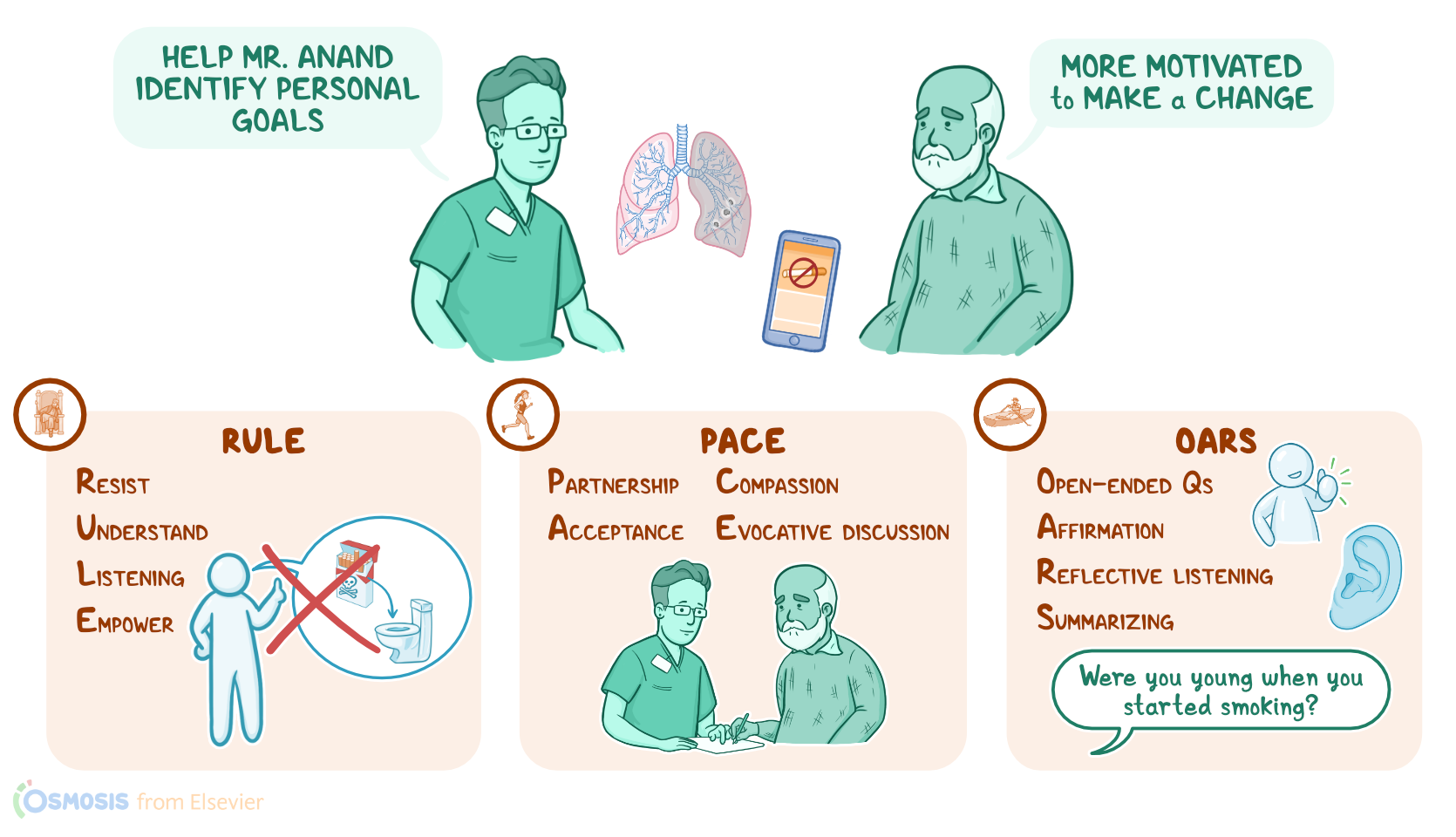
So, by using motivational interviewing, Nurse Joe can help Mr. Anand to identify personal goals that are meaningful for him to achieve so he feels more motivated to make a behavioral change.
Motivational interviewing can be very effective when working with clients who need assistance making lifestyle changes, especially those clients who may feel ambivalent about making a change.
Guiding Principles1:08–3:23
Ambivalence is when your client feels uncertain or unmotivated to take the steps needed to produce behavioral change. Nurse Joe recognizes Mr.
Anand is showing signs of ambivalence when Mr. Anand goes on to say, “I know I should quit smoking, but I really enjoy it.” Motivational interviewing can take some practice but there are three acronyms you can use to guide you, including, RULE, PACE, and OARS.Let’s start with RULE which can help you remember the four guiding principles of motivational interviewing: Resist, Understand, Listening, and Empower.
When using motivational interviewing with your client, the “R” in RULE stands for resist. This means it’s best to resist using the righting reflex, which is where you impose your solution about what they should do.
Motivational interviewing is most successful when change is made at a pace that is comfortable for your client.Next, the “U” in RULE stands for Understand, meaning, you should try to understand your client’s own intrinsic motivations.
With this in mind, Nurse Joe asks Mr. Anand to describe the reasons that he wants to quit smoking.
Mr. Anand replies that he wants to quit because his first grandchild was just born and he wants to be around to see the child grow up.
The “L” in RULE stands for Listening with empathy. Empathy is when you understand someone else’s point of view.
Nurse Joe is listening with empathy when he encourages Mr. Anand to express his frustration in past attempts to quit smoking, and acknowledges that the addictive components found in cigarettes make it extremely difficult to quit.
Lastly, “E” stands for Empowering your client which means you let your client know that they are in charge of their decisions and have the ability to change their behavior.
So, to empower Mr. Anand, Nurse Joe offers education on techniques to help quit smoking that Mr.
Anand can use to take control of his own decision-making.The next acronym is PACE which can help you get into the right mindset and be successful when using motivational interviewing.
Right Mindset3:23–5:01
PACE stands for Partnership, Acceptance, Compassion, and Evocative discussion. First, Partnership describes the relationship built between you and your client.
In motivational interviewing, you shed your authoritative role in order to become a collaborator in your client’s care. Nurse Joe has built a partnership with Mr.
Adnand over past clinic visits. They now work collaboratively to develop a plan to stop smoking based upon Mr.
Anand’s goals.The “A” is for Acceptance which means being non-judgmental of your client because of the choices they have made.
Instead, you should have Compassion, for your client, which is the “C” in PACE. Compassion is understanding the circumstances, difficulties, and obstacles that your client has faced.
Nurse Joe shows acceptance and compassion for Mr. Anand by acknowledging that quitting smoking is very difficult and avoiding any blaming language when speaking to him about quitting.
Finally, the “E” in PACE is for Evocative discussion. Evocative discussion means engaging your client in conversation with emotional depth.
To be successful in motivational interviewing, you need to guide your client to understand their own internal motivation for pursuing the change.
To do this, Nurse Joe asks Mr. Anand to talk about how the arrival of this new grandchild is a strong motivator for him to quit smoking.The last acronym is OARS which can help you remember the core skills and techniques of motivational interviewing.
Techniques for Motivational Interviewing5:01–7:44
OARS stands for Open-ended questions, Affirming, Reflective listening, and Summarizing. Now first, the “O” in OARS is for Open-ended questions.
When you ask an open-ended question, it allows your client to provide a narrative response and convey what is important to them.
An example of an open-ended question that Nurse Joe asks is, “How were you first introduced to cigarettes?” Mr. Anand’s response might include a story about the first time he smoked, the age at which he first smoked, and the fluctuations in the amount he has smoked over the years.
That is a lot of information! On the other hand, the opposite of an open-ended question is a close-ended question where you ask a direct question with predefined responses.
An example of a close-ended question that Nurse Joe could ask is, “Were you young when you started smoking?” Mr. Anand would likely respond with a simple “yes” or “no” which provides Nurse Joe with very little information.Next is “A” in OARS for Affirmation.
This means that when you talk with your client, you offer support for their efforts and journey in the process of making a behavioral change.
Nurse Joe uses affirmation by commending Mr. Anand’s past smoking cessation efforts and his internal motivation to stop.
The “R” in OARS is for Reflective listening. This means that you repeat back what your client has told you.
This is a helpful tool for clarifying what your client has said and also lets your client know that you have heard them and understand what they are saying.
Nurse Joe uses reflective listening by saying, “Mr. Anand, I’m hearing you say that you are ready to quit smoking because you want to be able to watch your grandchild grow up, but you feel as though it will not be possible for you to quit for good.” Last, is the “S” in OARS, which stands for Summarizing.
Summarizing occurs at the end of the motivational interviewing session and allows you and your client to work together to summarize important highlights from the visit.
Nurse Joe summarizes the visit by stating, “We have spoken about your desire to quit smoking and the motivation behind that desire.
We also talked about what has worked for you in the past when making a behavioral change and discussed several options for smoking cessation.
I will call you next week after you have had time to think about the different options and we can finalize your smoking cessation plan then.”It is not possible to evaluate the success of motivational interviewing instantly because change occurs over time.
Evaluating Motivational Interviewing7:44–8:37
However, a positive sign is when your client begins to include “change talk” into their conversation. Change talk is when your client talks about their behavioral change regularly.
So, three months later at Mr. Anand’s next clinic visit, he tells Nurse Joe that his cigarette cravings are much more manageable and that his family have been praising him for his hard work.
He also states that he has significantly reduced the number of packs of cigarettes he smokes in one week from 7 to 2. Mr.
Anand acknowledges that he still has work to do but is proud of the progress he has made. Alright, as a quick recap… Motivational interviewing is a client-centered strategy that is effective in producing changes in client behavior.
This strategy uses your client’s intrinsic motivation, which is when a person engages in a behavior because it is personally rewarding to them, so they feel more motivated to make a change.
Review8:37–9:41
You can use the three acronyms RULE, PACE, and OARS to help guide your interview. RULE is for the guiding principles of motivational interviewing and stands for Resist, Understand, Listen with empathy, and Empower.
PACE describes your mindset during the interview to best engage your client. It stands for, Partnership, Acceptance, Compassion, and Evocative discussion.
Finally, OARS helps you remember the core techniques of motivational interviewing. It stands for Open-ended questions, Affirmation, Reflective listening, and Summarizing.
You will know that motivational interviewing has been effective when your client begins to meet their goals and includes “change talk” in conversation.
affirmation reflective listening and summarizing. You will know that motivational interviewing has been effective when your client begins to meet their goals and includes change,
| MOTIVATIONAL INTERVIEWING (MI) | ||
| KEY POINTS | NOTES | |
| INTRODUCTION |
| |
| DEFINITION |
| |
| GUIDING PRINCIPLES |
| |
| RIGHT MINDSET |
| |
| TECHNIQUES FOR MI |
| |
| EVALUATING MI |
| |
No notes for this video yet
Try adding a note below