Quality and safety: Nursing
Introduction0:00–0:49
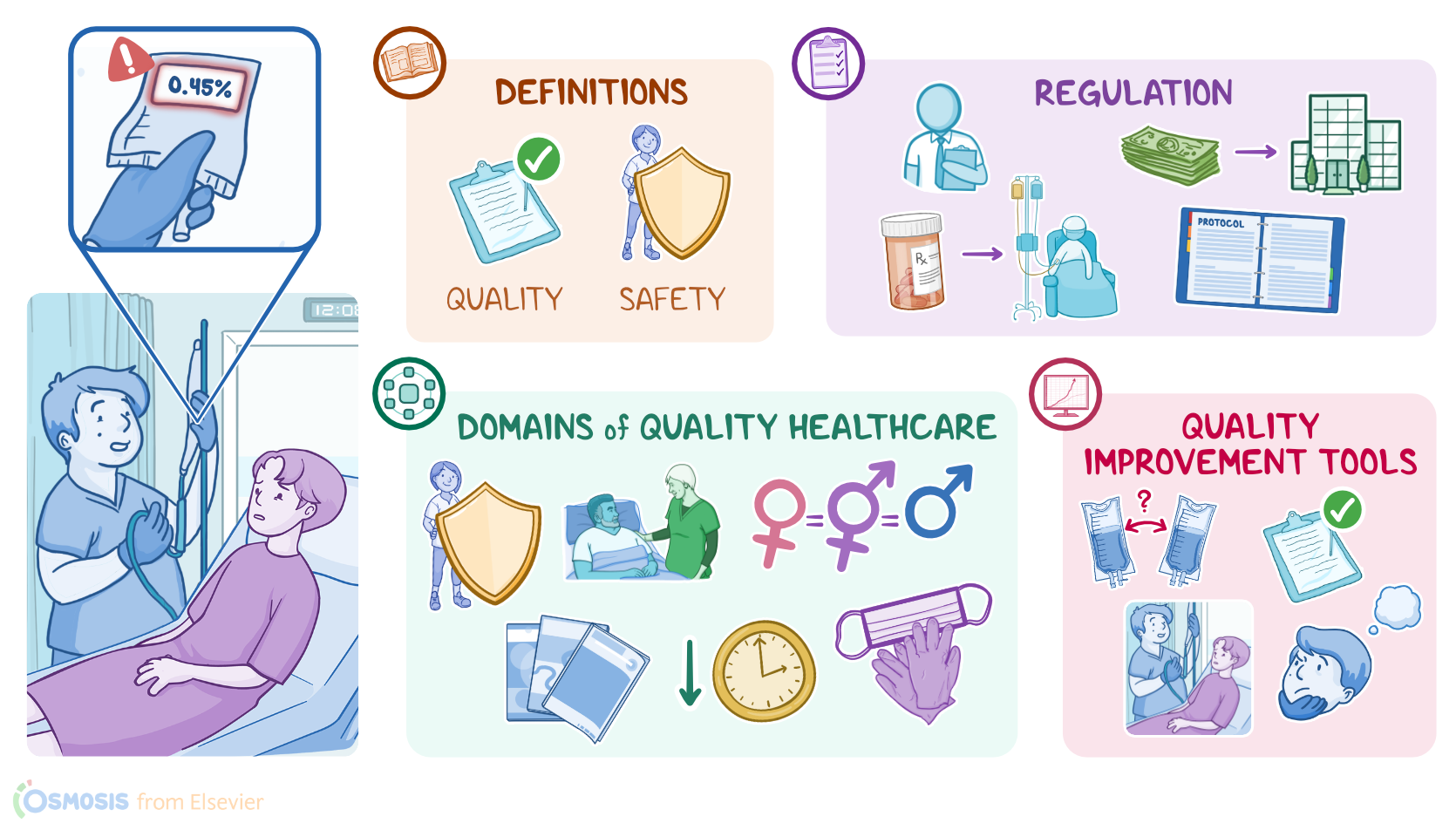
Nurse Kendra works in the pediatric intensive care unit and is caring for Jonah who is being treated for cellulitis. While preparing to administer Jonah’s medications, Nurse Kendra accidentally reconstitutes the prescribed antibiotic with a 0.45% saline solution instead of the 0.9% normal saline as ordered.
As Nurse Kendra spikes the bag, she notices the error and returns to the medication room. Nurse Kendra knows that if she had not noticed the medication error, it could have led to serious consequences for her client.
Because of this near-miss event, Nurse Kendra decides to begin a quality improvement initiative on her unit to prevent errors like this from happening in the future.Quality and safety are closely related concepts in healthcare.
Defining Quality and Safety0:49–1:27
Quality is how well health services achieve the desired outcomes for a client or population. Safety refers to protecting clients from risk and harm while they’re receiving care.
So, safety can be considered a component of quality. When Nurse Kendra discovered the medication error, she identified a safety issue because administering the medication as she prepared it would have resulted in client harm.
If that had occurred, the quality of Jonah’s care would also be compromised since providing safe care is part of quality care.
Now, quality and safety are highly regulated and monitored within healthcare institutions. Two of the major regulatory bodies include the Centers for Medicare and Medicaid Services and The Joint Commission.
Regulation of Quality and Safety1:27–2:53
The Centers for Medicare and Medicaid Services is a national organization that collects data on quality measures, for example the percentage of their hypertension clients whose blood pressure is adequately controlled.
These data points are used to ensure that all healthcare organizations receiving Medicare and Medicaid funding are compliant with current standards when providing care.
The Joint Commission is an independent, non-profit organization that develops standards of safety as a measure of quality.
They accredit healthcare institutions like hospitals and assisted care facilities when they meet the determined standards of quality and safety.
For example, in order for an organization to earn accreditation, they must have written safety plans for the management and administration of high-risk medications, like chemotherapeutics, to reduce the risk of adverse medication events for clients and staff.Another agency that focuses on client safety is The Agency for Healthcare Research and Quality, which is a division of the Department of Health and Human Services.
They spearhead safety initiatives, provide grant funding for quality and safety research, and provide education on how to improve healthcare delivery using best practices.
Now, a framework can help institutions focus on the key factors that affect quality care. One of the most widely used quality frameworks is the six domains of quality healthcare: Safe, Effective, Client-centered, Timely, Efficient, and Equitable.
Factors that Affect Quality and Safety2:53–4:42
Safe means that we avoid harming our clients. Effective means that we only use evidence-based data when making clinical decisions.
Client-centered means that we are respectful and responsive to client needs and values and that we place the client in the center of decision-making.Timely means that we should reduce delays in care.
Efficient means we avoid waste of supplies or personnel. Lastly, equitable means that the quality of care we provide should not change because of personal characteristics of the client like age, race, gender, or socioeconomic status.In addition to the six domains, healthcare organizations use standards of care which are written value statements that define quality.
These standards help us apply larger concepts of quality and safety to everyday practice and are used to measure performance and outcomes of organizations.
Standards are usually developed from benchmarking data obtained from regulatory organizations which review the best practices from top performing organizations.
So, in Nurse Kendra’s hospital, there is a quality standard of safe medication prescribing and delivery. This standard was violated when the medication was not prepared as prescribed.As a nurse, you can contribute to your facility’s quality improvement, or QI, which is the process of identifying weak areas, and making changes to provide better care for all clients.
Quality Improvement4:42–5:18
First, it’s important to become familiar with your facility’s QI goals, and then help to identify lapses in quality and safety, like how Nurse Kendra recognized Jonah's near-miss medication error.
When you identify areas that require change, you can become an advocate for quality care and you can work with other members of the healthcare team to bring about change.
One tool that you can use to improve quality and safety is a communication tool called SBAR. SBAR stands for Situation, Background, Assessment, and Recommendation.
Quality Improvement Tools5:18–8:13
This tool is very effective in improving and standardizing communication between members of the healthcare team and its use is strongly associated with improved clinical outcomes.
Using SBAR, client information is presented in a step-by-step approach starting with the Situation, or what went wrong; Background, or what lead to the current situation; Assessment, which is where the nurse will state their impression of the situation; and Recommendation, where the nurse provides a potential solution to improve or correct the problem.
Now, back to Nurse Kendra, who reports the near-miss to the charge nurse. Nurse Kendra uses the SBAR model to present the situation.
The situation is that the client, Jonah, was involved in a near-miss when the medication ordered was not prepared correctly.
The background is that Jonah is a pediatric client being treated for cellulitis on the unit. Nurse Kendra assessed there was a potential issue with how the solutions are stored in the medication room that contributed to the near miss.
And she recommends a quality improvement project that involves identifying ways to prevent this type of medication error, including separating the solutions for medication reconstitution into distinct storage cabinets.Another tool that can be helpful when making a practice change to improve quality and safety is the PDSA improvement model for testing the change.
PDSA is an acronym that stands for: Plan, for making a plan for change; Do, for carrying out the plan; Study, for observing the outcomes of the plan and; Act, for figuring out what additional changes need to be made to improve its effectiveness.
Nurse Kendra, along with her charge nurse, use PDSA to help improve quality and safety related to the IV solutions. The plan is to store these IV solutions in two separate cabinets instead of all together.
They do this by reorganizing the IV solution storage so that the different solutions are stored in separate cabinets and they are distinctly labeled with bright colors.
After a month, Nurse Kendra studies the unit data on medication error and notes a significant reduction in medication errors during the day shift but notes there are still night-shift errors occurring so, Kendra acts by implementing a secondary safety measure of having a second nurse cross-check any IV medication before it is administered.
This results in consistent reduction of errors and therefore, increased client safety. Increased safety meets the institutional standard of safe medication prescribing and delivery and so, Nurse Kendra has been successful in improving the quality of delivered care.Alright, as a quick recap… Quality and safety are vital components to providing excellent client care.
Review8:13–9:26
Quality refers to the pursuit of excellence of healthcare delivery or, how well health services achieve the desired outcomes for a client or population.
Safety aims to prevent errors and harm to clients when they are receiving care. The Centers for Medicare and Medicaid Services, The Joint Commission, and The Agency for Healthcare Research and Quality are regulatory bodies concerned with quality and safety in healthcare.
Facilities can use frameworks to guide implementation of quality care. One of the more commonly used ones is the “six domains of healthcare quality” which includes Safe, Effective, Client-centered, Timely, Efficient, and Equitable care.
Quality improvement, or QI, is the process of identifying weakness and implementing practice changes to improve and standardize the delivery of care.
Nurses can contribute to client safety and quality by becoming familiar with their institution’s QI goals and current initiatives.
Communication tools, like SBAR, have been shown to enhance the success of quality improvement initiatives within healthcare while models of change, like PDSA, can be helpful to structure a
| QUALITY AND SAFETY | ||
| KEY POINTS | NOTES | |
| INTRODUCTION |
| |
| DEFINITIONS |
| |
| REGULATION |
| |
| DOMAINS OF QUALITY HEALTHCARE |
| |
| STANDARDS OF CARE |
| |
| NURSING IMPLICATIONS |
| |
| QI TOOLS |
| |
No notes for this video yet
Try adding a note below