Research - Data analysis: Nursing
Introduction0:00–0:59
She said, “I’ve noticed that sometimes the nurses at our urgent care forget to introduce themselves when going into a client’s room.
I find myself forgetting to do this too, I wish there was something that would remind us to do it more consistently.” After speaking to several other nurses, Nurse Luis decided to do a research study focused on the use of pop-up reminders for nurses to introduce themselves each time they access a client’s electronic health record.
Now it is time for Nurse Luis to analyze all the data he’s collected. Data analysis is the systematic process of applying different techniques to describe and evaluate information that the researcher has collected.
Defining Data Analysis0:59–1:25
Data analysis can be one of the most exciting steps of the research process since the researcher is finally able to find answers to their research question!
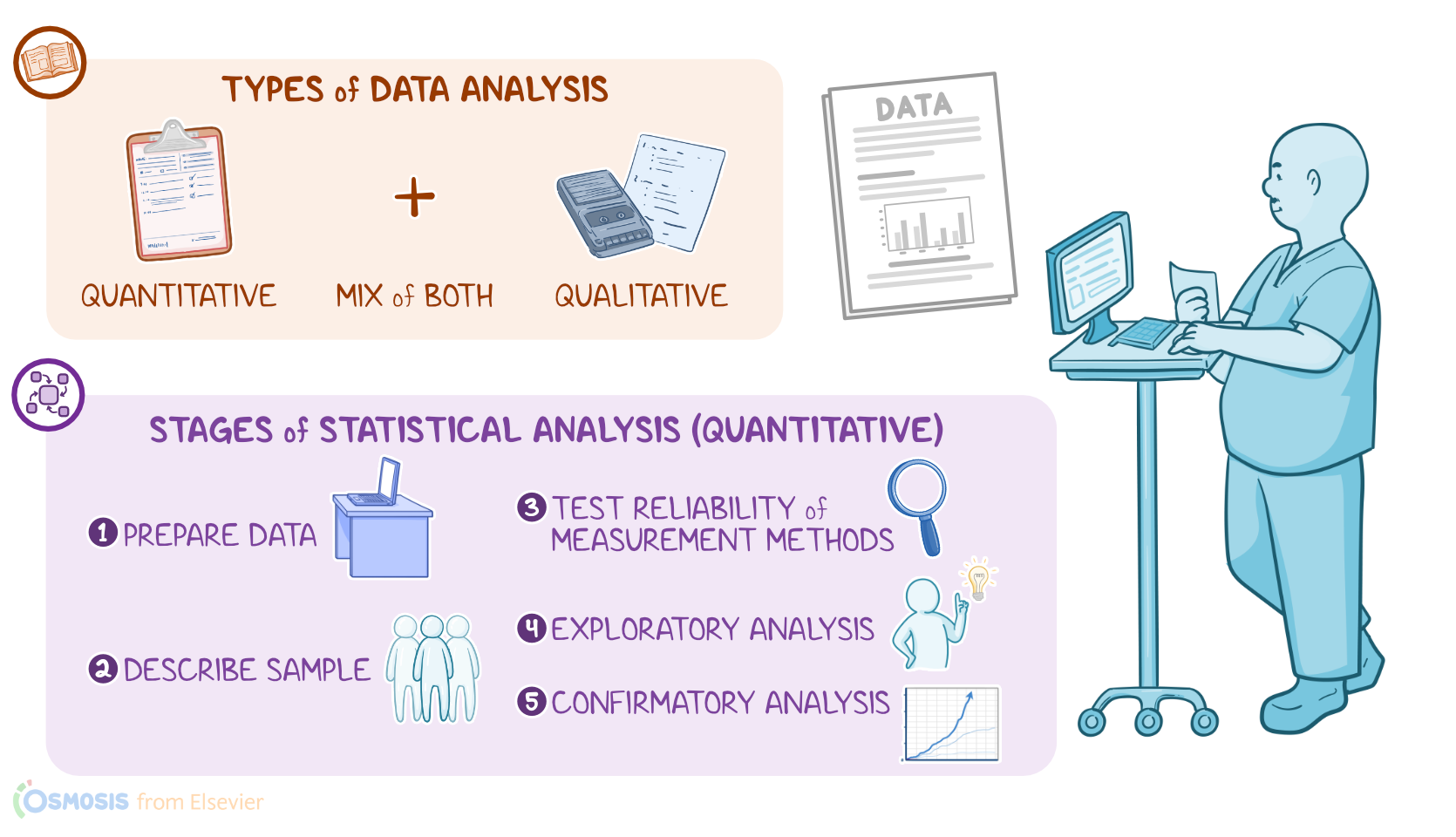
Whether your study is quantitative, qualitative, or a mixture of both, you will use data analysis techniques to understand the findings.
All right, there are different ways to analyze data, depending on the type of data that was collected. Quantitative research analyzes numerical data through descriptive and inferential statistics.
Types of Data Analysis in Research1:25–2:57
Descriptive statistics allow researchers to describe, organize, and summarize characteristics of data. For example, Nurse Luis included descriptive statistics about the number of years the participants in his study have been a nurse, and this could help bring more insight into the study findings.
On the other hand, inferential statistics allow researchers to draw conclusions and generalize findings. In this case, Nurse Luis was able to show the success of the pop-up reminder by comparing the survey results from clients whose nurse had the pop-up reminder enabled, to clients whose nurse did not.
Changing gears, data analysis for qualitative research tends to be more subjective, consisting of narrative information rather than numerical data.
Qualitative data includes interview transcripts, observation notes, diary entries, nursing records, and audio or video recordings.
When you analyze qualitative data, the focus is on exploring participants' values, beliefs, and experiences. To do this, the researcher begins by performing data coding where they look for narrative patterns throughout the data and categorizing them into groups.
For example, Nurse Luis noticed that many participants made comments like “I don’t have time to introduce myself” and “I have too much work to do,” so he decided to code all similar comments as “workload issues”.
Okay, so one strategy commonly used to analyze quantitative data is through statistical analysis, which helps to give meaning to numerical data.
Stages of Statistical Analysis2:57–5:02
There are stages of statistical analysis that should be followed. These stages are: preparing the data for analysis, describing the sample, testing the reliability of measurement methods, completing exploratory analysis of the data, and completing confirmatory analysis of the data.
This includes entering the data into a computerized statistical management system and checking for any errors. Next comes describing the sample.
During this stage, Nurse Luis compiles the age, gender, ethnic and racial characteristics, and years of nursing experience of the participants, providing a description of the sample.
These are the descriptive statistics. Testing the reliability of the measurement methods comes next.
This is where Nurse Luis will use statistical tests to establish the reliability of the client survey tool to ensure it measures the client responses consistently.
Next, Nurse Luis performs an exploratory analysis of the data, where he conducts additional statistical tests to learn more about the data, such as identifying outliers, or extreme values that could skew the data, and he determines how to deal with them.
In this case, Nurse Luis identifies one participant as an outlier; a nurse who introduces themselves 10% of the time where the average introduction rate is 70%.
Lastly, Nurse Luis performs a confirmatory analysis, which involves using statistical software to answer the research question.
Applying Data Analysis to Nursing Research5:02–6:08
Nurse Luis uses descriptive statistics to summarize the participant characteristics and finds that the mean age is 37 years, 71% of participants are female, and 52% report being mixed race.
He also finds that the average nursing experience is 6.5 years. Then, he uses inferential statistics to establish that the pop-up reminder had a significant impact in nurses introducing themselves when entering the client's room.
His qualitative data analysis also supported the use of the pop-up reminders with the participants reporting positive nurse-client interactions following proper nursing introductions.
After completing data analysis, Nurse Luis presents his findings at a local nursing conference and goes on to publish a manuscript highlighting the results of his study.
All right, as a quick recap… Data analysis is the systematic process of applying different techniques to describe and evaluate information that the researcher has collected.
Summary6:08–7:00
Whether you are using a quantitative, qualitative, or mixed-methods research design, there are types of data analysis techniques associated with each.
When conducting quantitative research, there are two types of statistics analyzed: inferential and descriptive. There are also stages of statistical analysis which are preparing the data for analysis, description of the sample, testing the reliability of measurement methods, exploratory analysis of the data, and confirmatory analysis.
In qualitative research, analysis is completed using data coding and saturation. In nursing research, data analysis is crucial to drawing conclusions that extend beyond the study’s data to guide practice
| RESEARCH - DATA ANALYSIS | ||
| KEY POINTS | NOTES | |
| INTRODUCTION |
| |
| DEFINITION |
| |
| TYPES OF DATA ANALYSIS |
| |
| STAGES OF STATISTICAL ANALYSIS |
| |
| APPLICATION TO NURSING RESEARCH |
| |
No notes for this video yet
Try adding a note below