Types of leadership: Nursing
Introduction0:00–0:45
She speaks to the unit manager and says, “I’d like to create a Bedside Reporting Team made up of other nurses on the unit to help solve the change-of-shift reporting issue we are experiencing.” Nurse Natasha will use what she has learned about types of leadership to determine how to lead this new team.
What is leadership?0:45–2:07
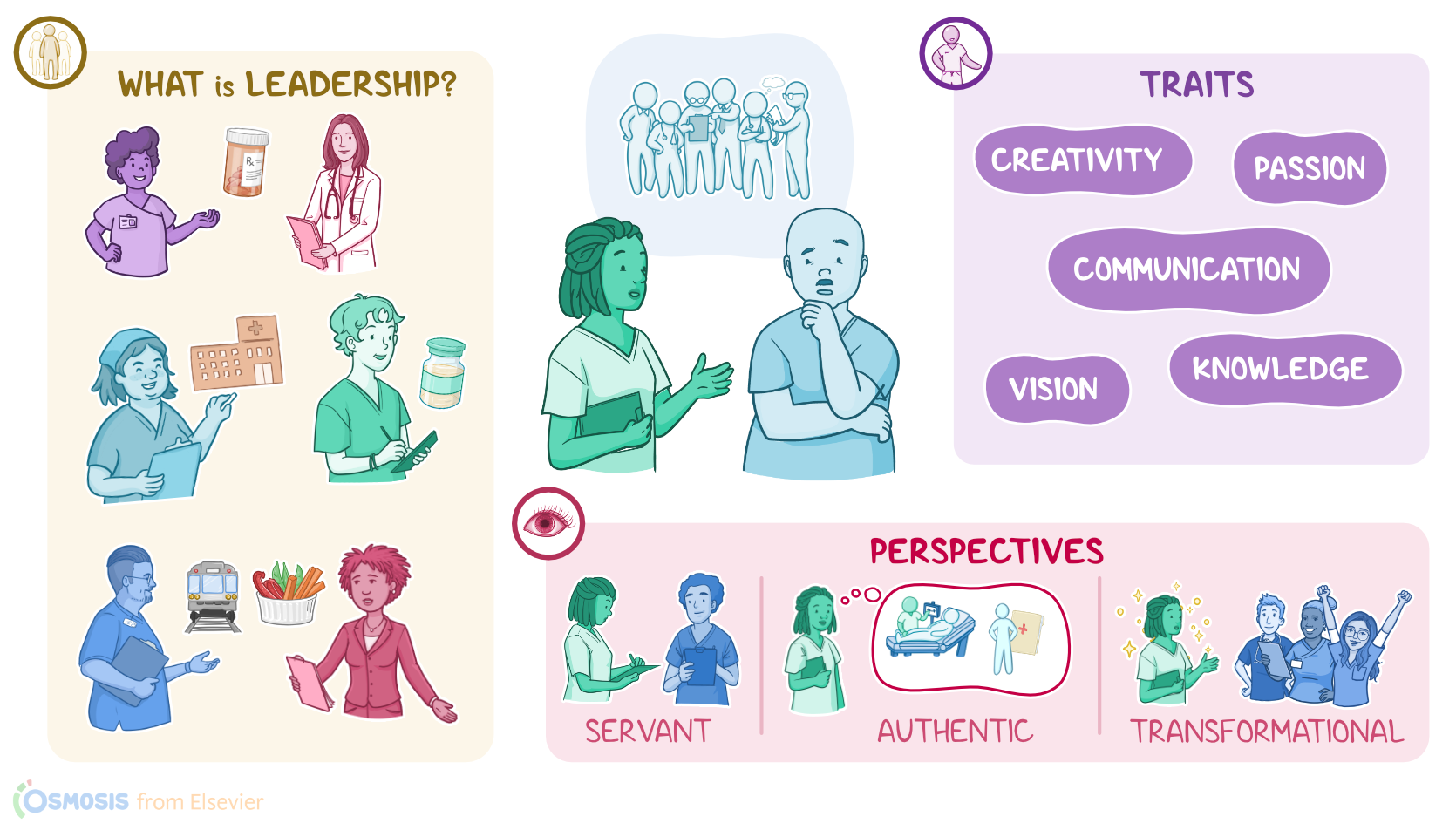
A leader influences a person or group of people to change behavior or actions in order to accomplish a goal. Leadership comes from a desire to make things better, bring people or groups together, improve communication, and work to achieve goals.
A manager, on the other hand, is a particular kind of leader that concentrates on achieving the goals of an organization like decreasing costs or improving employee satisfaction.
A manager is often placed in a position of authority within an organization. Therefore, a manager may act as a leader but a leader does not necessarily have to be a manager.
Leaders who are not in an official position of authority are called ‘informal leaders’. In nursing, leadership is crucial for solving problems, providing safe, effective, and cost-effective client care, and for promoting the health of clients and communities.
In fact, every nurse can serve as a leader. Just a few examples of nurse leaders include a nurse practitioner coordinating with a pharmacist to avoid drug interactions for a client, a nurse manager enforcing safe staffing ratios for a hospital unit, a community health nurse speaking to policy-makers to lobby for better access to public transportation and healthy food in the community, and a clinical nurse advocating for better pain management for a client.
Now, leadership can be categorized into traits, styles, and perspectives and it is helpful to understand these categories to help decide the type of leader you are or want to become.
Types of leadership: Traits, styles and perspectives2:07–7:07
Leadership traits are characteristics that can either come naturally to you or can work to develop over time to be an effective leader.
Some traits that are important to leadership include passion, creativity, confidence, vision, trust, knowledge, communication, and courage.
Some common leadership styles include authoritarian, democratic, and laissez-faire which can be considered to be on a continuum from least to most freedom for followers.The first leadership style is authoritarian leadership and gives the least amount of freedom to followers.
An authoritarian leader directs the behavior of the followers with decisions made solely by the leader. This type of leadership works well when decisions need to be made quickly, like in an emergency or code situation.
However, it can cause hostility in the followers and make them dependent on the leader. So, if Nurse Natasha decides to use an authoritarian leadership style, she will come up with a plan without the input from her team and direct the Bedside Reporting Team to observe their colleagues during shift changes and report the nurses who are not following the policy to the unit manager.
Next is democratic leadership. A democratic leader uses group discussion and decision making to come to a consensus.
This style of leadership helps the followers to feel valued and more accepting of changes. A disadvantage, however, is that decisions can be slow as finding a consensus can be difficult.
Also, some minority groups may be underrepresented and their thoughts and opinions not as easily heard. For Nurse Natasha, if she uses a democratic leadership style, she can provide direction to the Bedside Reporting Team by asking them to brainstorm ideas on how to get their colleagues to do their change-of-shift reports at the bedside.
The team can then discuss the potential advantages and disadvantages of each idea, with input from Natasha, and vote on the best one.Lastly, laissez-faire leadership gives the most freedom to followers.
In fact, a laissez-faire leader gives total freedom to the group to make decisions and has minimal participation. This leadership style can be useful for groups that are highly self-directed but there is a risk that a clear decision may never be made.
There are also some leadership perspectives that can help guide you to become an effective leader like servant leadership, authentic leadership, and transformational leadership.
In servant leadership, the leader puts the needs of others first which helps to promote personal growth of the group members.
So, if Nurse Natasha adopts a servant leadership perspective, she may encourage one Bedside Reporting Team member to include this experience in their admission essay for an Advanced Practice Nursing program, and she may assist another team member in collecting data to help publish the project as a quality improvement initiative report.
In authentic leadership, on the other hand, the leader has a thorough understanding of their own beliefs and makes decisions based upon values.
Doing change-of-shift reporting at the bedside gives clients improved access to their health information and, therefore, increases their autonomy.
Finally, in transformational leadership, the leader motivates the followers by using charisma, excitement, and empowerment.
This excitement leads to greater motivation from the team members to accomplish the goal of greater compliance with change-of-shift reports being done at the bedside.Each type of leadership has advantages and disadvantages and one is not necessarily better than the other.
Rather than selecting one leadership type, you may find that it is most effective to use a mixture of leadership traits, styles, and perspectives to accomplish a goal.
You should be flexible in your leadership style and decide how you can most effectively act as a leader, taking into consideration the situation as well as the people you are leading.
Alright, as a quick recap…. A leader influences a person or group of people to change behavior or actions in order to accomplish a goal.
Summary7:07–8:09
This is different from a manager who concentrates on achieving the goals of an organization. Leadership in nursing helps to solve problems and provide the best care to clients and communities and every nurse can be a leader.
There are different types of leadership that each nurse leader should consider. Leadership traits, like passion, vision, and courage, are characteristics that people are born with or can develop to be an effective leader.
Leadership styles are tasks and behaviors that a leader can use to accomplish goals. Going from least to most freedom of followers, these styles are authoritarian, democratic, and laissez-faire.
There are also perspectives that help to guide leaders. These perspectives include servant leadership, authentic leadership, and transformational leadership.
It is most important for a nurse to be flexible in their leadership and take into consideration the situation as well as the followers when
| TYPES OF LEADERSHIP | ||
| KEY POINTS | NOTES | |
| INTRODUCTION |
| |
| DEFINITION |
| |
| TYPES OF LEADERSHIP |
| |
No notes for this video yet
Try adding a note below