Workplace violence: Nursing
Introduction0:00–0:22
Workplace violence is an undesired consequence that can sometimes occur when working with people in stressful situations such as in healthcare settings.
Workplace violence can range from threats, harassment, intimidation, and verbal abuse to physical assaults that could even result in homicide.
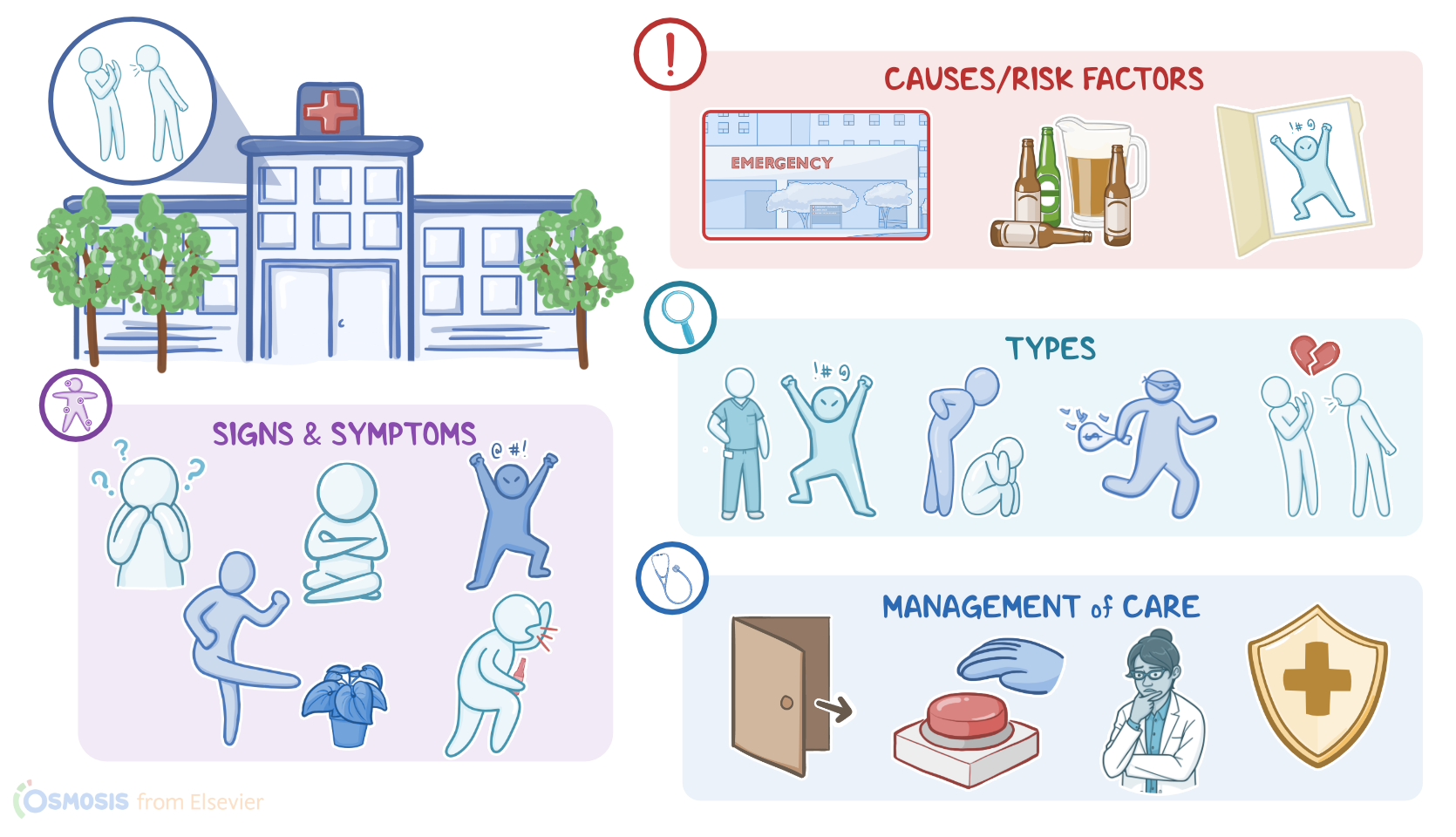
Now, there are four major types of violence that nurses might face in their work environment. The most common type is violence that’s perpetrated by a client that’s receiving care from the nurse.
Types of workplace violence0:22–1:18
This can also include family members or friends of the client the nurse is interacting with. Then there’s worker-on-worker violence, also known as bullying or lateral violence, where the perpetrator and the nurse work together.
There is also violence that can occur from personal relationships, where the nurse has an existing exterior relationship with the perpetrator.
This could include acts of domestic or intimate partner violence that are committed in the healthcare setting. Finally, there’s violence that’s associated with criminal intent.
This is where the violence is carried out during the commission of a crime in the healthcare setting, which can include, trespassing, robberies, active shooters, and terrorism.Now, violent behavior can occur anywhere on a hospital, but there are some high-risk areas, such as psychiatric units and the emergency department.
Risk factors for workplace violence1:18–2:43
Other risk factors that can lead to violence include working with individuals under the influence of drugs or alcohol, or who have a history of violence or certain psychiatric disorders.
The risk is also greater when working alone or when the unit is understaffed. The environment of the workplace can also result in some violent behaviors.
This includes poor environmental design, lack of security, long wait times, and uncomfortable waiting rooms. Other risk factors include, lack of staff training on personal safety and de-escalation techniques, lack of institutional violence prevention programs or policies, as well as access to firearms and other weapons, unrestricted movement of the public and poorly funded mental health and social services in the community.
Finally, nurses who work in highly stressful and violence-prone areas can become desensitized to verbal and other forms of aggression.
Clinical manifestations2:43–3:34
Okay, there are some clinical manifestations that can predict imminent violence, including confusion, or not being oriented to person, place, or time; irritability, where the person is easily annoyed or angered; and loud, boisterous behavior, which can include yelling or slamming doors.
These may be accompanied by threatening behaviors, such as verbal threats, which are aggressive verbal outbursts that can include verbal attacks or name-calling aimed at intimidating others; attacks on objects, including banging, kicking, or smashing objects; and physical threats, such as taking an aggressive stance or making a fist.
Now, when 2 or more of these are present, the risk of violence is high, and measures should be taken to de-escalate the situation and prevent violence.Okay, the priority nursing goal in potentially violent situations is to promote safety.
Management and care3:34–5:50
Now, if your client is irritable, confused, and showing signs of threatening behaviors, your first priority is to ensure the safety of yourself, the client, visitors, as well as other members of the healthcare team.
First, assess your environment, making note of any exits, as well as the location of any panic buttons or alarms that call for assistance.
Also, ensure that you are not standing directly in front of the door, but rather off to the side, to prevent blocking anyone from exiting the room.
Next, encourage your client to have a seat, and sit down at least one arm’s length away from them. Then, attempt verbal de-escalation techniques.
Speak to your client with a soft, nonjudgmental tone, use empathetic statements, and provide feedback on what you are observing, such as “You seem to be very upset,” or “You seem to be in pain and confused; let me help you try to figure this out.” These statements reinforce a safe environment, allows them to express their feelings, and can lead to de-escalation of the situation.
Now, if your client continues to show signs of aggression, assess whether the client’s behavior is an immediate danger to self or others.
If you observe that there is immediate danger, immediately call for assistance or remove yourself from the situation. Once supportive staff arrives to assist, be prepared to continue with de-escalation techniques, administer prescribed psychotropic medications or assist with other forms of physical restraints to prevent harm.
Keep in mind, prescribed medications and physical restraints should only be used if a client poses an immediate danger to themselves or others, and as a last resort when all other de-escalation techniques have been attempted.
Once the event has resolved, be sure to document what occurred, review the incident with the healthcare team as part of the organization’s violence prevention program, and participate in post-event support for staff involved in the incident.All right, as a quick recap… Workplace violence can range from threats, harassment, intimidation, and verbal abuse to physical assaults that could even result in homicide.
Review5:50–7:30
There are four major types of workplace violence, including violence that’s perpetrated by a client or a client’s family member; worker-on-worker violence; violence that can occur from personal relationships with individuals not associated with the healthcare setting; and violence associated with criminal intent.
Risk factors for workplace violence are working in a high-risk area, such as psychiatric units or the emergency department.
Other risk factors include working with individuals under the influence of drugs or alcohol, or with those who have a history of violence or certain psychiatric disorders; as well as working alone or when the unit is understaffed.
Environmental risk factors include lack of security, long wait times, and uncomfortable waiting rooms. The risk of workplace violence can be increased by lack of staff training on personal safety and de-escalation techniques, lack of institutional violence prevention programs or policies, access to firearms and other weapons, as well as unrestricted movement of the public and poorly funded mental health and social services in the community.
Clinical manifestations that can predict imminent violence, include confusion, irritability, and boisterous behavior, which can lead to verbal threats, attacks on objects, and physical threats.
Finally, the priority nursing goal in potentially violent situations is
| WORKPLACE VIOLENCE | ||
| KEY POINTS | NOTES | |
| DEFINITION |
| |
| TYPES OF WORKPLACE VIOLENCE |
| |
| RISK FACTORS |
| |
| SIGNS AND SYMPTOMS |
| |
| MANAGEMENT OF CARE |
| |
No notes for this video yet
Try adding a note below