Hygiene - Ostomy care: Nursing skills
An ostomy is a surgically created connection between an internal organ and the outside of the body. When an ostomy is created within the abdominal wall, a piece of intestine is brought through the opening, and the part of the intestine that’s seen on the abdomen’s surface is called a stoma.
The stoma is connected to a pouching system, also called an appliance, that’s composed of a skin barrier or adhesive wafer that attaches to the skin, and a pouch where stool and flatus collect. These ostomies can be permanent or temporary and can be necessary because of conditions like an intestinal tumor, bowel trauma, or inflammatory bowel disease; or to allow the bowel to rest and heal after surgery.
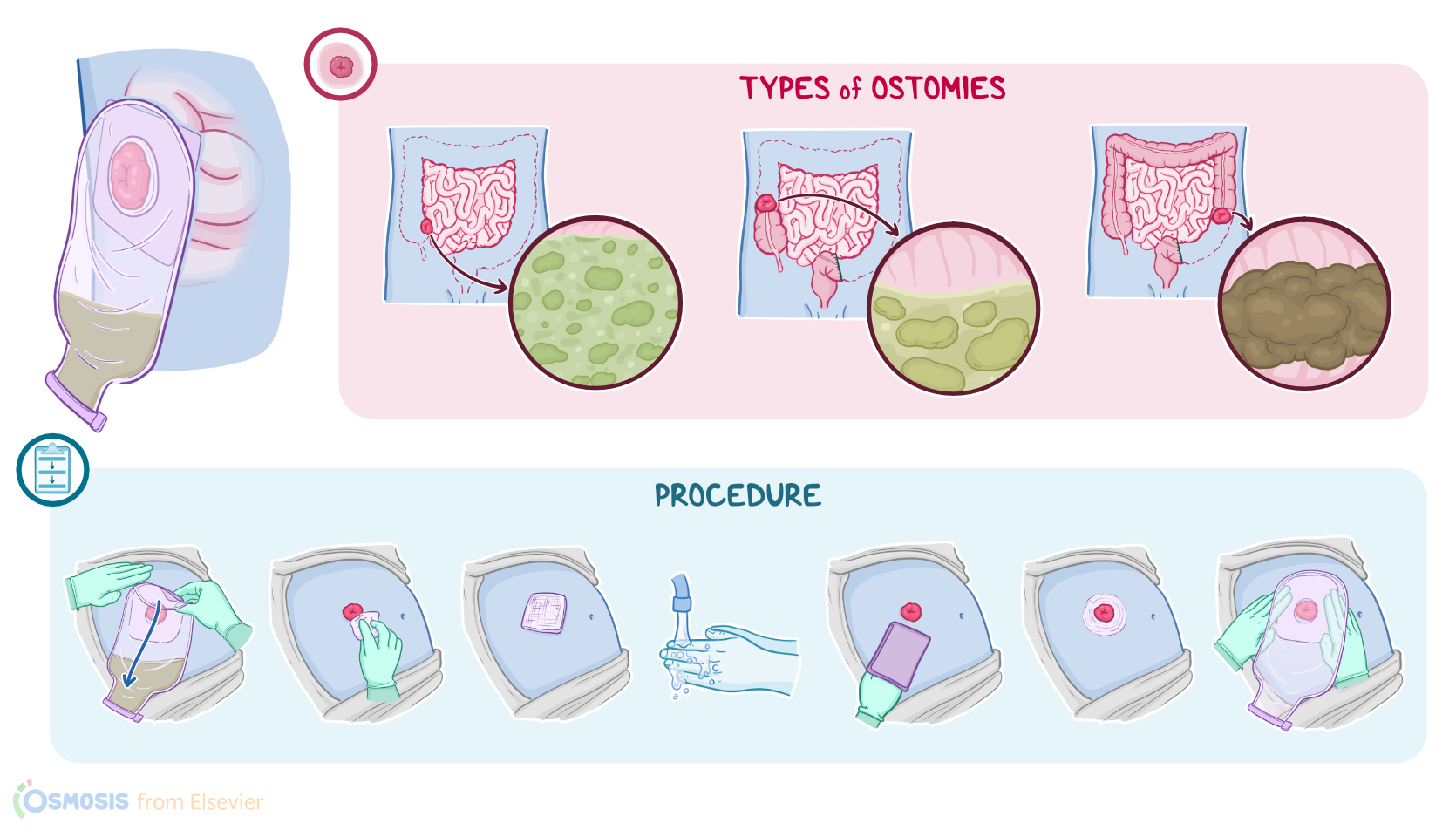
Now, an ostomy can be either an ileostomy or a colostomy depending on its location within the intestines. An ileostomy involves part of the small intestine, called the ileum; whereas a colostomy involves the part of the large intestine, or colon.
Keep in mind that normally, in the small intestine, the stool is mostly liquid because the majority of water is normally reabsorbed in the large intestine.
So, with an ileostomy, the stool is usually semi-liquid, and it flows at a fairly constant rate.
On the other hand, with a colostomy, the stool will have a different consistency depending on its location within the colon. So, if the colostomy is located near the beginning of the colon, like in the ascending colon, the stool is typically watery and loose; while if the colostomy is located near the end of the colon, like in the descending colon, the stool will be more solid.
Okay, let’s move on and discuss the types of pouching systems. There are drainable, or open-ended pouches, which are sealed with a clip or Velcro-type system at the bottom so they can be drained and reused. Then there are closed-ended, or disposable pouches which can be removed and replaced when full. Additionally, some pouching systems have pre-cut skin barriers, so they come in different sizes to match various stoma sizes. For other types, you’ll need to cut out the opening yourself.
Another variation refers to whether or not a skin barrier is attached to the pouch. If it is, it’s a one-piece; if not, it’s a two-piece.
| HYGIENE - OSTOMY CARE | ||
| KEY POINTS | NOTES | |
| DEFINITION |
| |
| TYPES OF OSTOMIES |
| |
| TYPES OF OSTOMY POUCHING SYSTEMS |
| |
| COMMON CARE TIPS |
| |
| OSTOMY CARE PROCEDURE |
| |
| CLINICAL IMPLICATIONS |
| |
- "Fundamentals of nursing (11th ed.). ISBN: 9780323749619 " Elsevier (2025)
- "Clinical nursing skills & techniques (11th ed.). ISBN 978-0-443-10718-4 " Elsevier (2025)
Aún no hay notas para este video
Intenta agregar una nota a continuación