Incident reports: Nursing
Revisores de contenido
Nurse Kevin has just started his lunch time rounds on the unit. As he approaches room 3B, he’s shocked to see his client, Mrs. Baron, laying on the floor. Nurse Kevin moves quickly to reach Mrs. Baron, and immediately assesses the situation.
“Mrs. Baron, are you alright?”. “Oh, I’m just fine”, she says, “I fell out of bed trying to reach my meal tray.” After ensuring Mrs. Baron’s safety and collecting information from her about what happened, it’s time for Nurse Kevin to complete an incident report:
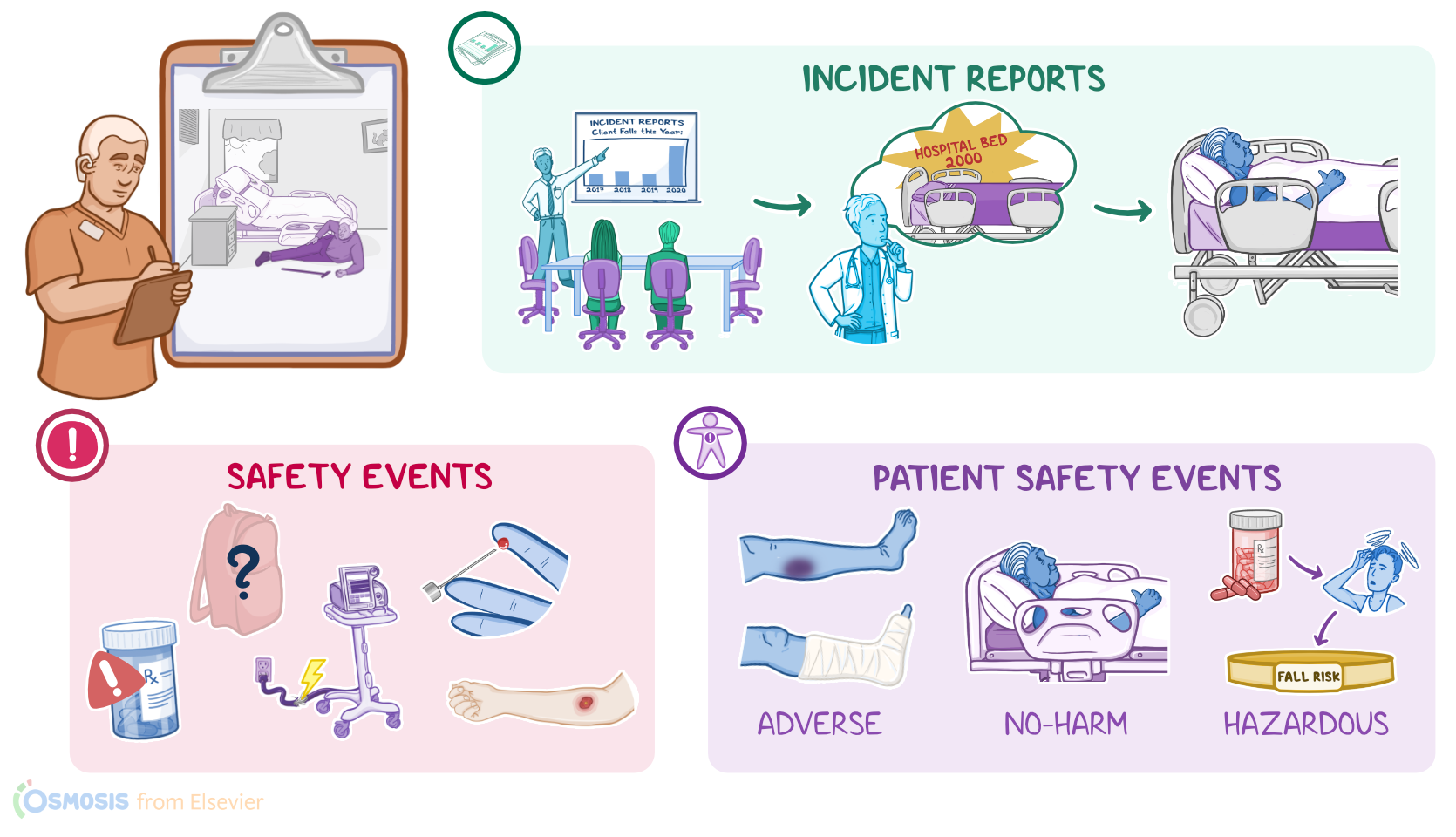
Incident reports, or sometimes called incident reporting, unusual occurrence report, or variance report; is a commonly used term to describe safety event reporting. A safety event can occur when evidenced-based best practice isn’t followed, resulting in harm or potential harm to a client.
Some examples of safety events include accidental needlesticks, falls, medication errors which are the number one cause of incidents, defective systems or equipment failure, missing client belongings and hospital acquired infections. Usually, an incident report is generated from the healthcare worker, like a Nurse Kevin for example, that was either involved in the incident or witnessed it.
Now, incident reports are an important safety communication tool, and the ultimate goal of this type of reporting is to provide risk management and healthcare administration with information that can help them identify areas that are most prone to error.
For example, if a risk manager recognizes there’s an increase of reports about clients falling out of bed, this can indicate problems with things like bed safety, client monitoring, or the call light system.
With the data collected, risk managers, hospital administration and staff can further research the events and help develop best practices to prevent those events from occurring in the future.
While many facilities encourage and support the reporting of incidents, it’s essential that they also have a solid plan in place for following up on the report, developing solutions, and implementing those actions.
Incident reports are frequently used to document Patient Safety Events. A patient safety event can be an incident, or in some cases a condition, that could result or did result in harm to a client.
For example, failure to maintain the side rails in an upright position for a client who is at risk for falls is a safety event that could result in harm. If the client actually does fall out of bed and is injured as a result of the side rails not being in the upright position, then this incident did result in harm to the client.
The three main types of Patient safety events include adverse events, no-harm events, and hazardous conditions.
| INCIDENT REPORTS | ||
| KEY POINTS | NOTES | |
| DEFINITION |
| |
| INCIDENT REPORTS |
| |
| PATIENT SAFETY EVENTS |
| |
| COMPLETING AN INCIDENT REPORT |
| |
| BARRIERS TO INCIDENT REPORTS |
| |
Aún no hay notas para este video
Intenta agregar una nota a continuación