Osmosis video - Empirical formulas
00:00 / 00:00
Video Summary of Empirical formulas
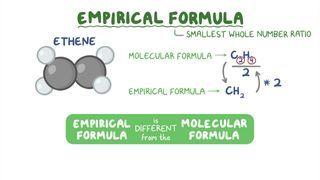
An empirical formula is a specific type of chemical formula that specifies the ratios of the atoms of each element in a compound. It is obtained by measuring the relative masses of the atoms present in a molecule and dividing them by the number of atoms of each element. The subscripts in an empirical formula indicate the number of atoms of each element in a molecule, not their relative masses.
For example, if carbon dioxide is analyzed and found to have one carbon atom for every two oxygen atoms, then the empirical formula for carbon dioxide would be CO2 . If it were found to have one carbon atom for every four oxygen atoms, then the empirical formula would be C2O4. In both cases, there are twice as many oxygen atoms as carbon atoms.