Osmosis video - Neonatal jaundice: Clinical
00:00 / 00:00
Video Summary of Neonatal jaundice: Clinical
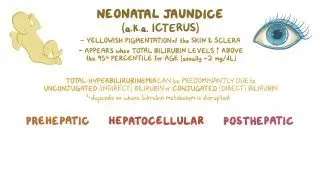
Neonatal jaundice, also called icterus, is the yellowish pigmentation of the skin and sclera that appears in newborns, when total bilirubin levels rise above the 95th percentile for age, which is usually around 2 mg/dL. Bilirubin is produced when the body breaks down red blood cells, and it is normally excreted from the body through the liver and the intestine.
Neonatal jaundice can occur when the liver is not fully developed and is not able to effectively remove bilirubin from the blood. Jaundice can also occur if the baby has an excess of red blood cells that need to be broken down, or if there is a problem with the baby's red blood cells that makes them more prone to breakdown.
Symptoms of neonatal jaundice may include yellowing of the skin and whites of the eyes, dark urine, and light stools. The severity of jaundice can vary depending on the underlying cause and the level of bilirubin in the blood. Treatment for neonatal jaundice may include phototherapy and, in severe cases, exchange transfusion may be needed.