Osmosis video - Plasma cell disorders: Clinical
Learn deeper with Osmosis
Master this topic faster with videos, questions, and AI.
Used by 8M+ healthcare learners.
No credit card · Cancel anytime
00:00 / 00:00
Video Summary of Plasma cell disorders: Clinical
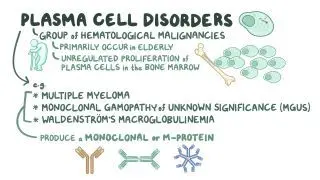
Plasma cell disorders are a group of hematological malignancies that primarily occur in the elderly, and are characterized by unregulated proliferation of plasma cells in the bone marrow. These disorders can include multiple myeloma, which usually makes IgG, monoclonal gammopathy of undetermined significance, or MGUS, which also usually makes IgG, and Waldenström’s macroglobulinemia, which usually makes IgM.
Multiple myeloma patients present with hypercalcemia, renal disease, anemia, and bone pain. A skeletal survey in multiple myeloma shows lytic bone lesions, and a bone marrow biopsy reveals more than 10% plasma cells. MGUS, on the other hand, is usually asymptomatic, has no bone lesions, and a bone marrow biopsy shows less than 10% plasma cells. In waldenström’s macroglobulinemia, patients can develop hyperviscosity syndrome and autoimmune hemolytic anemia. Treatment options for plasma cell disorders include chemotherapy, radiation therapy, and stem cell transplantation.