Osmosis video - Reading a chest X-ray
Learn deeper with Osmosis
Master this topic faster with videos, questions, and AI.
Used by 8M+ healthcare learners.
No credit card · Cancel anytime
00:00 / 00:00

Video Summary of Reading a chest X-ray
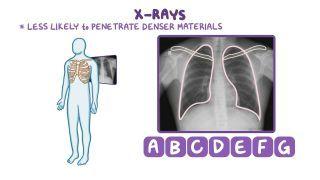
A chest X-ray is a diagnostic test that uses some amount of radiation to produce images of the structures inside the chest including the lungs, heart, and blood vessels. To read a chest X-ray, you can use an easy-to-remember checklist, which is associated with the first 7 letters of the alphabet: ABCDEFG. A is for the assessment of data and quality as well as looking for air where it should not be. B is for bones and the body wall, specifically looking for fractures, deformities, missing bones, and if any swelling, or masses are present. C is for the cardiac silhouette and its size. D is for diaphragms, which should appear fairly symmetric. E is for equipment, such as the lines, tubes, and wires involved in life support, and pleural effusion, a form of pathology commonly seen on X-rays. F is for lung fields which should look symmetric, without any haziness, white dots, or blotches. Finally, there is G, which is for great vessels including the superior and inferior vena cavas, the ascending aorta, the aortic arch, the descending aorta, and the pulmonary artery.