Osmosis video - Respiratory: Mechanical ventilation
Learn deeper with Osmosis
Master this topic faster with videos, questions, and AI.
Used by 8M+ healthcare learners.
No credit card · Cancel anytime
00:00 / 00:00
Video Summary of Respiratory: Mechanical ventilation
Mechanical ventilation, also known as artificial ventilation, is the use of machines to assist or replace the body's natural breathing process. It is used to support or maintain adequate oxygenation and carbon dioxide removal in patients who are unable to breathe adequately on their own.
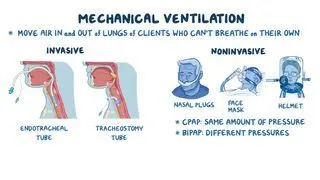
There are two kinds: invasive mechanical ventilation, and noninvasive mechanical ventilation also known as noninvasive positive pressure ventilation, abbreviated as NIPPV. Invasive mechanical ventilation involves artificial airways, including endotracheal tubes, which go through the mouth into the trachea, and tracheostomy tubes, which go through a surgically created opening on the front of the neck called a tracheotomy. NIPPV uses nasal plugs, face masks, or helmets to deliver positive pressure into the airways and force them open. It includes continuous positive airway pressure (CPAP), which delivers the same amount of pressure in both inspiration and expiration, and bilevel positive airway pressure (BiPAP), which delivers two different amounts of pressure.