Osmosis video - T-cell development
Learn deeper with Osmosis
Master this topic faster with videos, questions, and AI.
Used by 8M+ healthcare learners.
No credit card · Cancel anytime

00:00 / 00:00
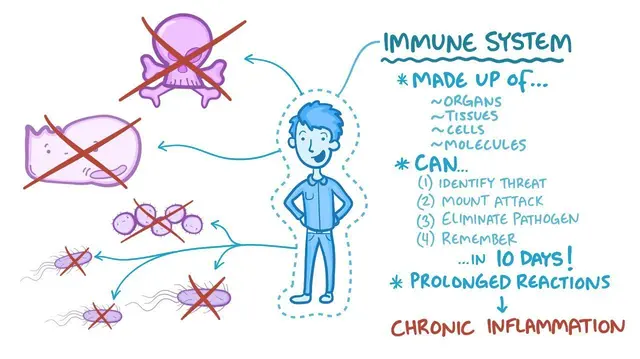
Video Summary of T-cell development
T cells, also known as T lymphocytes are a type of lymphocyte that play a central role in cell-mediated immunity. The process of T-cell development begins with the migration of immature T-cell precursors from the bone marrow to the thymus gland, where they undergo a series of steps to become fully mature T-cells. In the thymus, T-cells are exposed to a diverse array of self-antigens and undergo positive and negative selection to ensure that only T-cells that recognize foreign antigens but not self-antigens are allowed to leave the thymus and enter the bloodstream.
During positive selection, T-cells that recognize self-antigens displayed by thymic stromal cells receive survival signals, allowing them to continue their development. During negative selection, T-cells that recognize self-antigens too strongly undergo apoptosis to prevent the development of autoimmunity. Once T-cells have successfully completed positive and negative selection, they leave the thymus and enter the bloodstream, where they travel to various organs and tissues to carry out their functions.