
Arcuate Line · What Is It, Clinical Significance and More

Published: Feb 04, 2025
Author: Nikol Natalia Armata
Editor: Alyssa Haag
Editor: Józia McGowan, DO
Illustrator: Jillian Dunbar
Copyeditor: Sadia Zaman, MBBS, BSc
7-day free trial

Go deeper with Osmosis

Osmosis is a learning platform with videos, questions, and AI tools to help you master topics like this.

4.8 · 12,000+ reviews
Watch quick, visual videos
Practice with Qbank-style questions
Use AI to explain, quiz, and review
Study anytime with the mobile app
Start free trial

No credit card · Cancel anytime

What is the arcuate line?

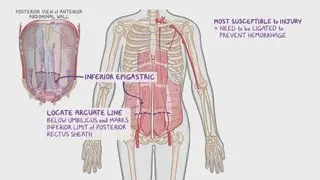
The arcuate line, also known as the semicircular line of Douglas, is a curved line found posterior to the rectus abdominis muscle bilaterally, between the umbilicus and the pubic symphysis. This anatomical finding may not always be present, and its exact position may vary.  

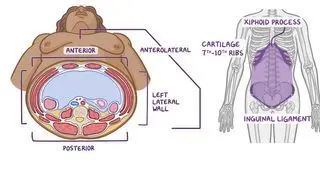
Superior to the arcuate line, the external oblique aponeurosis (i.e., a thin layer of connective tissue that covers and supports the muscle) passes anterior to the rectus abdominis muscle. The aponeurosis of the internal oblique splits to surround the rectus abdominis muscle. Additionally, posterior to the rectus abdominis muscle is the aponeurosis of the transversus abdominis muscle, as well as the transversalis fascia. All of the aforementioned aponeuroses wrap around the rectus abdominis muscle, forming the rectus sheath. At the level of and posteriorly to the arcuate line, the aponeuroses of the internal oblique and transversus abdominis pass anteriorly to the rectus abdominis muscle, instead of surrounding the muscle. Therefore, the transversalis fascia is the only structure located posteriorly. 

Learn deeper with Osmosis

Master this topic faster with videos, questions, and AI.

Used by 8M+ healthcare learners.

Start free trial

No credit card · Cancel anytime

Where is the arcuate line located?

The arcuate line is usually located at about one-third of the distance from the pubic crest to the umbilicus. However, the exact position of this line may vary; it has also been located as superior as the umbilicus, or as inferior as the public symphysis. 

What is the clinical significance of the arcuate line?

The arcuate line is an anatomical structure of great clinical significance, especially for surgeons. It may be the site of weakness in the abdominal wall through which abdominal hernias may form. For example, Spigelian hernias develop between the lateral border of the rectus abdominis muscle and the linea semicircularis (i.e., the bilateral vertical curved lines in the anterior abdominal wall where the rectus sheath layers fuse laterally to the rectus abdominis muscle). They typically protrude through the transversus abdominis aponeurosis, very close to the level of the arcuate line. Notably, individuals without the arcuate line are less likely to develop a ventral hernia

In addition, the arcuate line is the location where the inferior epigastric vessels perforate the rectus sheath, to supply blood to the inferior portion of the anterior abdominal wall.

What are the most important facts to know about the arcuate line?

The arcuate line, also known as the semicircular line of Douglas, is a curved line found posterior to the rectus abdominis muscle bilaterally, at about one-third of the distance between the umbilicus and the pubic symphysis. This anatomical finding may not always be present, and its position may vary. However, when present, the arcuate line is of great clinical significance, especially for surgeons, as Spigelian hernias usually present close to the arcuate line. Additionally, the arcuate line indicates where the inferior epigastric vessels perforate the rectus sheath. 
Students say Osmosis is 100% worth it

Because Osmosis saves them time. Lowers stress. And actually helps them remember when it counts.

I used Osmosis to prepare for my first medical school licensing exam! Super helpful and interactive for people who may not do great with just pages of text info!

Cecilia Ruiz

Cecilia Ruiz

MD student

Sayan Misra

I have used Osmosis for about four years. Best thing I have ever used for my medical studies.

Sayan Misra

Sayan Misra

Med student

Osmosis videos are superior because they define simple concepts, tell a story with a clear progression, and provide context.

Jay Pate

Jay Pate

Dental student

References


Desai, P., & Bell, D. (2021). Spigelian hernia. In Radiopaedia. Retrieved 12 Oct, 2021 from: https://radiopaedia.org/articles/5885


Hacking, C. (2021). Semilunar line. In Radiopaedia. Retrieved 12 Oct, 2021 from: https://radiopaedia.org/articles/38680


Nassereddin, A., & Sajjad, H. (2021). Anatomy, Abdomen and Pelvis, Linea Semilunaris. In: StatPearls [Internet]. Treasure Island (FL): StatPearls Publishing LLC. Retrieved 12 Oct, 2021 from: https://www.ncbi.nlm.nih.gov/books/NBK555983/


Tromp, D., & Hacking, C. Arcuate line. In Radiopaedia. Retrieved 12 Oct, 2021 from:  https://radiopaedia.org/articles/47218