
BE FAST

Stroke Symptoms Acronym

Author: Emily Miao, PharmD, MD
Editor: Alyssa Haag, MD
Editor: Józia McGowan, DO
Editor: Kelsey LaFayette, DNP, ARNP, FNP-C
Illustrator: Jannat Day
Modified: Jan 06, 2026

What is a stroke?

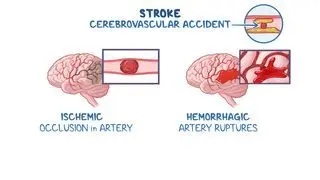
stroke is a medical emergency characterized by a sudden focal neurological deficit due to loss of blood supply in one or multiple parts of the brain. There are two major types of strokes: ischemic and hemorrhagic strokes. An ischemic stroke occurs when there is a blocked artery, thereby reducing blood flow to the brain. A hemorrhagic stroke occurs when a blood vessel in the brain ruptures, creating bleeding within the brain. Among the two types, ischemic strokes are the most common type of stroke

Risk factors for ischemic stroke include adults aged 65 or older; migraine headaches with aura; systemic disorders that predispose one to develop blood clots (e.g., malignancy, sickle cell disease); atrial fibrillation; diabetes mellitus; smoking; uncontrolled high blood pressure; individuals of African American descent; and a history of transient ischemic attacks (TIA), which are brief, temporary blockages to the brain that do not cause long term damage. Regardless of the type of stroke, the lack of a steady blood flow to the brain results in progressive neuronal cell death, and sometimes, irreversible brain damage. Therefore, it’s important to recognize the signs and symptoms of a stroke to ensure rapid diagnosis and treatment. 
An infographic detailing the symptoms of stroke in the BE FAST acronym.

What is BE FAST?

BE FAST is an acronym that highlights the main symptoms in the setting of an acute stroke and emphasizes the urgency of the situation. 

What does the “B” in BE FAST mean?

The “B” in BE FAST stands for balance, which refers to the sudden loss of balance or coordination. Loss of balance or coordination may manifest as gait imbalance or difficulty walking (e.g., abnormally swaying from side to side) and dizziness

What does the “E” in BE FAST mean?

The “E” in BE FAST stands for eyes, which refers to sudden vision changes like blurred, double, or loss of vision. Damage to the nerves that control the eyes can lead to weakness and paralysis of eye muscles. One eye may visibly droop as well.  

What does the “F” in BE FAST mean?

The “F” in BE FAST stands for facial drooping, which may be another symptom of a stroke. To assess for facial droop, one can ask the individual to smile. If one side of the face remains droopy or is numb to palpation, these may be early signs of a stroke.

What does the “A” in BE FAST mean?

The “A” in BE FAST stands refers to arm weakness or numbness on one side of the body. To assess for arm weakness, one can ask the individual to lift both arms. In the setting of a stroke, the individual may not be able to raise both arms, and the affected arm may slowly drift downward, indicative of muscle weakness 

What does the “S” in BE FAST mean?

The “S” in BE FAST stands for speech, which refers to speech difficulties including the inability to speak or speech that is difficult to understand. Individuals may also have difficulty comprehending what others around them are saying. 

What does the “T” in BE FAST mean?

The “T” in BE FAST stands for time, which serves as a reminder that if any of the BE FAST symptoms are present, it is imperative to call for help (i.e., 9-1-1 or one’s local emergency) as soon as possible! 

What are the most important facts to know about the BE FAST acronym?

stroke is a medical emergency characterized by a sudden focal neurological deficit due to a part of the brain losing its blood supply. are important and the acronym BE FAST can aid one in recognizing the major signs of stroke: balance, eye changes, facial droopingarm weakness and/or numbness, speech changes, and timely 

Key Takeaways

Definition 

BE FAST is an acronym that highlights the main symptoms in the setting of an acute stroke and emphasizes the urgency of the situation.   

Stroke 

- Sudden focal neurological deficit due to loss of blood supply in one or more regions of the brain causing progressive neuronal cell death and potentially irreversible brain damage 

- Medical emergency  

- Types:  

     - Ischemic stroke → blocked artery 

          - Most common  

          - Risk factors: 

               - Age ≥65 years 

               - Migraine headaches with aura 

               - Systemic disorders predisposing to clots 

               - Atrial fibrillation 

               - Diabetes mellitus 

               - Smoking 

               - Uncontrolled hypertension  

               - Individuals of African American descent  

               - History of transient ischemic attacks  

          - Hemorrhagic stroke → blood vessel rupture resulting in bleeding  

BE FAST 

B 

Balance 

- Sudden loss of balance or coordination 

- Gait imbalance, difficulty walking, dizziness 

E 

Eyes 

- Sudden blurred, double, loss of vision; drooping of one eye 

F 

Facial drooping 

- Ask to smile → one side of the face is droopy or numb to palpation 

A 

Arm weakness or numbness 

- Ask to lift both arms → unable to lift affected arm which may slowly drift downward  

S 

Speech 

- Inability to speak, or difficult to understand 

- Difficulties comprehending others 

T 

Time 

- If any BE FAST symptoms present, call for help as soon as possible 

References


Centers for Disease Control and Prevention. Stroke Facts. https://www.cdc.gov/stroke/facts.htm. Accessed May 7, 2024. 


Centers for Disease Control and Prevention. https://www.cdc.gov/stroke/about.htm. Accessed May 7, 2024. 
 
Fang J, Keenan NL, Ayala C, Dai S, Merritt R, Denny CH. Awareness of stroke warning symptoms—13 states and the District of Columbia, 2005MMWR2008;57(18):481–5. 


GBD 2019 Stroke Collaborators. Global, regional, and national burden of stroke and its risk factors, 1990-2019: A systematic analysis for the Global Burden of Disease Study 2019. Lancet Neurol. 2021;20(10):795-820. doi:10.1016/S1474-4422(21)00252-0  


Kremer PH, Jolink WM, Kappelle LJ, Algra A, Klijn CJ; SMART and ESPRIT Study Groups. Risk factors for lobar and non-lobar intracerebral hemorrhage in patients with vascular disease. PLoS One. 2015;10(11):e0142338. Published 2015 Nov 5. doi:10.1371/journal.pone.0142338 
 
Magid-Bernstein J, Girard R, Polster S, et al. Cerebral hemorrhage: Pathophysiology, treatment, and future directions. Circ Res. 2022;130(8):1204-1229. doi:10.1161/CIRCRESAHA.121.319949