
Brachialis · What Is It, Location, Function, and More

Published: Nov 16, 2025
Author: Georgina Tiarks, MD
Editor: Alyssa Haag, MD
Editor: Józia McGowan, DO
Editor: Kelsey LaFayette, DNP, ARNP, FNP-C
Illustrator: Jillian Dunbar
Copyeditor: David G. Walker
7-day free trial

Go deeper with Osmosis

Osmosis is a learning platform with videos, questions, and AI tools to help you master topics like this.

4.8 · 12,000+ reviews
Watch quick, visual videos
Practice with Qbank-style questions
Use AI to explain, quiz, and review
Study anytime with the mobile app
Start free trial

No credit card · Cancel anytime

What is the brachialis muscle?

The brachialis muscle is a deep muscle located in the upper limb that is mainly responsible for elbow flexion (i.e., the movement that allows the forearm to move closer to the upper body).  

In most people, the brachialis muscle is innervated medially by the musculocutaneous nerve (C5-C6) and laterally by the radial nerve (C7). Blood to the brachialis is supplied primarily by the brachial artery and branches of the radial recurrent artery. Occasionally, the ulnar collateral arteries may also provide blood to this muscle. 

Learn deeper with Osmosis

Master this topic faster with videos, questions, and AI.

Used by 8M+ healthcare learners.

Start free trial

No credit card · Cancel anytime

Where is the brachialis muscle located?

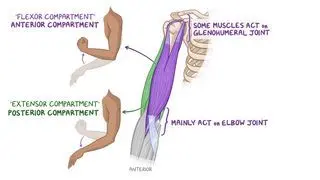
The brachialis muscle is one of the three muscles located in the anterior compartment of the upper arm, alongside the biceps brachii muscle—or simply biceps—and the coracobrachialis. The muscle fibers of the brachialis muscle join to form the brachialis tendon, which connects the brachialis muscle to the humerus at one end and the ulna at the other. Proximally, the brachialis tendon originates mid-shaft through the humerus. It then extends distally and crosses the elbow joint to attach to the coronoid process and the tuberosity of the ulna. 

What is the function of the brachialis muscle?

The main function of the brachialis muscle is flexion of the forearm at the elbow joint. Unlike the biceps, which also helps with forearm supination and shoulder flexion, the brachialis is a pure elbow flexor. This is because the brachialis inserts into the ulna, a bone that stays fixed during supination and pronation. Since its position and function don’t change with forearm rotation, the brachialis can consistently generate force regardless of the forearm position. In fact, it becomes the main elbow flexor when the forearm is pronated and at 90°, a position where the biceps loses mechanical advantage and contributes less to the movement. 

Functionally, the brachialis is most active in pulling movements like rows, hammer curls, or when picking up heavy objects with palms facing each other or down.

What are the most important facts to know about the brachialis muscle?

The brachialis muscle is an important muscle involved in the flexion of the forearm, located at the anterior compartment of the upper arm. It is located beneath the biceps brachii. It originates mid-shaft through the humerus and inserts at the coronoid process of the ulna. Innervation arises from both the musculocutaneous nerve and radial nerve, while blood may be supplied by the brachial artery or the radial recurrent artery.  

Key Takeaways

Definition 
 

The brachialis muscle is a deep muscle located in the upper limb and involved in the flexion of the forearm. 

Location 

- Anterior compartment of the upper arm 

     - Deep to the biceps brachii 

- Origin 

     - Mid-shaft of the humerus 

- Insertion 

     - Coronoid process of the ulna 

- Innervation 

     - Musculocutaneous nerve (C5-C6)  

     - Radial nerve (C7) 

- Blood supply 

     - Brachial artery 

     - Branches of radial recurrent artery 

Function 

- Flexion of the forearm at the elbow joint 

     - At multiple angles, regardless of forearm pronation 

Students say Osmosis is 100% worth it

Because Osmosis saves them time. Lowers stress. And actually helps them remember when it counts.

I used Osmosis to prepare for my first medical school licensing exam! Super helpful and interactive for people who may not do great with just pages of text info!

Cecilia Ruiz

Cecilia Ruiz

MD student

Sayan Misra

I have used Osmosis for about four years. Best thing I have ever used for my medical studies.

Sayan Misra

Sayan Misra

Med student

Osmosis videos are superior because they define simple concepts, tell a story with a clear progression, and provide context.

Jay Pate

Jay Pate

Dental student

References


Drake RL, Vogl AW, Mitchell A, eds. Gray’s Anatomy for Students. 5th ed. Elsevier - Health Sciences Division; 2023.


Mistry PN, Rajguru J, Dave MR. An anatomical insight into the morphology of the brachialis muscle and its clinical implications. Int J Anat Radiol Surg. Published online 2021. doi:https://doi.org/10.7860/ijars/2021/46128.2625


Soames RW. Anatomy and Human Movement: Structure and Function. 8th ed. Churchill Livingstone; 2024.