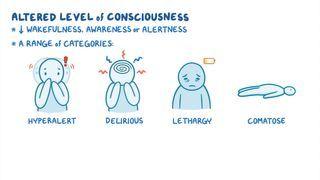
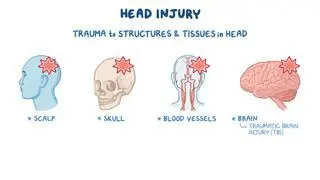
The Glasgow Coma scale (GCS) uses a scoring system that assesses three items: eye movement (maximum four points), verbal response (maximum five points), and motor response (maximum six points). The points are added to provide a total score of 3 to 15, with three representing a comatose state and 15 representing normal.
For eye movement, if the individual opens their eyes spontaneously, that is four points. Three points are awarded if they open their eyes only when asked. If they open their eyes only in response to pain, such as rubbing the orbit of the eye, that is two points. One point if they don’t open their eyes at all.
Verbal response can be assessed by checking if a person is oriented (i.e., knows who they are, where they are, and the current date/year). Five points are awarded if they answer correctly. If they respond with full sentences but are confused or disoriented, that is four points. If they respond with words that are unrelated to the question, that is three points. If they respond with groaning or incomprehensible sounds, that is two points. If they do not respond at all, that is one point. If a person is unable to communicate due to intubation, it should be noted with a “T”.
For motor response, six points refer to the ability to obey a motor command, like “raise your arm.” If they are unable to do so, the next step is to assess the response to a painful stimulus, such as rubbing the orbit of the eye or pinching the trapezius muscle with moderate pressure. If a person moves their hand in the direction of the pain, signifying that they are localizing the pain well, that is five points. If instead they withdraw or move away from the pain, that is four points. If the upper limbs are flexed with the wrists and hands flexed into fists near the chest (i.e. decorticate posturing), while the lower extremities are extended, that is three points; whereas two points are awarded if both the upper and lower limbs are extended (i.e. decerebrate posturing). Finally, if there is no muscle tone, that is one point.
When reporting the total GCS score of an individual, each category should be graded individually to provide additional clinical information. For example, a total score of 12 that scores three in eye responsiveness, four in verbal response, and five in motor response should be noted as GCS 12 (E3V4M5). The GCS should be performed at fixed intervals as part of a continuous assessment to monitor changes in the neurologic status of an individual. Generally speaking, initially low GCS scores or a high GCS score that decreases over time predicts a worse outcome compared to a persistently high GCS score or a low score that increases over time.