Inhibitory Neurotransmitters · What They Are, Their Function, Clinical Significance, and More

Published: Mar 04, 2025
Author: Emily Miao, PharmD
Editor: Alyssa Haag
Editor: Lily Guo
Editor: Kelsey LaFayette, DNP
Author: Jessica Reynolds, MS
7-day free trial

Go deeper with Osmosis

Osmosis is a learning platform with videos, questions, and AI tools to help you master topics like this.

4.8 · 12,000+ reviews
Watch quick, visual videos
Practice with Qbank-style questions
Use AI to explain, quiz, and review
Study anytime with the mobile app
Start free trial

No credit card · Cancel anytime

What are inhibitory neurotransmitters?

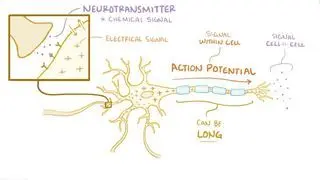
Inhibitory neurotransmitters are a specific type of neurotransmitter that plays a crucial role in decreasing the likelihood of an action potential (i.e., rapid rise of voltage across a cell membrane) being transmitted to another cell. Neurotransmitters are chemical messengers that transmit electrical signals across a synaptic cleft, a junction between the presynaptic neurons and postsynaptic target cells. Once an action potential reaches the presynaptic terminal of a neuron, it triggers the release of neurotransmitters into the synaptic cleft. The released neurotransmitter binds to various types of receptors (e.g., voltage-gated, ligand-gated, mechanically-gated) on the postsynaptic membrane, leading to further electrical changes in the target cell. Neurotransmitters are involved in a variety of cellular processes and physiologic processes including synaptic transmission, coordination of different parts of the nervous system, regulation of mood and hormones, memory formation, and motor control.

Learn deeper with Osmosis

Master this topic faster with videos, questions, and AI.

Used by 8M+ healthcare learners.

Start free trial

No credit card · Cancel anytime

What is the difference between inhibitory and excitatory neurotransmitters?

Neurotransmitters are broadly classified into two main types: excitatory or inhibitory neurotransmitters. Excitatory neurotransmitters increase the likelihood that the postsynaptic neuron or target cell will generate an action potential (i.e., excitation), whereas, inhibitory neurotransmitters decrease the likelihood that the postsynaptic cell will generate an action potential (i.e., inhibition). 

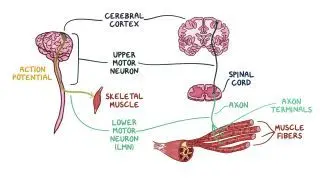
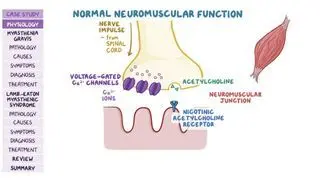
Examples of excitatory neurotransmitters include glutamate, acetylcholine, and dopamine. Glutamate is the most abundant excitatory neurotransmitter in the central nervous system. It is synthesized from alpha-ketoglutarate and upon binding to glutamate receptors, causes depolarization or influx of sodium ions into the cell, causing the membrane potential to become net positive. Acetylcholine is another excitatory neurotransmitter that is important in regulating synaptic transmission in the peripheral nervous system. Acetylcholine is synthesized from choline and acetyl-CoA via the enzyme choline acetyltransferase. Acetylcholine acts on nicotinic acetylcholine receptors and plays an important role in skeletal muscle contraction. It causes local depolarization of muscle fibers at the neuromuscular junction, which is the first step in muscle contraction.

Dopamine is another excitatory neurotransmitter that is synthesized from tyrosine via tyrosine hydroxylase, an enzyme that adds a hydroxyl group to the substrate (e.g., tyrosine). Dopamine is involved in reward processing, motivation, and regulation of mood. At low doses, dopamine may lead to vasodilation in the renal vasculature, and at moderate to higher doses, dopamine may exert cardiovascular effects (e.g., increased heart rate and contractility). 

Examples of inhibitory neurotransmitters include gamma-aminobutyric acid (GABA) and glycine. GABA is the primary inhibitory neurotransmitter in the central nervous system. It is synthesized from glutamate via an enzyme called glutamate decarboxylase, which is a type of enzyme that removes carboxyl groups from a substrate (e.g., glutamate). In the central nervous system, GABA binds to receptors (e.g., GABA-A and GABA-B), thereby opening chloride ion channels. Chloride ions cause the membrane potential to become net negative, known as hyperpolarization, and inhibit action potential generation. GABA transmission maintains a balance between neuronal depolarization and hyperpolarization.

Glycine is one of many amino acids in the body and is an important inhibitory neurotransmitter primarily found in the spinal cord and brainstem. Glycine is synthesized from serine via an enzyme called serine hydroxymethyltransferase, which is an enzyme that transfers hydroxymethyl groups to a substrate (i.e., serine). Like GABA, glycine binds to ligand-gated chloride channels, and the influx of negatively charged chloride ions results in membrane hyperpolarization.
What is the function of inhibitory neurotransmitters?

Inhibitory neurotransmitters are primarily responsible for preventing the overexcitation of neurons by inhibiting neuronal firing. There are also negative feedback mechanisms in place, which help modulate and prevent overexcitation within neural pathways. For example, if a particular population of neurons is repetitively stimulated, the body releases inhibitory neurotransmitters to regulate and limit the spread of neuronal firing. Inhibitory neurotransmitters can also adjust the neuron’s sensitivity to incoming stimuli, by making it less sensitive, as a mechanism to downregulate the overall responsiveness of the neuron. 

What happens if inhibitory neurotransmitters malfunction?

Inhibitory neurotransmitters can malfunction and lead to clinically significant implications, resulting in various neurologic and psychiatric disorders including epilepsy and mood disorders.
Deficiencies in inhibitory neurotransmission (e.g., GABA, glycine) can result in excessive excitation or reduced inhibition within neural pathways, resulting in seizures and epilepsy disorders. Additionally, impaired GABA-ergic transmission may play a role in anxiety, depression, schizophrenia, and sleep disorders.

What are the most important facts to know about inhibitory neurotransmitters?

Inhibitory neurotransmitters are a specific type of neurotransmitter that plays a crucial role in decreasing the likelihood of action potential transmission. Neurotransmitters are chemical messengers that transmit electrical signals across a synaptic cleft and are broadly classified into two main types, excitatory or inhibitory neurotransmitters. Key examples of inhibitory neurotransmitters include GABA and glycine, while examples of excitatory neurotransmitters include glutamate, acetylcholine, and dopamine. Inhibitory neurotransmitters are primarily responsible for preventing the overexcitation of neurons by inhibiting neuronal firing. Inhibitory neurotransmitters may malfunction, resulting in various neurologic and psychiatric disorders such as epilepsy, mood disorders, and sleep disorders
Students say Osmosis is 100% worth it

Because Osmosis saves them time. Lowers stress. And actually helps them remember when it counts.

I used Osmosis to prepare for my first medical school licensing exam! Super helpful and interactive for people who may not do great with just pages of text info!

Cecilia Ruiz

Cecilia Ruiz

MD student

Sayan Misra

I have used Osmosis for about four years. Best thing I have ever used for my medical studies.

Sayan Misra

Sayan Misra

Med student

Osmosis videos are superior because they define simple concepts, tell a story with a clear progression, and provide context.

Jay Pate

Jay Pate

Dental student

References


Bowery NG, Smart TG. GABA and glycine as neurotransmitters: A brief history. Br J Pharmacol. 2006;147 Suppl 1(Suppl 1):S109-S119. doi:10.1038/sj.bjp.0706443


Curtis DR, Watkins JC. The excitation and depression of spinal neurones by structurally related amino acids. J Neurochem. 1960;6:117-141. doi:10.1111/j.1471-4159.1960.tb13458.x


Cutler AJ, Mattingly GW, Maletic V. Understanding the mechanism of action and clinical effects of neuroactive steroids and GABAergic compounds in major depressive disorder. Transl Psychiatry. 2023;13(1):228. Published 2023 Jun 26. doi:10.1038/s41398-023-02514-2


Rizo J. Mechanism of neurotransmitter release coming into focus. Protein Sci. 2018;27(8):1364-1391. doi:10.1002/pro.3445


Südhof TC. Neurotransmitter release: The last millisecond in the life of a synaptic vesicle. Neuron. 2013;80(3):675-690. doi:10.1016/j.neuron.2013.10.022


Zhou Y, Danbolt NC. Glutamate as a neurotransmitter in the healthy brain. J Neural Transm (Vienna). 2014;121(8):799-817. doi:10.1007/s00702-014-1180-8