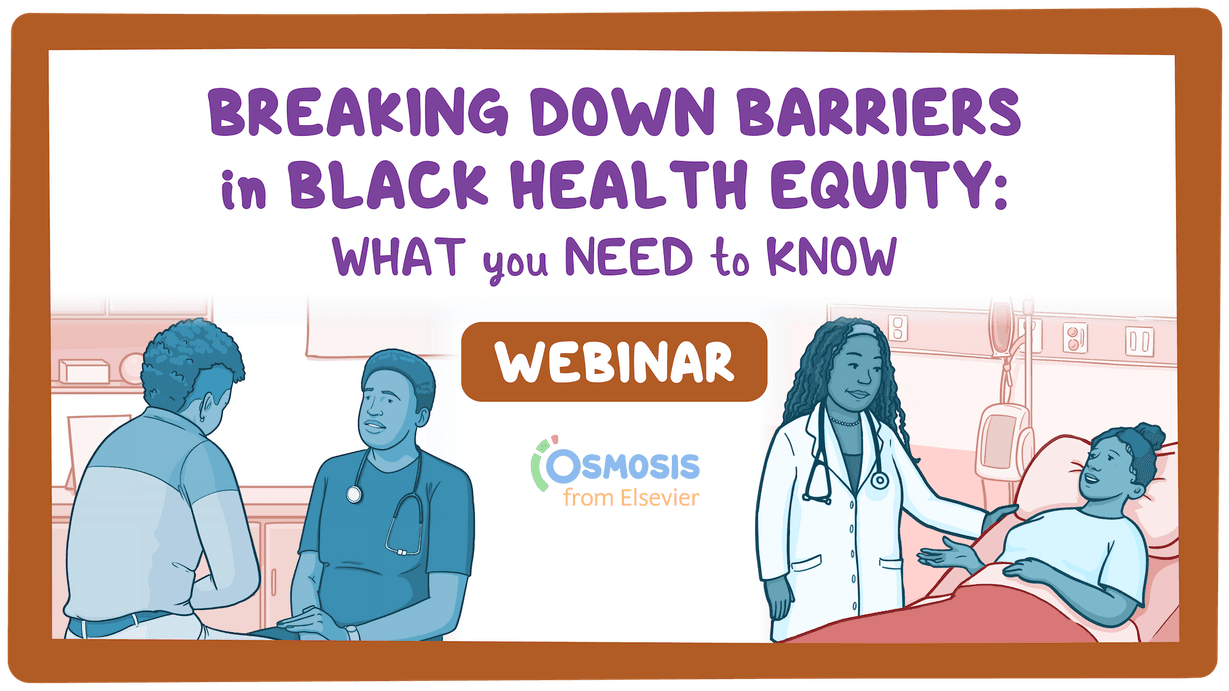
Breaking Down Barriers in Black Health Equity: What You Need to Know
February 13, 2025
Watch on Demand
Watch Dr. Itunu Johnson-Sogbetun deliver an insightful presentation on health disparities in the Black community, along with practical strategies to promote health equity and build a more equitable healthcare system through collaboration and empowerment.
Transcript
Hi everyone, welcome to today's webinar. I'm Dr. Itunu Johnson Sogebetun joining you from the UK, and we're going to be talking about a very important topic, which is on breaking barriers in Black health inequity. So we'll just give a few moments for people to join, and we'll get right into it. But, you know, as we start, it would be really great if people can share in the chat what they're hoping to get out of today's session, what their thoughts are. Yeah, just, just, you know, say hello, and thank you all for joining. It's great. So we'll just give it a few seconds for a few more to join. Thank you Susan, hi Lindsay, hi K, thank you guys, hi Danielle, hi C, hi Lenitra, hi Gifty, hi Ryan, hello, hello, hi Roman, hi Marlene, hi Michelle, thank you all for saying hello. We'll give it another minute and then we'll start the talk. Hi Don, hi Luke, hi Ash.
Today we're going to be talking about breaking down barriers in Black health equity: what you need to know. As I say, I'm Dr. Itunu Johnson Sogebetun. My ethnicity is Nigerian. I'm British, so I'm British Nigerian or Bridgerian if you like. I'm a general practitioner, so what you would call a family physician, but I also specialize in women's health and the menopause. In addition to that, I'm a passionate health equity advocate and educationalist. I lead EDI strategy at the Royal College of GPs North Northwest London Faculty Board, and that's really all about ensuring that our clinicians, our family physicians, are diverse and have adequate representation from different aspects of backgrounds and different aspects of life. I'm a GP2 turn examiner at Queen Mary's University of London Medical School, but guess what? I'm also a Black woman, just in case you hadn't noticed. That means that I've experienced my own personal health challenges as well as members of my family, which has provided me a unique lens from both sides of the aisle as a clinician and as a patient or as a family member to understand some of the challenges in health inequity.
I was just saying how, you know, unfortunately, my privilege as a doctor and as someone who's highly educated has not shielded me from experiences of health inequities that, you know, Black people experience across, you know, the Western Hemisphere or the Northern Hemisphere. I was diagnosed with hypertension at age 27. At the time, my blood pressure was 180 over 110. I could have had a stroke. I could have died, but thankfully I picked up that the headaches, I needed to check my blood pressure. Imagine my shock, and I was able to get treatment. But that, that's just the beginning of the story of what I've experienced personally. So again, those experiences have helped shape my perspective.
I think it's important to acknowledge that we want to create a psychologically safe space. We're going to be discussing health inequities which can be emotionally challenging, and it's normal to feel frustration, sadness, overwhelm, all sorts of emotions, and these are perfectly valid, right? So I think it's important to care for yourself if at any point you're feeling this is too much and you need a few moments. But also, I think it's important to say that discomfort is part of learning because discussing these things can be difficult. But sitting without discomfort actually is developing you into a more aware, empathetic, and effective health care professional. So, you know, it's part of the process. Now, differing perspectives are very welcome, and they can be respectful disagreement. We encourage open discussion, but we need to be respectful and professional. Courtesy is very, very paramount.
Now, this is not about having all the answers. These are very complicated issues, right? We are here to reflect, explore ideas, and learn. I've worked hard to shape this session thoughtfully, but I don't have it all figured out. It's learning, so your feedback and reflection will be highly valued. So I think let's approach this with openness, humility, and a shared commitment to better care for everyone.
Okay, so I'm going to start with a case study. We've got Michelle and Sarah. Both of them are 38 and both live in the same city and were recently diagnosed with breast cancer. Michelle, she's Black, single mother. She works long hours. She doesn't have paid sick leave. She doesn't have health insurance. After undergoing genetic testing, she discovers she carries the BRCA1 gene mutation, which some of you may know can be more common in women of African descent. Despite this, Michelle struggled to secure a timely appointment at the understaffed clinic in her neighborhood. When she finally saw a doctor, her concerns were initially dismissed. By the time she was diagnosed, her cancer was at an advanced stage, limiting her treatment options, and she had a poor prognosis.
In contrast, Sarah, who's also positive for BRCA1 mutation, she's also 38, with young-onset breast cancer, but she had insurance and strong family support. So this strong family support and social networks is a really important thing for people. She was able to book her medical appointment quickly. She was promptly referred for necessary tests, and she began her treatment early, which significantly improved her chances of survival.
So we have two women with a shared experience of breast cancer, the same age, both BRCA1 positive, but having two different outcomes because of different factors. So I just want you to think: what factors might have led to Michelle's delayed diagnosis, and what changes could have occurred that would improve health outcomes for all? This is something for you to reflect on, and we're going to pick up on some of these themes as we progress through today's talk.
So why this topic? I tell you what, I had a transformational experience. I've mentioned that I'm from the UK, and it had to take me traveling to the US to actually understand the concept of health equity. I was 23, in my final year of medical school. That's what I looked like in that year, so I'm sharing you a picture. I was at University of Chicago Medical Center, and for those of you who do not know Chicago, this is based in Hyde Park, which is a really nice part of the world, where the Obamas used to live. They don't live there anymore, but they used to live there, and it's really quite affluent. In that area, they have world-class maternal health outcomes, but not far away, a few blocks down the road, is the South Side of Chicago where women there were facing similar maternal outcomes to women in Sub-Saharan Africa. When I heard that statistic, I was shocked beyond belief. How could such extreme disparities exist within the same city? It did not make sense to me, and this experience really ignited what I would say now is a lifelong mission to understand health inequities.
So what is health equity? There's the concept of health equality, which strives to provide the same health care to all, but that means that if you're trying to do the same thing for all, it becomes unfair because health equity is about fairness and justice, acknowledging disparities and allocating resources based on need to address historical and current inequalities, and that helps achieve better outcomes, fairer, just outcomes by acknowledging social, political, economic, and environmental factors which impact health outcomes.
Some of you may have seen this diagram or similar diagrams which look at equality versus equity. Now, look at that little boy with red hair. When you're doing equality, he can't even see at all, but with equity, the taller man with the afro didn't need any additional help, but actually that little boy needed more help, and now he can see. Everyone can see, and this is what we're talking about: equity.
I think this is really important. I say this all the time because I'm really passionate about health equity in general, and of course we're talking today about Black health equity, but I want you to think about health equity in general because anyone, absolutely anyone, can find themselves in a position where they need extra support to achieve equitable health outcomes. So it could be your gender that renders you to need extra support, it could be your age. Someone might have had so much power and privilege as they were younger, but as they age, they may then find that they're not being listened to as much, they're being treated as the old person with delirium or dementia, and in that position they need extra support. So this can impact anyone. What we're talking about is giving everyone a fair opportunity to achieve their best possible health by addressing barriers that may hold some people back. It's not about treating everyone the same, it's about providing the right support based on different needs.
Now, social determinants of health are the conditions in which people are born, grow, live, work, and age which shapes their overall well-being. Key factors include financial stability, quality education, access to health care, safe living environments, and strong social connections. I mentioned this earlier about the importance of social networks. Anyone can face challenges that create the need for extra support.
While we're talking about social determinants of health, I wanted you to just look at this diagram which has loads of things that impact health inequities, and this is a diagram from the WHO, and this is where we are today. We're talking about ethnicity. Now, I know it's got racism in the background, and the truth is many of the communities that have ethnic health inequalities have faced systemic discrimination or racism, but it's part of the conversation. But it's not the only part of the conversation, and I want to make that clear. So it's not just about racism, but racism can be a very important part of the conversation. We see other factors like social class, gender, and we've talked about some of these other factors. So this is just looking at the overall picture to see where what we're talking about falls in.
Now I want to talk about some general themes in ethnic health disparities. Genetics being one. Some populations have higher risk genetic variants like BRCA1 and 2 in Ashkenazi Jewish communities which increases cancer risk; sickle cell anemia in Black people; HF causing HFV mutations causing hemochromatosis, which can be seen in individuals of Celtic descent. But also gene-environment interactions: how genetic traits influence disease risk based on environmental exposures and how genetic factors can actually impact behavior such as diet, physical activity, and substance misuse, which we also can see in some populations. This in turn influences health outcomes.
A lot of the understanding of genetics that we've had historically focuses mostly on people of European descent, and that's limited data for other groups, although this is changing, and that has hindered some of the research and tailored and personalized care, reducing health outcomes for some other groups. Now, populations with limited access to health resources may also not be able to access information about their genetic risks or tailored treatments, and that's important to note as well.
Now we come on to epigenetics, which fascinates me. This is about how environmental stressors can alter gene expression and contribute to long-term health disparities. So it's not a gene mutation but it's heritable changes?so inherited changes in gene function that do not involve alterations to the actual sequence but impact the expression and the traits. Very interesting stuff. Generational trauma can heighten stress-related conditions in ethnic minorities and this can impact health outcomes. But I also postulate that as we can inherit generational trauma and generational stress, we can also inherit generational strength. So let's think about this positively as well, and health outcomes can be influenced by this. Epigenetic modifications may contribute to health disparities.
Now other themes: historical injustices. We've talked about discrimination, segregation, and systemic exclusion that have had lasting impact, but also environmental factors like pollution, limited green spaces, food deserts, which can affect physical and mental well-being; socioeconomic inequalities; unequal access to quality health care; and insufficient culturally competent care?which we'll talk about, a really important phrase, one of the key phrases I want you to leave today with. Structural racism and biases which exist for many different communities; cultural and linguistic barriers that can exist, impeding effective communication but also trust; and then chronic stress, which we've mentioned.
Now, there are various groups in the US. I've highlighted a few to talk about ethnic health disparities just to give us, again, the overarching narrative around ethnic health disparities before we drill down to Black health disparities.
Celtic health disparities: individuals of high Irish descent have higher prevalence of certain genetic disorders but also elevated rates of alcohol dependence. It's important to know that both nature and nurture play with this, and that can impact health outcomes for people from this background.
American Indian and Alaskan Native individuals: these individuals can have some of the lowest life expectancies amongst racial groups, high uninsured rates?25% not having a usual healthcare provider. We know that impacts long-term outcomes and more. Children in these communities are three times more likely to experience food insecurities.
We've already talked about the BRCA1 and BRCA2 gene mutations that exist in Ashkenazi Jewish populations, which increase the risk of a host of different cancers. But there's also higher prevalence of certain genetic conditions like Tay-Sachs disease, Gaucher disease, and so many different things that impact Jewish health outcomes.
Asian health outcomes: Far East Asians have higher rates of liver and stomach cancers, lower rates of routine care screenings. Southeast Asian Americans have higher rates of diabetes and heart disease, reduced access to mental health services.
Talking about Hispanic and Latino health disparities: high obesity rate, increasing risk of diabetes, hypertension, cardiovascular disease, non-alcoholic fatty liver disease, and others, and mental health as well.
Also thinking about Native Hawaiian Pacific Islanders also experiencing health disparities.
What I'm trying to let you realize is that there are many different ethnic health disparities across the UK.
So why then focus on Black health inequities for this talk? Well, it's because the data speaks quite clearly. Black Americans consistently experience the worst health outcomes across nearly every specialty and statistic. If we addressed health inequities for this group and for all the other groups, we create solutions that improve outcomes for everyone. Improvements lift us all up. It is not a zero-sum game.
I just want to show you some statistics because, you know, for me, every time I go through this, obviously I'm familiar with it, it just hits me really hard.
Cancer: Black Americans have the highest cancer mortality rate and the lowest five-year survival rates amongst racial ethnic groups. Black men face higher rates of stomach and prostate cancer, whereas Black women have increased mortality from uterine and breast cancer and stomach cancer. Prostate cancer deaths in Black men are more than double those of other groups, and Black women are 40% more likely to die from breast cancer than White women. Black men have the highest cancer incidence and death rates, with mortality nearly twice as high from cancer as in Asians and Pacific Islanders.
In maternal health, Black women are four times more likely to die from pregnancy and childbirth, and in some areas some cities report 12 times higher. They're more likely to experience preterm birth, low birth weight, pregnancy-related conditions like preeclampsia. Black infants have a mortality rate twice that of White infants, largely due to complications from low birth weight. Black women lead in 22 of the 25 severe maternal health complications tracked by the CDC.
Mental health and suicide: suicide is the leading cause of death amongst Black youth, with Black males dying by suicide at over four times the rate of Black females, but Black female high school students attempt suicide at higher rates. Black adults are 20% more likely to experience serious mental health conditions, and Black young adults face higher rates of mental health issues but are less likely to access care. These things are costing lives.
Black adults are more likely to have hypertension but less likely to keep it under control. Black men have a 70% higher risk of heart failure, and Black women have a 50% higher risk compared to their White counterparts. Black adults are twice as likely to be hospitalized for heart failure, with longer hospital stays and higher readmission rates. Black women are more likely to have a higher heart attack, and Black adults overall face higher heart attack mortality, so if they have a heart attack, they're more likely to die.
Conditions like heart failure, stroke, sudden cardiac arrest occur more frequently and at younger ages in Black individuals. Often they lead to hypertension, diabetes, and obesity. Black adults are nearly one and a half times more likely to be diagnosed with diabetes and are 40% more likely to die from diabetes. They are nearly four times more likely to be hospitalized for uncontrolled diabetes and over three times more likely to develop end-stage kidney disease due to diabetes.
We have stats from 2018 saying that Black individuals were twice as likely to die. Biological risk factors like obesity and insulin resistance contribute significantly to diabetes, but there's also structural and social determinants of health.
Now skin diseases: more keloids, post-inflammatory hyperpigmentation. Eczema can present differently in Black children, making timely and accurate diagnosis more challenging. When Black people suffer from a lot of these skin health issues, there just isn't sufficient clinical guidance and research. Clinicians don't feel confident about how to manage them, and that leads to poorer outcomes.
Autoimmune disease: Black women are three times more likely to develop lupus and often experience more severe symptoms. Multiple sclerosis is increasing in prevalence in Black Americans; before, it was thought that it's more common in White populations, but rates in Black populations are increasing, and mortality rates are increasing.
When we think about Black men's health: higher mortality rates from chronic disease despite having health insurance. If they do have health insurance, they're 50% less likely to visit a physician. Even for those who have health insurance, on average Black men die more than seven years earlier. The only group that has a shorter life expectancy is the Native Americans in male groups.
Prostate cancer disproportionately affects Black men. They are also less likely to receive intensive treatment. They're more likely to develop benign prostatic hyperplasia and all these other metabolic and cardiovascular diseases that we talked about.
Black women are diagnosed with uterine fibroids approximately three times more and at younger ages, experiencing more severe symptoms. They're half as likely to be diagnosed with endometriosis and diagnosed later. There's often underdiagnosis or misdiagnosis. There was also the false belief that Black women have a higher pain tolerance, and that contributes to so many disparities with gynecological treatments and procedures.
So a lot of stats, why this matters. Did you know how bad it was? Something to reflect on. A fair system leads to better outcomes for all because everybody deserves their best outcomes of their own health. I think awareness, which is what this talk is really about, is the first step towards improvement. You as clinicians have a role to play.
Yes, there are so many systemic and political issues that drive all of this, but what can you do as a clinician? You also have a role to play.
Now why do these health disparities exist? We already mentioned some general themes, but for Black health disparities specifically, there's the history of segregation, systemic barriers, and past injustices creating lasting mistrust, but also bias and unequal treatment. Economic inequality still abounds; access to health care?so many underserved areas have fewer hospitals, clinics, reliable transport. Historical injustices cause mistrust, and that leads to inadequate care because people don't necessarily trust the medical establishment. Sometimes that can lead to detrimental outcomes.
There's also biases, underrepresentation in clinical research, and that leads to gaps in knowledge?we still don't know so much about what we don't know. Educational and economic disparities, and then stress and the impact of minority trauma and racism and discrimination that people still experience.
This isn't about assigning blame; it's about identifying the barriers so we can work to address them or remove them together.
How do we move forward? This concept of cultural competent care, which I'll come back to, is where health care providers prioritize understanding diverse patient backgrounds, beliefs, and needs while developing clinical curiosity and ongoing learning to improve trust and outcomes. This is important for Black health equity but for all ethnic health disparities.
Bias awareness: are you aware of your own bias? Encouraging self-reflection to address unintentional biases to improve patient care. Expanding access: some of these things are policy-related, but what can you do as you become more senior in your journey as a clinician to improve healthcare availability, affordability, and quality for everyone?
Investment in community care, community outreach is so important. How about the charity sector, the volunteer sector? Let's strengthen local health programs and preventative measures. Let's improve longer-term health and wellbeing because so many of these issues are to do with things like obesity, food movement, and so many other fundamentals of preventative health care.
Local advocacy: working together with communities supports these outcomes. Mentorship and support really help increase the relationship between communities and health care professionals but also increase healthcare representation because representation matters. It matters because it improves the diversity of thought and improves outcomes going forward for everyone.
Bridging conversations, bringing together different perspectives is really important for collaborative solutions, which is the next point, because partnerships are really, really important. No one can change this alone.
Empowerment: we need to empower individuals to be able to advocate for their own health. I love that sometime in June we're going to be having a seminar or webinar about how to empower patients to advocate for themselves because this is fundamental to improving health outcomes.
Back to one of the key take-home points: equity benefits everyone. When Black health equity improves, health care systems become stronger and more inclusive, benefiting everyone.
Now cultural competence, what can you do? Take an interest in your patients' lives. They are people, not just their symptoms. It's always about biopsychosocial. Have you considered the other factors? You know, it's really important: integrated, trauma-informed care, respect and include cultural factors, and an understanding of added challenges such as minority trauma into health care discussion to align with the patient's background. Open communication, safe and judgment-free space. Let the patients be able to discuss their concerns, experiences, and expectations regarding their health.
I'll give you an example: I'm a women's health doctor, and often I'll say to women, like if they've got pelvic period pain and period problems, and I suggest hormonal treatment, they say, "Oh no, I don't want hormones." Rather than having a judgmental approach to that, I often just ask, "What is it about hormones you don't want?" I want to understand. I want to give them the space to be able to share. It's often a really mixed picture. People might say all sorts of things: "I've heard that they're dangerous for you," "They're not natural," all sorts of different things. Then we can explore them together in a non-judgmental approach.
Symptom recognition: are we listening? Are we validating? Are we acknowledging symptoms? One of the most common things that Black people share about their health experiences is that they don't feel listened to and they don't feel heard. That often makes people turn to non-safe spaces of misinformation. But if we as clinicians can be a safe space for information with culturally competent approaches, this will improve outcomes.
Education and awareness: providing clear and culturally sensitive information about potential causes, diagnosis, and treatment options. It's shared care, personalized patient-centered care. It's a conversation between two experts: we have the clinical expertise, but they have the expertise about their knowledge and experiences about their body.
Continuous learning: it's so important to be curious and to want to know more. Coming for a talk like this shows that you're open and you want to learn. Then we can bridge disparities and enhance care.
We're rounding up now, and I just want to share another case study.
Tasha is a 42-year-old Black woman. She lives in an urban community in New Jersey. She works two jobs to support her family and often struggles to find time for medical appointments. Despite having a family history of high blood pressure and diabetes, she's not had a routine health check in over five years. Recently she started experiencing frequent headaches, fatigue, and dizziness. When she finally visits a nearby clinic, she's diagnosed with uncontrolled hypertension and pre-diabetes.
The doctor advises lifestyle changes, including healthier eating and regular exercise, as well as medication, but she faces challenges. The nearest grocery store with fresh produce is far from where she lives, which makes healthy eating difficult. Her neighborhood lacks a safe space for exercising, and she doesn't have money to pay for a gym. High health care costs, lack of paid sick leave make follow-up and medication adherence challenging, so she just keeps running around in a vicious cycle.
I wanted you to think: what social determinants of health are contributing to Tasha's health disparities? How does limited health care access impact her chronic disease management? What role does systemic bias and past negative experiences play in trust and health care engagement? How can communities improve access to healthy food and exercise opportunities? You don't have to ask about the policy one because I think let's focus on those four questions, and also how can health care providers build trust? If you want, put some answers in the chat; that would be great.
I'm just going to come out of this and then come into the chat to see what people are saying.
How do we know the disparity between Black health and others is not genetic? I think this is important because of course there are genetic contributors to health disparities. We also talked about epigenetic disparities, but often there are additional factors, many of which are related to systemic barriers, including history of discrimination, implicit bias, many of the other factors that I mentioned. So it can sometimes be challenging to unpack because there is a genetic disposition to some of these conditions; however, it's not just about it.
When you look more broadly, you can see that when effort is put into place, you can see improved outcomes. I'll give you an example: Southeast Asian people here in the UK have a much higher risk of heart disease and dying from heart attacks than in fact any other group in the UK, but actually there are some areas where when that is known and effort is put into place, it has actually caused that negative health outcome to be significantly improved. That's what I'm talking about: yes, the genetic risks still exist, but when people are aware of it and things are put into place to address those health inequities, then you can see change.
Do we have any understanding of the reasons for Black patients being less likely to see a doctor? Yes. We know about historical things like the Tuskegee syphilis trials, and that's just one example of historical distrust. Underrepresentation in trials, many Black people have recent history of severe discrimination that they or their ancestors have faced, with recent history of segregation, areas where Black people lived had poorer health resources allocated. So again, there is distrust with the medical establishment, but also even when there is engagement, a lot of the time the services provided are not culturally competent. People feel not listened to, dismissed, unvalidated, and that also leads to negative health outcomes, so people may feel, "I don't want to go because even when I go, I don't feel listened to," or "I feel judged." Often, a lot of Black people explain that when they go to see a doctor about it, they feel judged around obesity or diets or lack of exercise, which is a really important part of the conversation, but how it's framed in a culturally sensitive way is often lacking. So again, that can cause barriers.
How can we provide health access to all? Each country has its own health care system, and the merits of each system is very much a political issue, so that's kind of outside the remit because it's a political question. However, when we're in the position to provide health care, how can we provide equitable health care? That's a different question because it's how we as clinicians are providing the appropriate support to the patient to ensure that they are receiving the best possible health outcomes. That has to do with all the different things I was talking about in relation to thinking about our own bias, how we are approaching this, are we doing a shared care approach, a personalized approach? Are we curious about the background of our patients? Are we providing adequate information? Are we empowering our patients to advocate and ask the right questions? All of these things are really important.
Do you know of anything that is being put in place to reduce these disparities in health care and to ensure that health equity is really being achieved? There are so many different strategies depending on where you are based?in the US or depending on where you live. Many different outcomes, and there are also national strategies that have been put into place. But again, some of these things are systemic and political. If you want to just focus on what you can do as a clinician, because some of these things may well be out of our personal or individual control although we know they exist, what can you do as an individual when you see a patient in front of you? I think that's one of the take-home points: regardless of the systemic issues, there are things you can do as an individual to address some of these things, and hopefully you can also advocate for policy changes and systemic changes to improve some of these more structural factors that impact health inequities.
If we just go back to the talk, I see many people are still asking about why these health inequities exist. I just want to bring you back to this slide talking about the historical impact: segregation, racism, systemic barriers, and past injustices, discrimination are a very important part of why these inequities exist, but they're not the only part. There's also economic inequalities, access to healthcare, mistrust, biases that individuals and clinicians can carry, underrepresentation in clinical research, educational and economic disparities, and stress, and the impact on the individual of minority stress and minority trauma. These are some of the factors that impact it because quite a few people were asking that question.
In conclusion, health and health equity benefits everyone. When we address disparities, we create a stronger, more effective health care system for all. Black health inequities matter. These disparities are significant, but tackling them leads to broader improvements in health care generally and in quality outcomes for everyone. Collaboration is key. Open dialogue and commitment to fairness will help break down barriers and build trust.
I want to leave us with the thought: imagine a future where your background doesn't determine your life expectancy or health outcomes. That future is possible but only if we work together.
I'm going to come back to the questions: why do you think the US has such a huge health inequality problem? Well, I think that answer is very complicated because there are many different factors with regards to the health care system that's in place. Not to say that there aren't certain merits of the US health care system; no health care system is perfect. But the health care system in itself lends itself to more disparities because it is very much shaped by people's socioeconomic abilities, and that impacts outcomes. But then of course there's a rich historical heritage of so many different factors that increase bias, discrimination, and systemic issues that have occurred.
Again, there are huge socioeconomic disparities within different ethnic groups, and many of the ethnic groups I mentioned?whether it be Celtic groups, Latino groups, Jewish groups?many of these groups have experienced ethnic discrimination at some point and continue to throughout the history of America. So even though America is a multicultural society, there's historical discrimination that has been a part of the national narrative, and that of course impacts Black people because some of this was law against Black people in particular. Unpacking and unwinding that has been very challenging, and of course we need to keep moving forward on this.
Someone mentioned generational poverty. In every encounter we have with the patient, we meet them where they are and address what they need. Absolutely.
Is there a link between racism? Okay, I think I've answered that one.
So do let us know if there's any more questions. Very happy to answer, or if I've missed any questions then sorry, re-highlight them.
How do we know it's not genetic? I think that's such an important question which I already began to answer. Genetics and epigenetics are very much part of the narrative with ethnic health disparities, but there is more. That's why we talked about all the different other factors. Yes, genetics and epigenetics are part of it. I gave the example of how even if these genetic disparities exist, with applying appropriate need to counteract that, we can improve health outcomes. But a lot of the time, these genetic disparities are known but nothing is done about them or they're ignored, and then we have worse health outcomes because of all these other issues. Does that make sense? So again, yes, different ethnic groups have different genetic width and different ethnic disparities, but how are they addressed? It's important that we address them in order to improve outcomes for everyone.
One last question: you mentioned that you yourself experience inequality even as a health provider. Can you share your experience?
I'm happy to share my experience regarding the statistic about Black women being four times more likely to die in pregnancy and childbirth and more likely to have pregnancy health outcomes. You'd be surprised to know that the statistic is exactly the same here in the UK for Black women. We have a completely different health care system; our health care system is free at the point of access, yet Black women are still four times more likely to die in pregnancy and childbirth.
I'll share my story. With my first pregnancy, I was pregnant with twins, and at 18 weeks, because of a urine infection that was missed, I went into preterm labor and eventually became septic. I lost that pregnancy at 22 weeks. My own learning point from that was when you have your booking maternity assessment, you have a urine sample. I was told the urine sample was normal; I didn't ask any more questions. It was a mixed growth and should have been repeated, but I assumed if they said it was normal, it was normal. It turned out that it was that very urine infection that caused me to eventually lose my pregnancy.
My care at the point when I went into preterm labor was excellent because I was very lucky that I got to be known as a doctor, and so that really helped. They did everything they could to try and protect the length of the pregnancy, but unfortunately, I still ended up losing the pregnancy at 22 weeks and nearly dying of sepsis.
But it actually started with that booking assessment where somebody just said, "Oh yeah, it's fine," whatever, and didn't take the time to say, "You need a repeat sample." As a doctor, I experienced that, and that led me to losing my babies at 22 weeks.
I had two experiences: one was the experience of it didn't matter as much, and that cost me; and then I had the experience of the clinicians doing everything they could because of my privilege as a clinician myself to try and save the pregnancy. Unfortunately, it was too late. I was already part of that statistic of preterm labor and loss.
In my next pregnancy, everything was so because I was aware, and the team looking after me was aware. Everything was run through the consultants, and I ended up having seven urine infections during my second pregnancy, but they got me to nearly term, 36 weeks, and I had my baby.
I've also experienced two different autoimmune health conditions. I've been diagnosed with hypertension at age 27. I've also experienced three Wom cancers because I've got PCOS, and that could very nearly have been missed. Initially, my management was a bit interesting when I was diagnosed with atypical hyperplasia.
I'm almost 40, and to have experienced all those many different health conditions at this stage is very typical, sadly, of the Black woman experience, and the fact that I'm a doctor hasn't spared me that.
I share my story not because I'm unique but because I've had privilege which has supported me, and that's why I'm here today and I'm well and able to share with you. Many women like me are not so lucky. This is why it's so important that we provide equitable health care for everyone.
Thank you so much for listening and for being part of this webinar. Thank you to Osmosis for having me. I'm so grateful. Thank you to everyone, and thank you for your kind words helping current and future clinicians focus, learn, retain, and thrive. Learn more.
Event recordings
The Mind-Body Connection: Integrating Mental Health into Primary & Specialty Care
October 20, 2026
The Future of Education with Dr. Mike
September 29, 2026
What You Need to Know About Using Social Media as a Health Care Student
August 13, 2026
Transition Strategies for New Nursing Graduates
July 9, 2026
Delivering Better Virtual Care: Improving Your Telehealth Skills
June 18, 2026