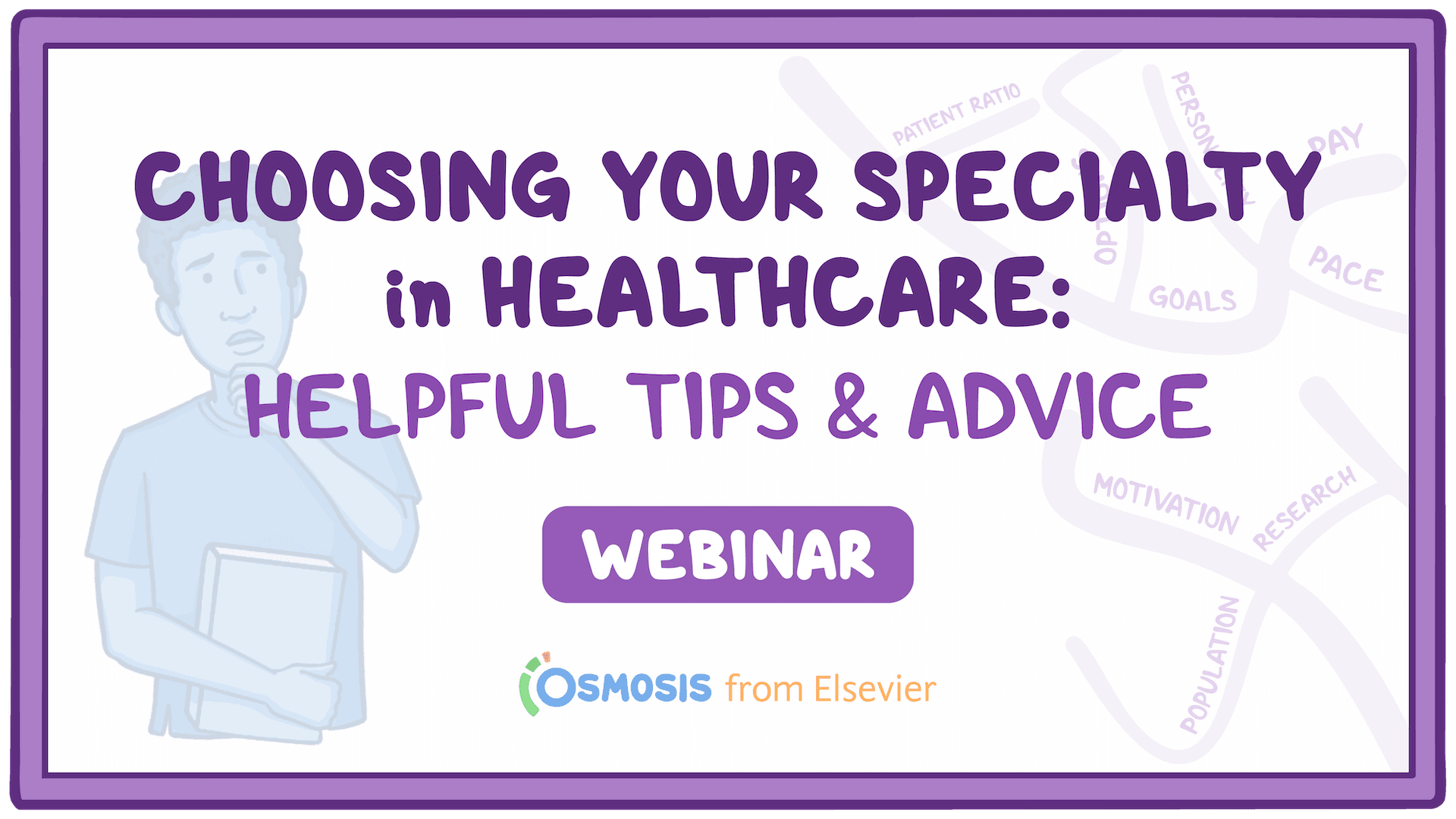
Choosing Your Specialty in Healthcare: Helpful Tips and Advice
June 26, 2025
Watch on Demand
Get expert advice on choosing a healthcare specialty, taking work-life balance, competitiveness, lifestyle & finances into consideration in this free webinar. To help you get the most from this webinar, here are three questions to consider while you are watching. What specialty aligns best with my interests, strengths, values, and preferred patient population? What lifestyle, training, competitiveness, and financial factors should I consider before choosing a specialty? How can clinical rotations, mentorship, shadowing, and real-world experience help me confirm whether a specialty is the right fit?
Transcript
I think we're going to go ahead and get started. So, welcome everybody to today's webinar, Choosing Your Specialty in Healthcare. We're going to talk about helpful tips and advice. Please feel free to share your questions in the chat. Just keep in mind that it can take us a little bit of time to answer. We're going to do our best to address the majority of them before the end of the webinar. So, thank you all for your patience. We'll also be sharing additional information in the chat as we go through. So please make sure to open the links and save them. Last but not least, this webinar is being recorded and it will be posted to Osmosa's events page early in the next week. We're going to post the link in the chat as well. You will be receiving an email reminder when it's available.
My name is Rowida Kheireldin. I am an international medical graduate. I graduated from Egypt and Champs University. I did my residency in pediatrics at the University of Toledo in Ohio and I did a year of NICU fellowship at the University of Texas in Houston. I'm currently a general pediatrician. I do work in clinical and hospital settings and I'm working with Osmosis as a medical question writer. So, my journey is kind of like different or choosing a specialty different for everybody. For me, I kind of knew I wanted peds from medical school early on. I did decide between obstetrics and pediatrics through going into deliveries and I found myself going with the baby rather than staying with the mom. So that was my main decision for going into pediatrics. And that's about me. I'm going to let everybody introduce themselves. So, please go ahead.
I'll go ahead and go next. Hi everyone. My name is Kelsey. I am a nurse and a nurse practitioner. I graduated from the University of Illinois Chicago a few years ago with my family nurse practitioner degree, my DNP, and I have actually been working here at Osmosis as a senior content manager as well. I will go ahead and pass it on to Liz.
Thanks, Kelsey. And hi, everyone. I am a nurse and a nurse educator. So, that is my personal specialty. But before going into education and realizing that was my passion, I was also quite passionate about and loved oncology. So, I worked in a couple inpatient and outpatient oncology units as my specialty before transitioning into education. And I got my doctorate in nursing education just a few years ago. And with Elsa, I was a content manager for Osmosis. And now I work on the product team working on products like Shadow Health, HESI, and Sherpath. And last but not least, I will pass it over to Britton.
Thank you. I'm Britton Zuccarelli. I'm a pediatric neurologist. I work in Kansas. I do inpatient and outpatient work in a pretty underserved region for this specialty. I was born with congenital heart disease and so I spent a lot of time in and out of hospitals myself and interacting with pediatricians and so always felt medicine as a calling. But like many of you perhaps, my mind changed several times when I was actually in medical school about what specialty I might want to pursue. Ultimately, I landed back in pediatrics and then just really fell in love with the neurological aspects of care. So that's how I landed in this clinical position. But I have been with Osmosis for about a year as a question writer.
That's awesome. Thank you everybody. Britton, do you want to go ahead and move with the presentation so that we can get started with our questions? These are questions that we hope help everybody to choose or kind of decide how they want to choose their specialty in the health profession. So we're going to go ahead and start with our first question. Again, please feel free to share any questions that you have through the chat and we're going to try our best to answer them through the webinar.
So our first question is: How do I know which specialty is the best fit for me? I can go ahead and answer that question. There's no right or wrong answer for that question. It totally depends on your interests, what you want to do looking ahead a few years in the future rather than looking at the current time. For everybody, I think the best thing is attending your rotations and kind of educating yourself about that specialty. Again, not everybody wants something especially in the beginning of your clinical years. You don't have to have a decided mind on a certain specialty. Just go ahead, attend every rotation, see what you like in every specialty. Do positives and negatives, pros and cons, and kind of go from there. Talk to residents, for the nurses talk to the nurses, kind of get the idea of what they like and what they don't like about that specialty. And then if you really like something, try to stick with it. Attend a lot of it so that you know if you really love it or you know what, nah, that's not the best for me. I'm gonna let the mic to everybody else to kind of put their input into that.
I can provide sort of the nursing perspective on this too because it's nice as a nursing student we're all trained as generalists. So we can kind of graduate and enter whatever field that we were most attracted to or thought was most interesting and we're also not kind of held to that then. So I would agree with Rowida whenever you're in school, try out as many things as you can during your clinical rotations and kind of maybe make a little mental list of what you liked about certain units or different healthcare facilities or what you disliked about those units and healthcare facilities. Kind of try to get a sense of what your work life would be once you enter as a nurse. And I would also say feel free to after graduation enter the field of nursing in whatever field you feel most strongest about. I can recall there was a bit of maybe not pressure but encouragement to go directly into medical surgical care right after nursing and that's a great place to start your nursing career because you really get a taste of almost everything. But also I would say there is a type of nursing for everybody. And so if you want to start your career in something a bit more specialized, that's totally okay too. I would say if the first few weeks to months to year plus feels hard, that's just normal. It's not necessarily that it's a bad fit for you. So let kind of settle into that role before you necessarily are deciding you want to actually switch paths.
I'll chime in from the medicine sort of side of things because in residency you do get locked in. So if we want to switch disciplines we get to go back and do a whole another residency and so it is important to really spend some time thinking about it. That said, I think there's two major divisions that happen in medicine in general, whether you're a nurse practitioner or a nurse or a DO or an MD or whatever, and that is: do you like children or not? And do you like procedures or not? So for me, I didn't want to be anywhere near an operating room. And so that already eliminated several specialties for me. And I love kids. So, I knew that I was going to be well suited in either family practice or pediatrics. But some people just know at the gate that they're not going to interact well with children. And so, maybe you're going to lean more towards internal medicine and some of those adult specialties. And so I think those two big questions are important to consider.
Yeah. And I'll, from the NP standpoint, I'll pretty much reiterate what the medical folks and nursing Liz has already said. But for most NP specialties, you need to know before you apply to your NP program. You have to know if you want to be family nurse practitioner or a psych nurse practitioner. It's not to say that you can't switch because you certainly can. But if you started out as a peds nurse practitioner and you decide, I hate kids, don't want to do it, I want to be an adult ger primary care, you're probably going to have to start over because not much of that is going to cross over. But as Liz said, to be an NP, you have to be an RN and most programs require you to have at least a couple years of RN experience. So, that's a really great opportunity to figure out, like Britton said, do I like kids? Do I want to work in peds? Do I like adults? Do I like inpatient, outpatient? So really use that nursing experience time that you have to have anyway to explore what you think you might want to be as an NP because then not only are you working and getting experience, but you're figuring out what specialty you'll want to have in the future.
I went ahead and moved us on to the next question. I'm not seeing any popping up in the chat, but please do put your questions there if any come up. This is really meant to be conversational. We just have these as prompts for us. So, Rowida already commented that we should really start thinking about specialties kind of out the beginning, right? Beginning early in your training in your pre-clinical years but certainly during your clinical rotations thinking about trying things that maybe sound exciting but also things that you don't know much about or things that maybe make you uncomfortable because sometimes you end up finding your most happiness in those areas. So, I'll tell you like I did the worst on my pediatric shelf exam. And then, you know, here I am as a board-certified pediatrician. But stepping outside your comfort zone, too, can sometimes be really helpful in carving out your path.
I definitely agree with Britton that you should start early and you should start with things that make you uncomfortable. Like, if there's certain specialties that you just know the thought of it sounds awful you're not excited at all then that's fine, but if there's some specialties where you just don't know much or you're like I wonder what that's about, go for it, explore it, shadow people, ask people, talk about it. I started out on a pulmonary floor when I was a brand new nurse and I was actually not good at lung sounds in nursing school and people with breathing difficulties scared me and I was like this seems like too much. Like you want me to take care of a patient with a trach? I don't think so. But I actually applied for this pulmonary job and I really liked the staff. I really liked the manager. It was a nice little unit. They had a lot of patients that came back and back. So, you kind of had this same patient population and I ended up loving it even though I was terrified of pulmonary stuff. I didn't know about it. I didn't feel like I excelled at it in nursing school. It ended up being one of my favorite jobs. And it led me to another one of my favorite jobs, which was ER because by the time I had been on the pulmonary floor, I'm like, "Oh, somebody's coming in respiratory distress. It's fine. I got it. I can handle this." So, exploring those things that you're a little unsure of before you're actually committing to a specialty is a great time to do it.
I'm struck by the fact that Britton you said and I think Rowida you said too that you both had experiences like before even deciding to become a physician that kind of led your path. I wonder how many people out there have a similar story. I certainly do. I had a friend growing up with leukemia and visiting her in hospital and seeing how the nurses interacted with her had a huge impact on my decision to become a nurse. Now I entered nursing school and I thought like I like the excitement ER nursing is definitely for me and then I was one of those rare students I actually got to do my preceptorship in the ER and I was like oh yeah no I don't like this, this is too much coming at me all at once. This is not for me. I need my set of patients and that's who I want to take care of. And I couldn't stand the fact that I was like, but what is going to happen to them? Like once we transferred them off to the ICU or they went to surgery or whatever happened to them, I kept asking my preceptor and she was like, you know what, you don't often get to know what happens to them. And I was like, nope, can't handle this. This is not it. But yeah, I think being open. I also saw like a little TikTok or something video the other day where nursing students said like, "Oh, when I was a freshman year, I wanted to go into pediatric nursing. My job is going to be in something else." And it was almost always a different specialty than they had originally thought. So, I would say just have an open mind. Kind of like Kelsey said, too, like you might not expect to like something that you ultimately really do like.
I totally second you guys. Beginning as early as possible is the best way to do that. We do have a question which is kind of interesting matching into this topic. So the question is: What if we match in an unpreferred specialty since many people apply to backups rather than risk not matching? So that's kind of actually an interesting question because for myself I do know some colleagues that transferred from pediatrics to other specialties, family medicine, emergency medicine. So it's kind of not the end of the world. They just did not find themselves into pediatrics. I did know people who switched fellowships, you know, they went from PICU to cardiology. So it's not the end of the world. You just get the best of wherever you matched and what you did through that year. Learn your most because everything that you learn is going to help you with another specialty or what you're going to do is you know what, you applied, you spent your year and you're like this is miserable. So you apply again to a different specialty. You're going to begin the whole trip again but at the same time you're going to be doing something that you love and you will be learning through that year. So again it's not the end of the world. It's not, you know, I would rather not apply to something that if I match into, I would be despising. Like every day is going to be rough. So, I wouldn't apply to something that I really hate. But at the same time, you know, apply to something that's kind of relevant, like don't apply to surgery and pediatrics, kind of irrelevant. And just try your best to get the most out of this year or whatever time that you spend.
I actually see another interesting question. I'm very curious to hear what my colleagues here think of this, but someone is asking, "What are your opinions on which specialties are set to become less viable due to artificial intelligence?" What a unique time we are in. I can't say that I've thought a lot about this beforehand except to say that certainly we know there's a shortage of nurses and certainly know there's a shortage of healthcare practitioners all across the board from nurse practitioners and physicians and PAs. We need all the people we can get entering health care not just in the United States but globally. There's plenty of shortages as well. And I don't see or predict AI replacing anybody or making certain specialties less viable or less attractive. I do see the potential for greater efficiency in a lot of ways. Things like charting, things like gathering research data, things like comparing diagnosis. In fact, I have seen a lot of tech related job postings directly related to AI, evaluating the output of AI, having healthcare practitioners give input on how AI is being implemented into some things like our charting systems and things like that. So, if anything, I almost think it's kind of spawning off additional areas to explore, especially if you're more tech heavy or into that kind of thing. But I'm curious what else everyone else thinks.
Liz, I totally agree with you from the nursing perspective. And I actually have a follow-up question for our docs on the call because it's something I've been seeing a lot on Instagram and everything is that there's some AI programs out there that are reading CTs and X-rays and everything. So, I'm wondering if the docs had any thoughts on how that would affect radiologists if they neither of you are obviously radiologists, but if you had any thoughts on that or if you had heard anything from anybody that you've been working with.
Yeah, I'll address this one. I do use AI in my day-to-day work. I have a little scribe that affectionately listens to ? it's a robot, you know, it's not a human being. It's totally AI. It listens to my patient visits ambiently and then generates a note and I'll try to trick it all the time. I'll ask extraneous information of a patient like tell me about your grandma's 90th birthday just to see if it'll end up in the chart and it doesn't. This thing is so smart which kind of creeps me out. But we use AI assist for looking at CT scans and stroke. Now we always have to follow that up with a human being looking at it because sometimes the algorithm spits out an answer that doesn't make sense. We use AI assist for reading EEGs. And so then I can jump to that part of the study and say like, "Oh yeah, that was a seizure." No, that wasn't. So I don't think it's going to replace us. I think we will always need a provider or a clinician to go and double check the work of AI. But I think it will allow us to do things more efficiently and especially from a meaningful use standpoint. I think it will assist us in making sure we're taking the very best care of our patients because we're turfing some of that administrative work like did I get a colonoscopy on that patient last year? There's systems keeping track of that for us now. So, I don't think any one of our specialties is going to become obsolete per se, but just more efficient with the use of AI.
I totally agree with everybody. If you read in studies like the New England Journal of Medicine, I did read an article a couple of days ago that was talking about the same as you're saying Britton, it's like reading radiology but at the same time, it's not the most sensitive and again it does make mistakes. So I don't think anytime soon it's going to replace radiologists or anything like that maybe 50 years from now you never know.
We do have another question. When deciding between NP, CRNA, MD routes, what should a student consider regarding scope of practice, role, responsibility, lifestyle? I'm going to actually like to hear Liz and Kelsey's input on that than kind of going through the MD route being the end just because I feel like there are two different routes.
Yeah, I definitely want to hear what Kelsey has to say too as she is the NP in the room here.
Yeah, I was reading the questions. You're starting the question.
I don't listen as well. Got you. Before you get started, Kelsey, first of all, no bad choices in the mix. Like all fantastic career paths. Certainly a lot of differences when it comes to lifestyle, scope of practice, things like that. Those are all absolutely great things to make. I think one thing that is maybe a misconception or like a misconception that I hear from time to time is that an NP is like a version or a PA is a version of an MD. But really, especially when it comes to nurse practitioners, they're trained differently. They're not trained using the medical model. So I think just the way in which a nurse practitioner even cares for the patient, even if in some cases the scope of practice has similarities like the ability to prescribe and diagnose and things like that, still the way each of those people function is different. I'll let Kelsey speak more to that.
Yeah, I totally agree with that, Liz. It also depends like if you're in the United States, which some of you are not in the United States, but it might also apply to different countries and areas within countries, but in the US, scope of practice varies by every state, especially for NPs. Some have full practice authority so they can work on their own. Some really have to work under a physician and then some are kind of in this middle ground where they just have to have a physician signing off on their charts and whatnot. So if you're in the States, that's definitely something you want to consider. Like, do I need to have a physician working with me to practice? Then you want to look and see what are the tasks that a CRNA does versus an anesthetist. Is it different? Is there something that is left out of the CRNA scope of practice that I really was excited about and wanted to do because that might be something like, "Well, I'm really interested in this and I want to do it so maybe I should go this route so I can do it." Just understanding the tasks if there's differences, sometimes there are not differences. I think another big thing too is schooling. So how much student loan debt would you have to take on if you go to med school versus NP school? Are you going to get into a good NP school that is going to give you enough clinical time and make sure that you are fully a safe practitioner and everything? So I would definitely say understanding exactly your area, your geographical area, what you can do in each profession, the specific tasks in that scope for that profession, and then just like what kind of school do I need to go to, how much is it going to cost, type of thing are probably the most important in my opinion.
Totally agree with you Kelsey. The other thing is kind of looking again into your specialty. Do you want to work in a clinical outpatient setting versus an inpatient setting? Do you want to be in the OR all the time? So that's kind of the lifestyle part of it. Deciding how you want to spend your day every day for the next whatever years. That's kind of some way into looking into it. I totally like the part where you talked about loads and stuff and your geographic area. So that's all important factors to help you decide between the different health professions.
Britton, if you want to weigh in.
Yeah, sometimes even as a physician I've been like maybe I should have become a PA or maybe I should have done something differently because there's some other things as well with different degrees come different responsibilities. While I have an excellent nurse practitioner who works in my clinic, she doesn't take call. I'm the one that has to take the call. I'm the one that has to come into the emergency room at 3:00 in the morning. So there are some factors that influence which path you go down in terms of that responsibility. There was a lot of extra school, a lot of extra money, but it comes with a lot of extra responsibility. In fairness, it comes with quite a bit more compensation. So there's some balance there. That kind of alludes to the question on your screen now, like what kind of lifestyle factors are you willing to accept or not willing to accept? Like, I absolutely don't ever want to take call. Well, then that might influence what specialty you're going to go into. Because a trauma surgeon is going to be expected to take some call, but maybe a geriatric psychiatrist wouldn't. So there's just different considerations. Some nurses, for instance, are like, I have got to be in an 8-to-5 job. I've got kids in school. There's no way I can be doing these 12-hour shifts. So I think considering your family and your personal life goals is really important when you're bringing your career considerations in.
Great. I think the next question is: What role does competitiveness or matching difficulty play in specialty choice? That's actually a great question. From an MD standpoint when we're applying into a residency, scores matter, competitiveness is a big thing. There are certain specialties. I'm an international medical graduate. So there are some specialties that I knew that I did not have a chance to match into. One of them is radiology just because there are a lot of people who want to apply for it. It's a good pay even in the long term, good hours. So for IMGs we had family medicine, internal medicine, pediatrics. These were kind of like the specialties where most people looked into. Dermatology I think was one of the more competitive as well. So it does play a part. However, it should not discourage you from looking into it. If you really want it, you're going to get it. So just do what you have to do. Fill in your CV, attend your clinical rotations, see if you really love it, and if you love it, you're going to get it. Also, mentorship is important. Your mentor can guide you into getting into these competitive specialties if you really want them. Help you strengthen your CV, your application to help you get into these specialties.
There's a related question in the chat about how early do we need to start trying to make ourselves look competitive, like maybe getting some away rotations, maybe at other sites to try to get our name out there. It really depends on your program. Each training program has different allowances for when you can do electives or away rotations. But I do think that's a really effective way to be competitive because if they've seen you in person, they'll remember you. On paper, we kind of all start to look the same, like we majored in some sort of science, we like to help people. On paper, we all really look alike. So, the more different or unique you can make yourself to a review committee, the better. So try to get in away rotations early. It's okay to do it in different specialties because you're exploring, you're getting a flavor. But once you like something, get a mentor and maybe try to write a paper before you graduate. Write a manuscript or something like that, I think will make you look attractive.
One thing I did that was a little bit different was I majored in Spanish literature and I listed that as my first major when I turned in all my med school applications. I was like, I majored in Spanish literature because as they're sorting through biochemistry, molecular biology, biology, kinesiology, they're like, "Whoa, Spanish literature, what is that?" So I think the way you can make yourself stand out, however that is for you, is going to help you be competitive.
Obviously in nursing, we don't match. That's not a thing in nursing, especially after undergraduate nursing, but you do have to get a job once you graduate. You think, oh everyone knows about this nursing shortage that it's going to be super simple to get any job you want. It probably depends on your geographical location to some extent and how many hospitals or facilities that you're interested in are around you. But it can be hard to get into some of them. Some units just tend to want as much experienced nurses to hire onto that unit. NICU is a common example. You think of those little itty bitty babies. Ideally, a unit wouldn't want a brand new nurse in the NICU, although certainly it does happen sometimes. I would say there's an equal need to attempt to stand out on your resume and in the impressions you're leaving. Good grades and highlighting your accomplishments during nursing school is one way. Another way is being really cognizant of what impression you're leaving people whenever you're in clinicals because even though there's a bazillion of us nurses, it ends up being a small community because we all know each other and live in the same place and your reputation can somewhat follow you if you didn't leave the best of impressions during a clinical or were a bit unprofessional in some way. That reputation might end up following you even if you're applying to a different hospital in the same area. So I would say find connections especially in places you've enjoyed working and make sure you're always leaving the best impression on people.
Similarly for NPs, we don't have to match. It's a matter of applying to the program you want and usually you have to give them your CV and you want your CV to look good and you usually do an interview and whatnot. NP schools can be very difficult to get into depending on what one you're trying to go for. There are a lot of fully online NP schools now. That's not for everybody. For me, I knew I needed in-person classes. I needed a professor in front of me. I also wanted a school that was going to find my clinical opportunities for me. A lot of online schools say you're on your own; you have to find your own clinical opportunities. In my area, Iowa, we are very saturated with NPs and it is almost impossible to find a clinical opportunity. But my school has relationships with healthcare systems in the area. Their students get first pick of clinicals. So it's very competitive to get into these schools that have those connections. I've seen a lot of NP students have to stay in school another year because they didn't get their clinical hours in. So it's very competitive to get into these schools. It's about showing you have good experience, interviewing well, showing you're professional and a safe practitioner and you want to represent the school well. That's pretty much what it's about in NP world.
Kelsey, while we have you, there's another question specific to NPs in the chat.
Yes, there's a question: Is FNP a better and safer choice for NP students because you can go into women's, peds, adults? Is it a good idea for an FNP wanting to work in women's health who has not been a labor and delivery nurse before? I see a lot of FNPs that work in women's health who have been labor and delivery nurses before. So, FNP is one of the most popular choices for NP students. I think it's either that or adult gerontology that is the number one most popular because it gives you an opportunity to work with all populations. You can do kids, gerontology, women's, outpatient. Some places still let you do inpatient. I've seen a few FNPs in the ER and whatnot but they are kind of phasing that out. I think you see a lot of labor and delivery nurses working as women's health NPs because they worked in labor and delivery, knew they liked it, and wanted to progress. FNP is a wonderful option if you want to go into women's health. Probably more if you're looking to go into a gynecology office that is doing annual wellness exams or episodic encounters that aren't complicated. If you want to get into OB/GYN labor and delivery, you should probably specialize in women's health. It's more like family practice but for women. I will say and I'm not saying this to scare anybody, but if you're going to go for an FNP and thinking of working in a women's health specific setting, you really want to understand any legal ramifications if you were to be sued. I've seen instances of an FNP working in women's health who didn't specialize as a women's health NP and it was used against them in lawsuits because the lawyers said, "How do we know you're competent? You were a family nurse practitioner, not a women's health nurse practitioner." So it's not to scare you, there's lots of FNPs that work in women's health. Just make sure you do your research, understand, and work in a setting where they are clearly recording all your competencies, that you've met all their competencies, that you're a safe provider for these procedures, prescribing, everything. Make sure you have really good documentation and understand any legalities surrounding that difference. But I do agree it's a great opportunity to keep your options open for where and what populations you want to work with.
There are a couple more questions in the chat geared towards physicians. One is: What specialty might we have wished to have explored more before residency? One that maybe you only kind of come to appreciate after you get past that selection point. I think it's hard for me to answer because I really knew from an early age I liked pediatrics. In terms of choosing pediatric neurology, that's a residency program. I did worry a little bit right after I matched that what if I get into my pediatrics, my first two years of pediatrics residency and decide I love cardiology after all or infectious disease or pediatric radiology or whatever. There is a little bit of that. You can switch and do a different fellowship or things like that. If you lean more towards general practice like family medicine, you can get the training necessary and then carve out your career to be what you want it to be. Many family practitioners do a lot of OB care because they liked OB/GYN but wanted more general training. Certainly in primary care residencies, you can do fellowships in just about anything. Also within subspecialties like child neurology, there are fellowships beyond this. You can do epilepsy or neuromuscular fellowship. There's always an opportunity for more training if you discover something after you get going that you really truly love. I'll let Rowida comment on that, but I'll address a second question here about work-life balance.
In my opinion, work-life balance is unachievable. You're never going to get a perfect balance between work and life. There will be ebb and flows, seasons when you need to be more present in your life and seasons when you can devote more to work. Certain specialties require you outside of regular business hours with frequency. Some specialties pretty much are needed only when clinics are open, 8 to 5 Monday through Friday. For example, some specialties don't do hospital work or emergencies. Emergency room providers work weird hours. Trauma surgeons have to take call at all hours. Dermatologists mostly work during business hours when their clinic is open or scheduled procedures happen. Many specialties are moving towards shift work. So even if you pick something like ER, you might be able to pick shifts that work with your lifestyle at the moment. For example, as a new parent, you might take all overnight shifts so you can be present during the day or vice versa.
There's another question: Is child neurology a subspecialty of neurology or pediatrics? Great question. We are a unique residency training program where you do two years of general pediatrics first, then a year of adult neurology, then two years of child neurology training. It is a residency. However, you can do a pediatrics residency and then a child neurology fellowship. So you would do three years of general pediatrics and then two to three years of child neurology fellowship. You can do an adult neurology residency which is one year of internal medicine and three years of neurology training and then decide to do a child neurology fellowship. But that's rare. It does happen occasionally.
For other specialties that I wish I had considered, similar to Britton, I kind of knew I wanted pediatrics. I did think about OB but I was in the OR delivering the baby standing by the mother and then I would just go follow the baby and leave the mom. So OB was not for me. I tried other specialties like radiology. I attended a clinical rotation and saw myself just sitting all day in a dark room not talking to anybody or patients. So that was not what I wanted. I like dealing with kids. I did not like dealing with adults. Kids are more real. They are sick, they are sick. Adults sometimes say they are really sick but sometimes they are not really that sick. For kids, if they're not sick they are jumping around; if sick, lying in bed. That question helps when deciding your specialty. Spend time in any specialty you want. Spend the most time in any of these specialties. See how the day goes. See how residents are dealt with, how they deal with patients, their interactions, how their day goes. Decide through lifestyle how their day goes, interactions. That will help you decide rather than later saying you wish you had done this. Switching between specialties is not that hard and it's not the end of the world.
Clicking through some questions in the remaining time, there was one about financial considerations. This has been briefly mentioned but if you go into any of these healthcare professions, you're going to spend some degree of money on your training. Scholarships and other funding are available but mostly student loans. I'll share what financial considerations influenced my specialty. I had ?365,000 of medical education debt to become a physician. When I was given the opportunity to work in an underserved county in my state as a pediatrician to have all of that forgiven, I took it. That influenced me going into a primary care residency, pediatrics. Then I did a combined residency of child neurology allowing me to pursue that passion. That was a huge financial consideration. There are other opportunities like that that might influence what specialty you go into or when you might do a fellowship. You might delay that if there's some loan forgiveness opportunity. Man, you don't go into pediatrics to make a lot of money. We just really like helping kids. We are one of the lowest paid specialties in medicine. But some specialties are very well compensated like anesthesia, dermatology, radiology, oncology. I don't think anyone on this webinar is pursuing healthcare just to make loads of money. We want to help people. But there is a huge pay differential. At a small regional hospital, specialists like orthopedic surgeons make four times what family practitioners make. So it's something to consider when looking at the lifestyle you want outside your medical practice.
Kelsey?
I'll echo what Britton said. I did not have near that much student loan debt but I did a lot less schooling than Britton. If you have to take out loans, you want to know what your earning potential is going to be because you don't want to do all this schooling and then have no extra money and be living paycheck to paycheck and have all this extra responsibility. So make sure you understand and are okay with that. The pay range for NPs is crazy. I've seen some job postings where NPs are paid less than nurses and some really great offerings. Among specialties, acute care NPs get paid a lot more than family nurse practitioners. It follows similar to MD specialties where people in primary care don't get paid as much but if you're doing more acute care things, you get paid more. Consider your geographic location too. I live in Iowa, one of the worst paid states for NPs and RNs, whereas California pays a lot more but cost of living is higher. So knowing where you want to go, the job market, and pay in that market is important.
Liz?
One thing I was really unaware of: I went into nursing a bit naive to my educational possibilities. I entered a traditional private 4-year baccalaureate program and didn't realize until near graduation that I had other options. I don't have a ton of nurses in my family. It wasn't presented as other options. I have no regrets; I had a fantastic college experience. Now, having been more educated, there are way less expensive options like starting with your associate?s degree or LPN, getting out there, then having hospitals or systems pay for your bachelor?s degree or NP. There are loan forgiveness programs like Britton had for nurses and nurse practitioners, especially going into rural settings. There are federal loan programs that allow you to not pay until after graduation or have other forgiveness like the nurse faculty loan program I was a part of to get my doctorate in nursing education. Had I gone into faculty, my loans would have been forgiven but I decided to join Elsair. No regrets. Just knowing your options is important.
I absolutely echo the geographic location. I lived in Iowa for a bit and that was the lowest I made. I had gone from Philadelphia where I made great money as a nurse. Things to look at when looking at jobs are shift differential, pay for evenings and weekends, and whether there is a clinical ladder. As you become more experienced or get certifications, you can climb a clinical ladder and be eligible for more money. There are certifications for almost every aspect of nursing. Those can help you climb the ladder and get paid more.
Great. I think you guys covered everything. There is a question about international medical graduates. Would you encourage an IMG who has OCD and ADHD to consider internal medicine? What are the alternatives? It's definitely not impossible to get into internal medicine. It might require going the extra mile, having a high support system, developing coping strategies but it's not impossible and you will succeed. Other specialties or alternatives: I am a pediatrician so not sure if these would be great alternatives compared to internal medicine but radiology, pathology are kind of less patient interaction, more detail-oriented specialties to consider. Hope that answers your question.
A couple other questions before we wrap up. Are LPNs finding employment in hospitals? Yes, absolutely. I employ three of them in my clinic. We're part of a hospital system. Nurses can weigh in on that. Yes, LPNs and LVNs definitely work in hospital settings. The National Council State Boards of Nursing provides the NCLEX exam to become a licensed nurse. They put out studies every few years about the nursing workforce related to RNs and LPNs. The latest one was just released recently. The majority of LPNs and LVNs are employed in long-term care facilities or clinics but a significant portion are also in hospital settings.
Is being double boarded or triple boarded as difficult as it seems? Yes, it is difficult. But once you take your board exam and get over that initial hump, re-certifying is not as hard as you might think. In child neurology, we are on an article review pathway meaning in three years there's 20 to 30 articles relevant to my clinical practice I have to read and take tests on. If you are board certified in general surgery and then do orthopedics, the principles you use as an orthopedic surgeon come from general surgery background. Maintenance of certification is not difficult but every board exam requires study and is expensive.
Yes, the recording will be available early next week. There are links in the chat for you to view later.
To echo Britton, LPNs and LVNs definitely work in hospital settings.
Okay, looks like we're at time.
Britton, I believe you were going to share the lead out?
Oh, I think we did talk about that and now I can't seem to find the proper thing I'm supposed to say except that I want to thank all of you for your time and attention today during this webinar. I hope you learned something about finding your medical specialty and that the thoughts of our panelists were worthwhile to you. You will be able to review this recording through the links provided in the chat as well as some links to other important information on your journey to finding the perfect career for you. We want to thank you again and best wishes for your future helping current and future clinicians focus, learn, retain, and thrive. Learn more.
Event recordings
The Mind-Body Connection: Integrating Mental Health into Primary & Specialty Care
October 20, 2026
The Future of Education with Dr. Mike
September 29, 2026
What You Need to Know About Using Social Media as a Health Care Student
August 13, 2026
Transition Strategies for New Nursing Graduates
July 9, 2026
Delivering Better Virtual Care: Improving Your Telehealth Skills
June 18, 2026