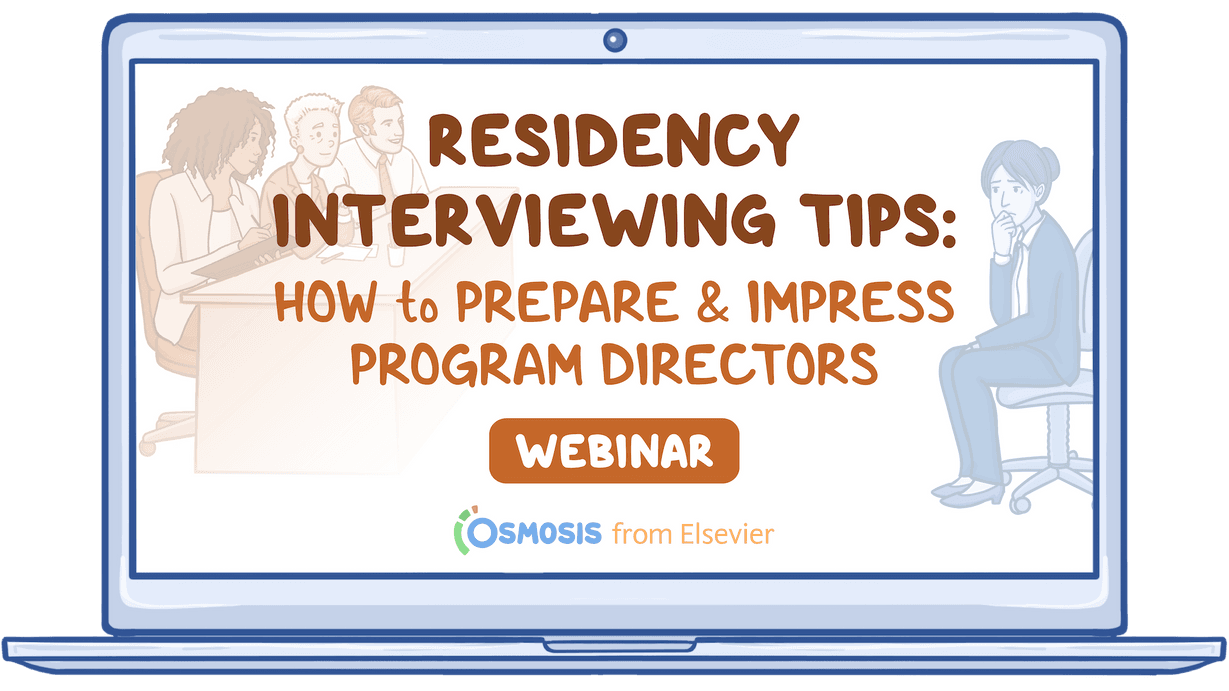
Okay, we are going to go ahead and get started. Thank you for joining us. Welcome to todays webinar: Residency Interviewing Tips: How to Prepare and Impress Program Directors. This webinar is being recorded and will be posted on the Osmosis events page early next week. We will send the link in the chat, and you will also receive an email when it is available. Please feel free to share any questions in the chat during the webinar. Keep in mind that it can take some time to answer them, so we will probably address them toward the end of the session and do our best to answer the majority before we finish. We will also share additional information and links in the chat throughout the webinar, so please open the links if you want to save them. My name is Rouida Caroline. I am a board-certified general pediatrician. I completed my residency at the University of Toledo in Ohio and completed a year of NICU fellowship at the University of Houston in Texas. I currently work in general pediatrics, and I have been working with Osmosis as a question writer for two years. I was also chief resident at the University of Toledo for a year. That is about it for me. I am happy you are all here. I know this is not the middle of interview season yet, so I am glad you are joining us early to learn how to prepare and what you need to do. Hopefully, this session will be helpful for you. Again, this webinar will be recorded and posted on the Osmosis events page early next week. Let us get started. Congratulations, everyone. Receiving an interview is a big deal. It means the program that sent it is already interested in you. Here is an interview pearl: one interview can get you to match. It is not about the quantity or how many interviews you get. It is about the quality of the interview and how much you show and impress during that interview. Residency interviews are a critical step. They are designed to assess your communication skills, professionalism, and overall suitability for the program. What are program directors and chief residents looking for? They are looking for your motivation, enthusiasm, communication and interpersonal skills, critical thinking, problem-solving skills, resilience, adaptability, teamwork, leadership, professionalism, and self-awareness. Three is our magic number for this webinar, and I want you to remember it. By the end of this webinar, I want you to remember three things. There are three phases of the interview: before the interview, interview day, and after the interview. There are three words to remember: practice, research, and impress. We will talk about each of these. There are three areas program directors value most: handling challenges, caring for patients, and working well within a team. These correspond to three things to prove during the interview: resilience, compassion, and collaboration. Let us start with the first phase: before the interview. First, you need to master your story. You need to know everything on your CV, personal statement, transcript, research, extracurricular activities, and clinical rotations. Here is another interview pearl: you will be asked about everything on your CV, so be careful what you put in there. When I was doing my residency interviews, I had listed a volunteer experience at a cancer hospital, and I was asked about it. You need to know the organization where you volunteered, what you did there, how much time you spent, how you found the opportunity, what it meant to you, and how it helped you grow. Being able to speak accurately about that experience shows it was meaningful and worth learning more about. Next, be ready for any red flags in your application. This means you need to be prepared to discuss any concerns, failed exams, or gap years. You will be asked about these. It is not to make you feel bad; it is to understand who you are, what happened, why it happened, and how you overcame it. Discussing red flags demonstrates the lessons you learned, your growth, your self-awareness, and your improvement. I will give an example. I had a red flag on my application, and I was asked about it in every interview I attended. I had a gap year because of illness in a family member. I explained that I had a gap year during my training, and during that time I was unable to finish my studies or take the exam as planned. But then I studied hard and took the first opportunity to sit for the exam after that circumstance. We overcame it, and there I was interviewing. They just want to know what happened and what you did afterward. It is not enough to say that something happened. You need to show that it happened, you learned from it, and you overcame the challenge. Next: practice makes perfect. Conduct mock interviews. Do them with a friend, resident, or family member. Have them use a list of common questions, difficult residency questions, or questions you feel weaker answering. You can also record yourself to see your body language. If it is a virtual interview, look at your interaction with the camera. Try to practice with people interviewing in the same specialty. This can help you brainstorm how to answer questions, especially questions like why you chose the specialty. You will also feel like you are practicing with someone who understands what you are going through. Practice will help refine your delivery and help you give clear, concise responses. The goal of practice is to become familiar with the questions, not to memorize answers. It is very clear when an applicant answers in a monotone, robotic way as if they memorized everything. That is not what we are looking for. Practice, but do not memorize. What are the key questions to prepare for? If you look online, you will find many questions, but these are the ones you will be asked in almost every interview: tell me about yourself, why this specialty, why our program, what are your strengths, what are your weaknesses, where do you see yourself in five to ten years, behavioral or STAR questions, hobbies, free time, and interesting situations or cases. Let us start with ?Tell me about yourself.? The goal of this question is not for you to repeat everything on your CV. I have already read your CV. I want to know more about you as a person and your professional journey. Be concise. Do not exceed about two minutes. Some interviews are only 15, 20, or 30 minutes, so you want every answer to be concise. Be relevant. Do not spend too much time on unrelated details. If your cousin went to medical school and inspired you, that may be part of the story, but I want to know why you wanted to go to medical school. Do not simply list what is on your CV. We already know it, unless you are adding meaningful context. For example, if you volunteered at a shelter and did not include all the details in your CV, tell me more about that. But you do not need to say you published 15 papers if I can already see that on your CV. Make it an interesting conversation. This is your first impression. You want the interviewer to think, ?I want to hear more about this person.? Your answer can include why you chose medicine, why you chose the specialty, a highlight from your journey, a career goal, or a fun fact about you. For example, my fun fact is that my name, Rouida, means ?take it easy.? Make it interesting and make them want to know more about you. The next common question is ?Why our program?? To answer this, you need to do your research. Know your destination. Once you get an interview from a program, go to their website. That is the first thing you should do. Invest time learning about the program. Get familiar with it. Know any recent or interesting news about it. This helps you have something insightful to discuss with the interviewer or program director. You should also understand the patient demographics and community involved. You do not want to enter residency without knowing what patient population you will be serving. This matters for you because this will be your next few years of training, and it also prevents you from appearing uninformed. Another thing I used to do was research the background of each interviewer and note any shared interests or career goals. If they had a publication or research area that excited me, I would bring it up during the interview. This helps you ask insightful questions and show genuine interest in the program. You might say, for example, that the program provides a balance of strong clinical training, a supportive learning environment, academic opportunities, a diverse patient population, and an emphasis on resident wellness. But I especially like when the answer is specific to that program. For example, ?I was excited to see that you are building a new hospital nearby,? or ?I noticed your team is interested in research on necrotizing enterocolitis.? Now we have answered ?Tell me about yourself? and ?Why our program.? Let us talk about strengths and weaknesses. These questions can feel tricky, but they are not meant to trick you. We are trying to understand who you are. The goal of asking about your strengths is to hear about your experiences and specific examples. Examples help the interviewer understand your goals and what you will bring to the program. For example, do not just say, ?I am a team worker.? Everyone says that. Give an example. Maybe there was a situation where someone was struggling, and you stepped in to help. You can pull examples from your CV or personal statement. For the question about strengths, try to give an example. For weaknesses, also use examples, but be careful what you choose. Do not say, ?I am very detail-oriented,? because in medicine we want you to be detail-oriented. We want you to know the patients history, physical exam, and details. Do not say you struggle with delegation, because as you grow into a senior resident, you need to delegate. If you say you fear public speaking, the interviewer may wonder how you will give presentations or interact with patients. Avoid cliché answers like ?I am a perfectionist? or ?I work too hard.? These are not really weaknesses. Focus on how you improved. For example, you might say you struggled with taking histories, then received feedback from an attending, responded to that feedback, and improved your history-taking skills during your internal medicine rotation. Talking about your weaknesses shows that you are self-aware. It does not mean you are weak. It shows you can improve and work on yourself. Now we are moving into STAR questions. STAR stands for situation, task, action, and result. These questions require examples. You need to describe the situation, your responsibility, the action you took, and the result or what you learned. These were the questions I found hardest when preparing for residency interviews. A common STAR question is, ?Tell me about a time you had to perform under pressure.? To answer it, understand what the interviewer is looking for: clinical competence under pressure. You will perform under pressure as a resident. You may be tired, in the ICU, or in the emergency room. We want to know how you will handle it. Will you get angry? Will you shut down? What will you do? For example, during residency, I was on a night call and had a two-month-old with respiratory distress who deteriorated quickly. I had to make decisions, intubate, and coordinate with my attending and the ICU team. Even though I felt pressured, I stayed calm, made decisions, followed a structured approach, and delegated tasks. The infant was stabilized and transferred safely. This experience reinforced my ability to stay composed, prioritize, rely on my team, and delegate. Tailor your answers to your specialty and your own experiences. Most of you have gone through clinical rotations and likely have a similar situation you can use. Another STAR question is, ?Tell me about a mistake you made and how you dealt with it.? This is not just about saying you gave the wrong dose or missed something in the history. You need to explain what happened next and how you corrected the mistake. I want to see accountability and what you learned. For example, in my first few days of residency, I called an attending about a patient with type 1 diabetes. My attending told me to give the patient ?15 of insulin,? and I did not clarify whether that meant 15 units or something else. I almost gave the wrong amount, but stopped when the nurse asked whether it was 15 units or 15 cc. I called my attending again and adjusted the care plan. Afterward, I reviewed diabetes management and created a folder to help with calculations for diabetic patients. This taught me the importance of details, teamwork, and asking for clarification when needed rather than risking patient harm. Mistakes are opportunities to grow. In this case, the mistake was caught in time, I learned from the nurse, and I learned more about diabetes care. Another STAR question is, ?How have you resolved a conflict with a coworker?? This shows emotional intelligence and teamwork. Conflict happens in residency. You may work with many residents, attendings, nurses, and staff. The interviewer wants to know what you will do if you disagree with someone. For example, we once had a conflict with a coworker about how to divide 60 patients. It created tension, but instead of letting it affect patient care, we listened to each others concerns, explained our perspectives, and created a clear system for dividing patients during high-volume months. Teamwork improved, we divided patients more efficiently for the next few weeks, and patient care benefited. The key is that you address the issue respectfully and privately when appropriate, not in front of everyone. Other questions you may be asked include ?Why did you pick this specialty?? and ?Are you interested in research or practice?? For the specialty question, this is your story. Think about what made you apply to internal medicine, family medicine, surgery, pediatrics, or whatever specialty you chose. What was your passion? For me, I always enjoyed pediatrics. I did not enjoy working with adults as much. I loved pediatrics from my clinical rotations. You can talk about the patient population. If you are going into surgery, maybe you enjoy helping people move from extreme pain to recovery after surgery. It can be a simple answer, such as being inspired by a role model. The most important thing is that you show passion and emotion. I want to know why you chose this path. The question ?Are you interested in research or practice?? often comes up in university programs because they do a lot of research. They want to know your interests. This is a long-term question, because you may not get heavily involved in research until after residency, although you will likely need to complete a project during residency. There is no right or wrong answer. We are not looking for something specific. We are getting to know you. If you say you want clinical practice or private practice, that is fine. If you say you are not sure whether you want research or practice, that is also fine. Be truthful. Do not tailor the answer just to the program. Tailor it to your true passion, because this answer will follow you through residency. It is fine to change your mind during training, but you do not want your answers to seem inconsistent or inauthentic. To summarize what program directors are looking for: motivation, professionalism, adaptability, fit with the program, and teamwork. These are the main qualities they will assess as they listen to your answers. Now you have prepared for the interview. Let us move to interview day. First impressions count. When someone enters the interview room, I notice how they are dressed. Dress professionally. For men, wear a suit. For women, wear a suit, either a pantsuit or skirt suit. It should be a full suit. Keep jewelry minimal. Be punctual. Arrive early or on time, and early is better. If the interview starts at eight oclock, that means eight oclock. If you arrive late, the first thing that will stick in our minds is that you were 15 minutes late. Be courteous to everyone. During the interview, maintain good posture, eye contact, and confident body language. For virtual interviews, make sure you have a good internet connection and a contact number for someone at the program in case of technical difficulties. Have a clean, non-distracting background and good lighting, either natural light or a ring light. Once the interview starts, look at the camera to show full engagement. It is easier to look at the person speaking, and you can do that while they are talking, but when you are speaking, try to look at the camera. A good way to practice is to record yourself answering a question and check where your eyes go. Let your true self shine. Interviewers want to know you. Show enthusiasm and genuine interest in the program. Avoid memorized or robotic answers. When you arrive for the interview, you are being assessed by everyone: the program director, interviewers, residents, coordinators, and staff. Maintain a professional and respectful attitude with everyone. We remember these things. Talk about your abilities using examples. Share your skills, values, and insights. Your answers should be memorable and impactful. The interviewer should remember something positive about you when you leave the room. For example, when I joined residency, the main thing people remembered was that I smiled all the time. You want to be remembered for something good. Be engaged and self-aware. Listen carefully to everything being said. If the program coordinator gives an introduction, pay attention. Do not look at your phone. When you get to the questions portion, adapt your responses. You can practice and research, but things will come up that you have not prepared for. If you do not understand a question, say so. If someone asks something and you do not immediately know the answer, you can say, ?Let me think about that,? take a few seconds, and then answer. That is completely fine. Let us talk about body language. First, a firm handshake matters. When you enter the interview, offer a firm handshake when appropriate. Everyone is nervous, but take a deep breath before entering the room and try to appear confident. Maintain a smile and good posture. Sit up straight. Use open hand expressions, but avoid too much hand movement. Do not chew gum. Do not appear disengaged or overly scared. We know interviews are stressful and can feel like they determine your future, but try not to show that fear too much. You may be shaking inside, but show confidence on the outside. We are looking for confidence. Now you are in the room. You have arrived, dressed professionally, shown good body language, and answered the questions. Now it is your turn to ask questions. You should have a list of questions for your interviewers. Remember, the interview is not only them assessing you; it is also you assessing the program and deciding whether it fits you. You will spend years of your life there, so feel comfortable asking thoughtful questions. Make your questions as personalized as possible to show interest in that specific program, hospital, or interviewer. For example, you can ask the interviewer, ?What drew you to work here?? or ?What is your area of interest?? Be careful with research questions, because if they have published research, you should already know that. But if they do not have many publications, it can be a good question. If you follow hospital or program news, you can ask about a new hospital building or wing and how it might affect future patient management, resident work, patient load, or patient volume. You can ask about the learning environment and opportunities for growth. For example, ask where most graduates go, whether they pursue fellowships or general practice, and how that aligns with your own future goals. If you are applying to pediatrics and want fellowship, but nine out of ten graduates go into general pediatrics or private practice, the program might not be the best fit for you. Another interview pearl: always be prepared to ask something. The worst interview is when there are five or ten minutes left and neither person knows what to say. It feels awkward and does not show interest in the program. Prepare at least two questions. They can also come from something discussed earlier in the interview that you want to clarify or learn more about. There are also questions you should avoid. Avoid asking questions that are easily found on the program website. For example, do not ask whether they have a lab or pediatric emergency room if that information is already online. Avoid personal questions for the interviewer, such as whether they are married or have children, unless it comes up naturally. They are not your friends yet. If you join the program, you will get to know them better, but during the interview, stay professional. Avoid asking the program director about salary, insurance, benefits, and similar issues, because these are usually on the website or in the contract information. You can ask residents about call schedule or vacation schedule when you meet them. Do not ask questions with an aggressive tone, such as ?Why do you not have a liver transplant program?? The answer may simply be that they do not have one. Try to avoid aggressive wording. Now you are done with interview day. Hopefully, it has been a great day and you have shown confidence, motivation, enthusiasm, and positivity throughout the process. One thing to remember: if you have one interviewer and feel you did not do well, do not let that ruin the rest of the day. If you have four interviewers and impress three of them, those three can make a strong impact. Do not feel discouraged if one interaction does not go well. Even one interview can get you to match. After the interview, and even during the interview day, write down notes about the program. Record details about the call schedule, patient demographics, what you liked, the attendings or interviewers you met, residents you interacted with, pros and cons, interesting topics discussed, and fun facts you learned about the program and interviewers. These notes will help you create your rank order list and decide which programs to place higher. Thank-you notes or emails are optional. It is up to you whether to send them, but be mindful of program rules. Some programs specifically say not to send emails or notes. If you do send them, make them personalized based on your experience with that interviewer. Send them to the specific person and reference something specific, such as their research or a conversation you enjoyed. If there is a program you are especially interested in, make the note as personal as possible. Here is a list of books that can help you prepare for interviews. The Successful Match is the one I used. Other options include The Residency Interview, BeMo, and How to Be an All-Star Resident, though some are better started earlier in medical school. I recommend The Successful Match. Your path to a successful match: you are almost there. You have worked hard. You have your CV ready. You have your personal statement, and someone is probably reading it right now. Your goal is to leave the interviewer with the impression that you are intelligent, mature, well-trained, and hardworking. Use examples and strong answers. You want them to know that you have excellent communication skills, are eager to learn, and will be a great member of their team. Remember, the best residency program is the one that is best for you. It is not necessarily the most famous or prestigious, and it may not be the best for everyone else. There is always debate about university versus community programs, but the best program is the best fit for you. The purpose of residency is to help you become the best physician you can be. You want that through great attendings, solid training, and a residency where you can be happy for three years. Think of it this way: this is three years of your life. You do not need to be in a prestigious place where you will be unhappy or end up leaving residency. That is all. I wish everyone the best of luck. Thank you for being with us today. We have about 10 to 15 minutes, so please let us know if you have questions. One question is: can you provide advice on how to manage interview day nerves and stay confident throughout? Great question. First, look in the mirror and feel impressed with how prepared and professional you look. Take a deep breath. When I knocked on the interview door, I would pause, breathe, and then enter. When I was sitting, I was shaking at times, but I reminded myself that I was okay. Choose a grounding technique, such as keeping your feet firmly on the floor. Drink water or coffee, eat between interviews if you have time, and do things that help you feel calmer. Another question is: what advice do you have for applicants interviewing at multiple programs in a short time? You will have to plan carefully. If the programs are in different states, cluster them by geography when possible. For example, if you are interviewing in New York and New Jersey, try to do those in the same week. If you are going to California or somewhere far away, schedule that separately. You do not want to go back and forth repeatedly, because it costs time and money. Another question: could you tell us about the letter of interest? Is it too late to send now? I will not say it is too late. You can send it and try. Applications are being filtered now, so if you upload it now, you may be lucky enough for it to be seen. Another question: how can applicants research and tailor responses to a specific residency program? Residency websites have the answers you need. Look into the details. Once you receive an interview, look at every page. Programs usually include information about call schedules, residents, interviewers, and news. Many programs also have Instagram or Facebook pages. Search those as well. This will help you understand the program and tailor your responses. Another question: can you share tips on how to communicate strengths effectively without sounding boastful? Examples help. When you give an example, you are not saying, ?I am amazing.? You are showing what you did, and the interviewer can interpret it. Instead of saying, ?I am a hard worker,? give an example that demonstrates it. Another question: are there specific strategies for virtual residency interviews compared to in-person interviews? Not necessarily, except for camera eye contact, lighting, and technical preparation. Have everything ready before the interview. Dress the same way you would for an in-person interview, including a suit. Keep jewelry minimal. Be prepared for the virtual setting. Another question: does not having social media, LinkedIn, or an online presence affect applicants negatively? No. We did not look at residents social media or LinkedIn. There is a system applications go through, and I do not think social media should affect your application. Another question: how can you effectively communicate weaknesses without seeming problematic? Again, examples help. Prepare your weakness answer this way: state the weakness, give an example, explain what you are doing to improve, and explain what you have learned. For example, you might say, ?I am a night owl, and I know that may be hard during residency when I need to wake up early. I am currently adjusting my schedule by going to bed earlier and going to the gym in the morning so I can prepare myself for residency. I think this will help me wake up earlier during training, and I can return to my night owl schedule on weekends or vacation.? That structure works: weakness, example, improvement, and learning. Another question: how do you get interviewers emails or contact information to send thank-you notes? During interview day, they may give you a pamphlet or interview schedule with names and contact information. When they send you the interview invitation, you may also receive interviewer names. Usually, contact information is available. If not, you can ask the interviewer, ?Can I have your email?? or ?How can I contact you?? That is fine. Another question: should I wear my hair up or down? It does not matter. As long as it is neat, clean, and professional, it is fine. Another question: are there any red flags or topics applicants should avoid bringing up in the interview? If it is on your CV, such as failed exams or a gap year, you should be prepared to discuss it. If you have not addressed it in your personal statement, be ready to talk about it in the interview. If it is not on your CV, it depends on what it is. If it is a weakness and you are asked about weaknesses, use the sequence we discussed. If it does not affect your workflow, teamwork, or residency training, it may not need to be brought up. Last question: for someone with many research publications, what should I be aware of? Be prepared to explain your role. If you have 15 publications, I may ask what you did in those publications. It is not enough for your name to appear on them. I want to know how you contributed, what your role was, whether you understand the research, and what each publication was about. Thank you so much for attending this webinar. You get 15 percent off Osmosis for attending todays webinar. We also have a two-week free trial of Osmosis as a thank you for attending. Stephanie will share the link in the chat. Thank you again for joining and for your great questions. To watch this or other recordings, or to register for future events, we will share the Osmosis events link. The recording of this event should be available early next week, and we will email you when it is live. Our next webinar is Proven Study Strategies for Learning Medicine and Nursing. It will be on November 13, and you can register on Osmosis events to get ready for exams. If you are ready to subscribe to Osmosis, we have the 15 percent offer for you, and do not forget the two-week free trial. Thank you again for joining us. We look forward to seeing you again soon. Helping current and future clinicians focus, learn, retain, and thrive. Learn more.