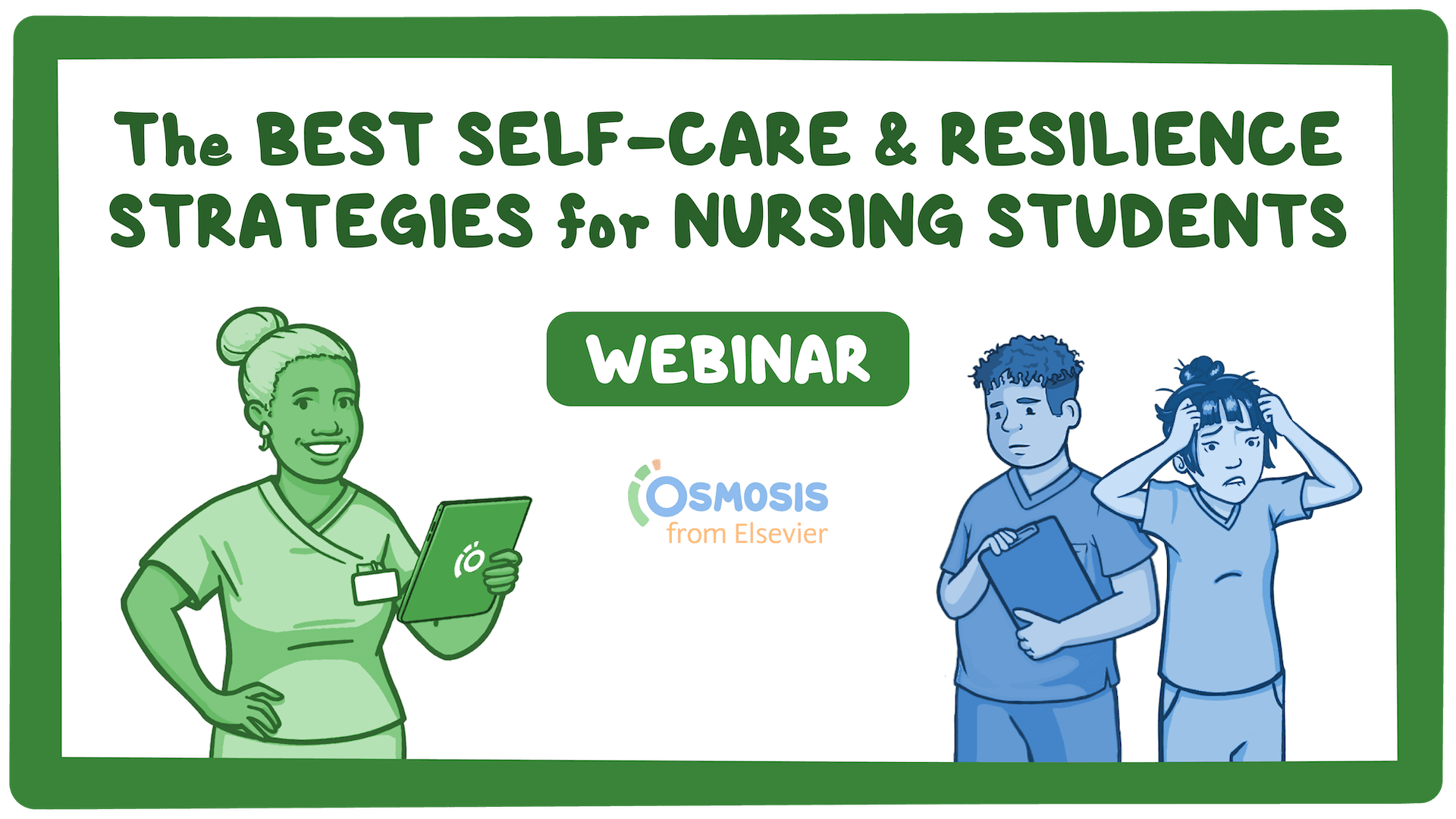
The Best Self-Care and Resilience Strategies for Nursing Students
April 29, 2025
Watch on Demand
Watch Osmosis nursing experts offer practical strategies for managing stress, building resilience, and promoting well-being in nursing. This webinar provides proven techniques to help you achieve a work-life balance and thrive both professionally and personally.
Transcript
I think we're just about there, so let me give one more official welcome now and we'll go ahead and get started. Welcome to today's webinar. Today, we're talking about the best self-care and resilience strategies for nursing students. Feel free to share any questions you have throughout the presentation and the webinar right there in the chat.
Keep in mind that it will take us some time to get to your questions; in fact, we'll likely wait until the end and do our very best to address the majority of your questions before ending the webinar. Thank you so much for your patience and for coming today.
We will be sharing additional information in the chat throughout this webinar, so feel free to go ahead and click on those links, open them up, and save them so you can refer back to them later. We will also, at the very end of the webinar, be offering a link to a free two-week trial, so stick with us to the end and you can get this extended free access to Osmosis.
Last but not least, this webinar is being recorded and we will post it on the Osmosis events page next week. If you want to refer back to it or even show it to your classmates or students, you can go to www.osmosis.org/events.
Okay, I'd like to introduce myself. My name is Liz Lucas. I'm the senior content manager for nursing here at Osmosis. I am a nurse, I have my doctorate in nursing and health professions education, and my nursing background is in inpatient and outpatient oncology. I live in Maryland in the United States.
I will allow Paige to introduce herself, but before she does that, I just want to brag about her for one minute. While her credentials under her picture show MS, she is literally days away from adding three more letters, which are PhD, and I am so excited for her. So with that being said, go ahead, Paige, introduce yourself.
Thanks, Liz. That was very nice of you to give me those kudos. My name is Paige Randall. I reside in Raleigh, North Carolina, in the United States. I am a nurse, and my clinical background is in emergency settings and cardiac nursing. For most of my career, I've been in nursing education. I taught a little bit in New York and in North Carolina, where I reside now. As Liz so nicely put, I'm almost done with my PhD in nursing from Duke University in Durham, North Carolina. I'm so excited to be here. Thanks, everybody.
Okay, so our agenda for today: We're talking about resilience. We'd like to start by just defining that for you. We're going to talk about resilience in nursing students and nurses, how self-care and resilience go together, some strategies to promote resilience, and we'll end with some resources for nursing students and nurses related to resilience. Then at the end, we'll have time to answer some of your questions.
Alright, so let's start with: What is resilience? Paige, do you mind helping us define this term?
Of course. Resilience is a pretty popular word right now. You've probably heard it discussed in school or in your program. As an educator or researcher, you?ve probably read it in the literature. The word resilience actually stems originally from psychology. One of the earliest research studies that used the term resilience was in the early 1980s. Researchers looked at resilience in children and adolescents to understand over time how some people in the study were able to adapt to adversity and challenges positively and how others were not. They looked at resilience as the ability to adapt to adversity and challenges.
You may have heard several different ways for resilience to be described?maybe as a trait, a mechanism, a concept, or a process. Today, we're not going to focus too much on the semantics. We know that resilience basically helps us navigate through trying times?from getting past small mistakes to finding our way through major life crises. It's the ability to face challenges directly in a positive manner and be able to move on, allowing you to recover, adapt, and thrive despite setbacks and failures, which are a part of life and certainly a part of nursing school and practice.
It's important to note that resilience is not an inherent trait. You're not born with or without it. Everybody has the capability of being resilient. It's a skill that can be learned and built up over time through strategies?some of which we'll talk about today?to build and promote self-care, self-confidence, and a positive mindset overall. We'll talk more in the upcoming slides about how you can build your own resilience.
Resilience has been researched quite a bit in nursing and nursing education. You might be wondering what it has to do with you as a nursing student or practicing nurse. Burnout, stress, and compassion fatigue are common factors that contribute to dissatisfaction in nursing, especially in high-intensity areas like emergency departments, pediatrics, intensive care units (ICUs). Research shows burnout can manifest as early as nursing school, so you're already going into nursing practice feeling stressed and burned out before practicing independently.
A method to combat these factors is to support the cultivation of resilience, backed by research (citations are in the presentation). By learning to cultivate resilience as a nursing student, you can bring these strategies with you into nursing practice to support your well-being and psychological safety as a nurse, especially when facing hard times.
Keep in mind, it's not just up to you alone to be resilient. Nurse leaders and managers have to establish a healthy work environment as well. This includes recognizing and applying strategies to foster resilience at the organizational level.
There's a lot of research showing how resilience helps clinical nurses adapt and survive challenges and stress. Resilience also combats workforce turnover and attrition?nurses leaving the profession or their units. It?s crucial for maintaining the strength, competence, and safety of the workforce.
We?re going to talk about some strategies to help you build resilience because, thankfully, resilience is not something you either inherently have or don?t have. It's something you can work on.
Before we get into that, a quick reminder: If any questions come to mind during the presentation, please place them in the chat.
Sometimes before thinking about resilience, it's important to consider choosing the right environment for you. Many factors in your personal and professional life can impact your resilience positively or negatively.
Let's pause and talk about environments that might reduce your need to develop a high level of resilience. Don?t get me wrong; there will be tough days even if you find the perfect work environment. I know as an oncology nurse and nurse educator, tough days are unavoidable.
If you?re considering your first job out of nursing school or thinking of a change, here are a few things to think about:
One thing I recommend asking about, especially in interviews, is the orientation to the unit?nurse residency programs and mentorship opportunities. Some hospitals have very thorough nurse residency programs. Nursing school prepares you well, but a good orientation or nurse residency program helps you start practicing fully independently. These programs vary from absent to lasting weeks or even one to two years, providing continued support and mentorship.
Also, when interviewing, remember they?re trying to see if you?re a good fit, but you also want to see if the unit or facility is the right fit for you.
Consider the culture of the unit or hospital, nursing turnover rates, and opportunities for social gatherings. High turnover might be a red flag.
Ask about paid time off policies?do you accrue hours over time or get a set number of weeks upfront?
Inquire about patient-to-nurse ratios, break and lunch policies?some units fully cover your breaks with handoff; others expect you to manage patients during breaks.
What will your schedule look like? How many night or weekend shifts?
If possible, speak to current nurses on the unit for unbiased opinions. Ask if you can shadow a nurse before accepting a position to understand day-to-day work.
Now, let?s talk about resilience and self-care, knowing what to watch for when considering role changes or first nursing positions.
Self-care is the cornerstone of well-being for nurses. It plays a pivotal role in your ability to provide high-quality care while maintaining your own health and happiness.
Taking care of yourself is key to providing safe patient care.
You can?t pour from an empty cup. Fill your cup before giving to others.
Put on your own oxygen mask before helping others.
These sayings might sound cliché but are true.
Build self-care into your daily routine?exercise, naps, TV, writing, meditation?whatever fits your interests.
Paige and I both enjoy exercise for self-care.
Self-care might seem frivolous compared to studying, caring for family, or working shifts, but it?s essential.
We recommend quick, easy self-care methods to help maintain energy and focus.
Neglecting self-care worsens stress and diminishes job performance.
Self-care is not a luxury or just for yoga fans; it?s your lifeline, especially when busy with textbooks, videos, or clinical chaos.
Self-care includes physical strategies like exercise and yoga, and mental strategies like journaling and therapy.
We?ll share a blog in the chat about the top 10 ways to become a happier person.
Now, how does self-care relate to resilience?
Engaging in self-care builds a foundation of physical, mental, and emotional well-being that helps handle stress and challenges.
This is ?filling your cup? so you can pour from a full cup.
Activities like exercise, mindfulness, and social connections enhance your ability to manage stress and recover from setbacks.
Many things are out of your control as a student or nurse?test schedules, clinical rotations, patient behaviors.
Self-care fosters adaptability to ?go with the flow? and navigate unpredictable work with ease.
It acts as a buffer against burnout and fatigue.
One self-care activity proven effective is mindfulness?the conscious practice of being fully present and engaged.
Mindfulness helps reduce stress hormones and improves emotional regulation.
Some mindfulness practices include meditation?just 10 to 15 minutes a day, guided or silent, to create restfulness.
Apps like Headspace or Calm offer beginner-friendly sessions. YouTube has thousands of free meditation videos.
Your school or workplace might offer free or discounted meditation apps.
Another practice is deep breathing exercises, such as box breathing: inhale for 4 seconds, hold for 4, exhale for 4, hold for 4.
It takes less than 30 seconds and helps manage acute stress, especially during clinical rotations or exams.
You can do it anywhere discreetly.
Let?s try box breathing together now: inhale for 4 seconds, hold, exhale for 4 seconds, hold.
Lastly, gratitude practice involves regularly focusing on positive aspects of life.
Keep a gratitude journal to refer back to on tough days.
Express gratitude verbally or in writing to others.
Reflect on positive experiences or moments of joy.
This helps shift attention from negative thoughts and promotes contentment.
There will be tough days when it feels like nothing goes right, but taking a moment to acknowledge simple positives can help.
I adopted a mindful practice early in my career: after each shift, I?d name what went well and what I could improve.
This helped me avoid obsessing over mistakes and improved my sleep and mood.
Even experienced nurses can find areas to improve.
For example, planning to be more efficient on medication passes or taking real lunch breaks.
You can?t change the past; just move on.
Paige will now discuss more strategies to promote resilience.
Thanks, Liz. Those were great strategies.
Consistency is key. Practices like meditation and gratitude need to be repeated over time for real change.
Doing them once won?t immediately make you resilient.
Making them part of your daily routine will show benefits over time.
Another strategy is developing your identity outside nursing.
While nursing is a huge part of your life, cultivating your personal life enhances well-being and perspective.
Having things to look forward to outside work helps balance bad shifts or mistakes.
It can be hard to fit in fun activities with demanding schedules, but scheduling personal time is important.
Using your identity outside nursing can be anything?being a good partner, family member, or enjoying hobbies like art, reading, or Netflix binges.
Giving back, volunteering, or helping loved ones after hard days can also boost resilience.
Setting realistic goals is another great way to foster resilience and accomplishment.
It helps minimize feeling overwhelmed?a common issue for healthcare professionals.
Achievable goals create dopamine hits and reduce anxiety.
Unrealistic goals often lead to stress, anxiety, and depression.
Using the SMART framework (Specific, Measurable, Achievable, Relevant, Time-bound) helps create clear, attainable goals.
Breaking down big tasks into daily or weekly steps reduces anxiety and provides a sense of progress.
Tracking progress with planners or apps helps motivation.
Celebrate your victories, no matter how small.
If you don?t meet a goal, be patient and compassionate. Learning is a process.
Looking back at past accomplishments can give strength and confidence for future challenges.
Using your support network?personal and professional?is vital.
Friends, family, mentors, teachers, and classmates provide powerful buffers against stress and burnout.
Isolation damages emotional well-being.
Even if you feel stressed and want to be alone, sharing your feelings can help.
Join study groups, professional organizations, or online nursing communities for camaraderie and problem-solving.
Some useful groups include nursegroups.org, operationappynurse.com, and nursesupportnetwork.org.
Reddit also has nursing student and nurse communities to share experiences.
Remember to pay it forward?help others who may face challenges.
Recognizing stress early is important.
Watch for ?stress red flags? like headaches, muscle tension, irritability, loss or increase in appetite, withdrawal, or seeking distraction.
Reflect on what coping techniques have worked for you and keep notes.
Weave stress management into daily life, so it becomes second nature.
For example, pause for 5 seconds before responding in conversation to reduce reactive stress.
Ask for help when needed. It?s a strength, not a weakness.
Maintaining mental health is crucial.
Normalize seeking therapeutic support?talking to professionals or taking medication.
Many universities offer confidential counseling services at low or no cost.
Hotlines like 988 in the US and 111 in the UK provide crisis support.
Online counseling platforms like BetterHelp or Telus can accommodate busy schedules.
Reach out for help with other life stressors too?finances, housing, childcare.
People won?t know you need help unless you say so.
Timely intervention supports long-term happiness and success.
Remember, resilience is not solely your burden.
Nurse leaders and managers must foster healthy work environments.
Staff well-being directly impacts patient safety and care quality.
Research shows burnout and resilience factors at individual and system levels.
Building resilience might feel like ?one more thing,? but you?re not alone.
The first year of nursing is typically the hardest.
If you feel overwhelmed or surprised by challenges, you?re not alone.
Support networks can help if you can?t share struggles at work.
Resilience is within your control and can be impacted by your actions.
Starting these practices early builds a bigger well to draw from.
Advocate for yourself. Speak to leaders if the environment isn?t right.
Hospitals want to keep their nurses?they invest time and money.
Nursing is already the best profession, and things are improving.
Nurse educators and researchers work hard to improve environments.
Hospital systems are working to better care for nurses.
Avoid comparisons; they steal your joy.
Everyone progresses at different rates, and struggles may be hidden.
Finally, there are many resources on resilience:
AACN: initiatives and toolkits on well-being and resilience
Nursing World: three steps to building resilience
American Holistic Nurses Association: self-care and resilience resources
NLN: education and well-being resources
Osmosis offers blogs and past webinars on self-care, resilience, and mental health.
Check the links in the chat and save resources for later.
Let?s check our time. We do have time for questions. If you have questions, please add them to the chat.
I see a question: How do I get into a competitive nurse residency program?
Great question?and actually related to resilience.
Good nurse residency and orientation programs help you start strong.
Advice: Research the hospital website. Look at their mission and vision and see if you align.
Tailor your resume and experiences to reflect their values.
Be thorough and detailed in your application.
Prepare for interviews by knowing why you want to join nursing and that hospital.
Write a concise cover letter highlighting why you?re a good fit.
Make personal connections if possible, e.g., via LinkedIn.
Paige, anything to add?
I think that covers it. Osmosis.org/events has webinars on resumes and cover letters.
Follow Osmosis on Instagram for career tips.
There?s plenty of career planning resources on the Osmosis site.
Another question: What is the big difference for first-year students starting clinicals compared to classroom?
Clinical is where you apply classroom knowledge.
Expect limited experience at first, progressing to more complex patients and responsibility.
You?ll never be fully independent but will do some tasks with less supervision.
Always follow school and hospital policies.
Paige, anything else?
Schedules change; clinical shifts can be long and irregular.
Prepare by reading clinical expectations: name badges, scrubs, supplies, logins.
Ask upperclassmen or faculty for advice.
Don?t be afraid to ask questions.
Someone asked about starting in ICU as a new grad.
It?s competitive and intense.
No wrong place to start; medical-surgical is a great start, but if ICU is your passion, seek orientation programs and experience.
Shadowing or clinical hours in ICU help you stand out.
Another question about pre-graduate internships or externships.
Many hospitals offer these as paid opportunities, often between junior and senior years.
Start researching early and apply timely.
If no other questions, thank you all for joining.
Remember to click the free two-week trial link in chat.
Good luck, everyone!
Helping current and future clinicians focus, learn, retain, and thrive. Learn more.
Event recordings
The Mind-Body Connection: Integrating Mental Health into Primary & Specialty Care
October 20, 2026
The Future of Education with Dr. Mike
September 29, 2026
What You Need to Know About Using Social Media as a Health Care Student
August 13, 2026
Transition Strategies for New Nursing Graduates
July 9, 2026

Delivering Better Virtual Care: Improving Your Telehealth Skills
June 18, 2026