Arrhythmias - Atrial fibrillation (Afib): Nursing
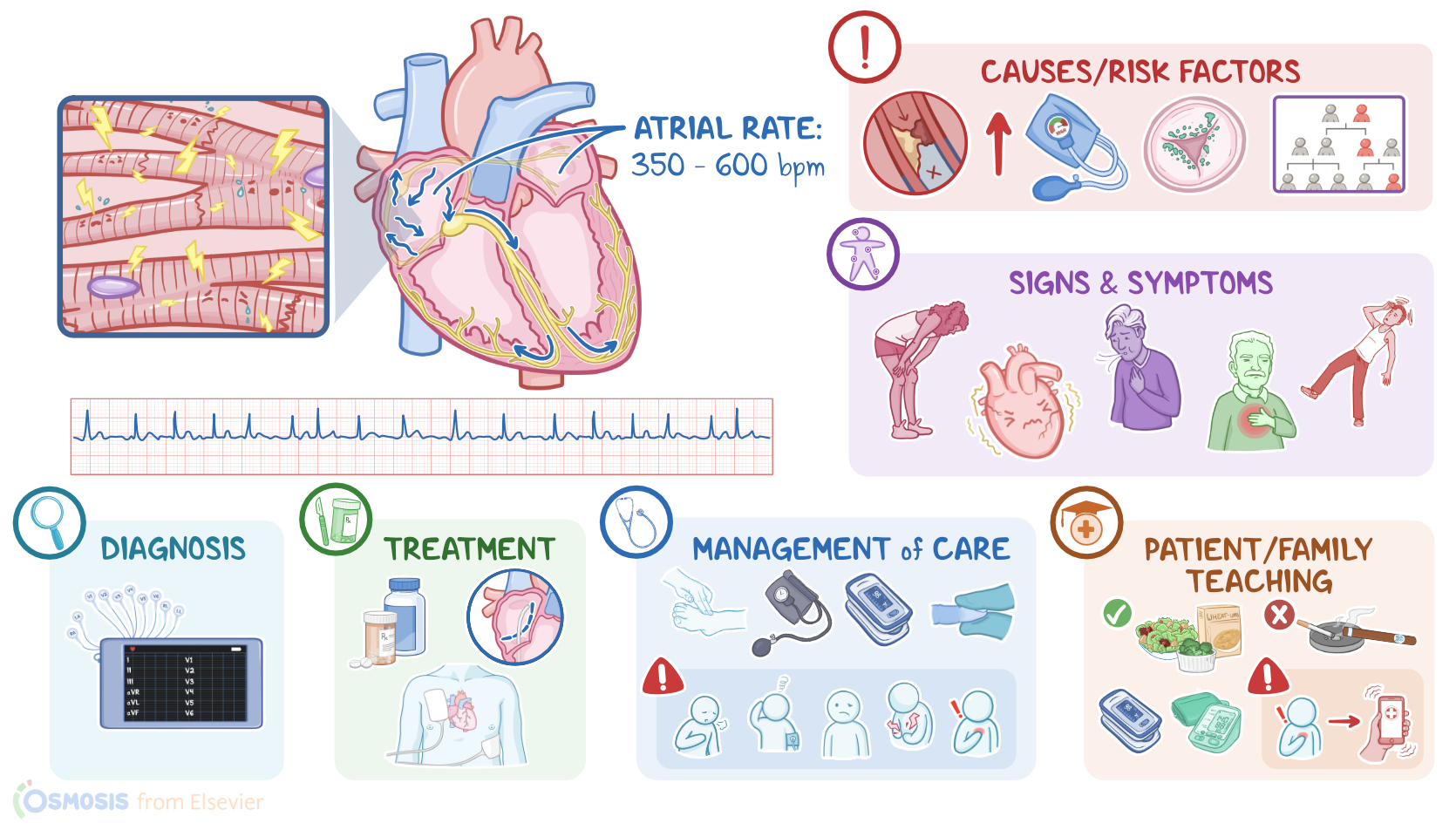
Atrial fibrillation, sometimes called Afib for short, is the most common cardiac arrhythmia which occurs when the atria contract way faster than normal, and in a disorganized manner. As a result, the atria have a quivering, or twitching movement that can’t pump blood into the ventricles efficiently.
Now let’s look at the normal electrical conduction pathway in the heart on an ECG, which shows how the depolarization wave flows through the heart during each heartbeat. The normal electrical activity of the heart starts in the sinoatrial or SA node, which is considered the pacemaker of the heart. Then, the impulse is conducted through the atrium, creating the P wave on an ECG. And when the atrial muscle cells get depolarized, they contract, pushing blood from the atria into the ventricles.
From the atrium, electrical activity goes to the atrioventricular, or AV node, where impulse propagation speed slows way down; this is the PR interval on an ECG. This pause allows the atria to contract while the ventricles fill with blood.
From the AV node, the depolarization wave goes through the Bundle of His, then the right and left branches of the Bundle, and finally through the Purkinje fibers, which deliver the current to the right and left ventricles, causing them to depolarize. This triggers simultaneous contraction of both ventricles, pushing blood into the systemic and pulmonary circulations, and it’s represented by the QRS complex on an ECG.
Finally, the ventricles repolarize to prepare for the next cycle, which allows them to relax and fill with blood, called diastole. And on ECG, ventricular repolarization will create a T wave, while the pause between ventricular depolarization and repolarization is represented by the ST segment. Sometimes, immediately after the T wave, there’s a U wave, which represents late repolarization of the ventricles.
Okay, now, atrial fibrillation is typically caused by any kind of structural damage to the heart, or any damage to the electrical conduction system of the heart. Often, these changes are strongly associated with several cardiovascular disorders and a variety of risk factors. For example, high blood pressure, coronary artery disease, valvular diseases, essentially anything that can create an inflammatory state or physically stretches the atria, may potentially damage the cells in the atria and lead to atrial fibrillation.
| ARRHYTHMIAS - ATRIAL FIBRILLATION (AFIB) | ||
| KEY POINTS | NOTES | |
| DEFINITION |
| |
| PHYSIOLOGY |
| |
| CAUSES AND RISK FACTORS |
| |
| PATHOPHYSIOLOGY |
| |
| SIGNS AND SYMPTOMS |
| |
| DIAGNOSIS |
| |
| TREATMENT |
| |
| MANAGEMENT OF CARE |
| |
| PATIENT AND FAMILY TEACHING |
| |
No notes for this video yet
Try adding a note below