Burn injury: Nursing
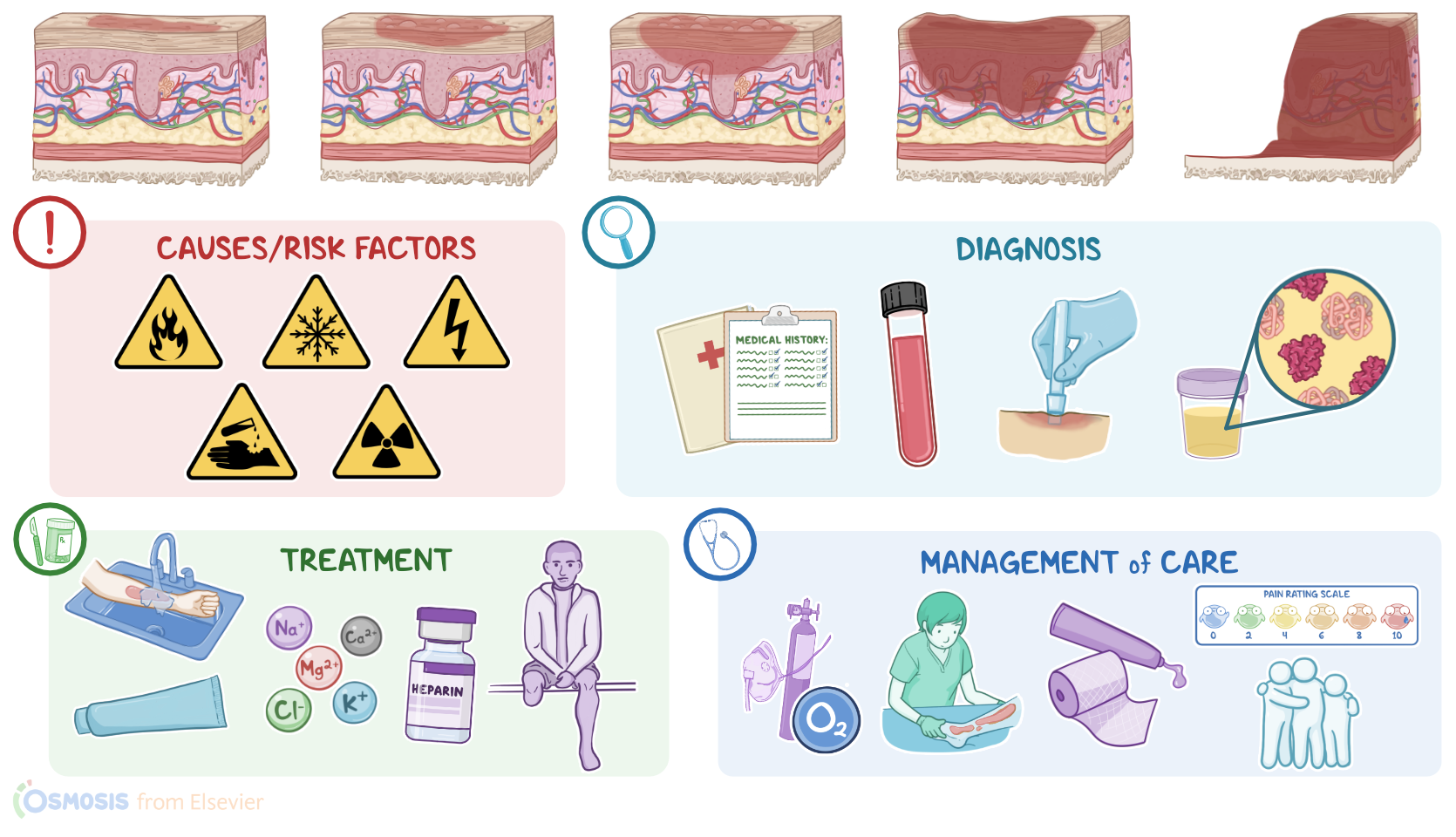
Burn injuries are a type of acute wound where the skin and tissue underneath are damaged by exposure to heat, extreme cold electricity, chemicals, or radiation.
Okay, first, let’s talk about physiology. The skin is the outer barrier that protects the body from excessive water loss, as well as any external threat like pathogens. The skin is divided into three main layers, the hypodermis, dermis, and epidermis. The hypodermis is made of fat and connective tissue that anchors the skin to the underlying muscle and acts as a cushion that protects underlying tissues from trauma. Above the hypodermis is the dermis, which is made of proteins like collagen that provides structural support, as well as elastin that provides flexibility. The dermis also contains hair follicles, nerve endings that collect sensory information, as well as sweat glands, and blood vessels, which help regulate body temperature. And just above the dermis is the epidermis, which itself has multiple cell layers that are composed of developing cells called keratinocytes.
Now, the skin has this special ability to repair itself when damaged. To do that, there are three main processes: reepithelialization, granulation, and wound retraction. Reepithelialization describes the resurfacing of damaged skin by new skin cells. If the damage is too great to be fixed only by reepithelialization, granulation and wound retraction come into action. Granulation is the process of forming granulation or scar tissue, which contains new blood vessels and fibroblasts. These fibroblasts form new connective tissue and have the ability to contract, pulling the edges of the wound together in a process called wound retraction.
Okay, burn injuries can be classified based on the cause. The most common cause are thermal burns, which can result from scalds from hot liquids or steam, from open flames, such as from house fires, or by direct contact when a hot object like oven doors or cookware is touched. Less commonly, there’s electrical burns from exposure to a lightning strike or high-voltage electrical current, and chemical burns from exposure to chemical substances like acid or alkaline chemicals. Finally, there’s radiation burns, which can be caused by exposure to UV radiation from the sun or from radiotherapy.
Alright, now burn injuries can also be classified based on the degree, depending on the severity. Starting with first degree burns, these are also called superficial burns and involve the epidermis only. Next are second degree burns, which are further classified into superficial second degree burns, which involve the epidermis and the superficial dermis; and deep second degree burns, which also involve the deeper parts of the dermis. Third degree burns are full-thickness burns, destroying the entire epidermis and dermis. Finally, fourth degree burns, also called deep full-thickness burns, extend beyond the dermis, destroying deeper structures like muscles, tendons, or bone. In addition, the total body surface area, or TBSA, affected by the burn also contributes to the severity, since burns that involve over 10% are more likely to cause systemic complications.
| BURN INJURY | ||
| KEY POINTS | NOTES | |
| DEFINITION |
| |
| PHYSIOLOGY |
| |
| CAUSES AND RISK FACTORS |
| |
| PATHOPHYSIOLOGY |
| |
| SIGNS AND SYMPTOMS |
| |
| DIAGNOSIS |
| |
| TREATMENT |
| |
| MANAGEMENT OF CARE |
| |
| PATIENT AND FAMILY TEAHING |
| |
Notes
| CASE STUDY - BURN INJURY | ||
| KEY POINTS | NOTES | |
| INTRODUCTION |
| |
| RECOGNIZING AND ANALYZING CUES |
| |
| PRIORITIZING HYPOTHESES, GENERATING SOLUTIONS, AND TAKING ACTIONS |
| |
| EVALUATING OUTCOMES |
| |
No notes for this video yet
Try adding a note below