Care of a client in the emergency department: Nursing
Introduction0:00–0:01
Introduction0:01–0:41
The role of a nurse in the emergency department, or ED, is to identify and respond to patients with potentially life-threatening conditions using a standardized triage process.
Triage involves rapidly classifying patients based on the severity of their condition and then caring for the most critically ill first.
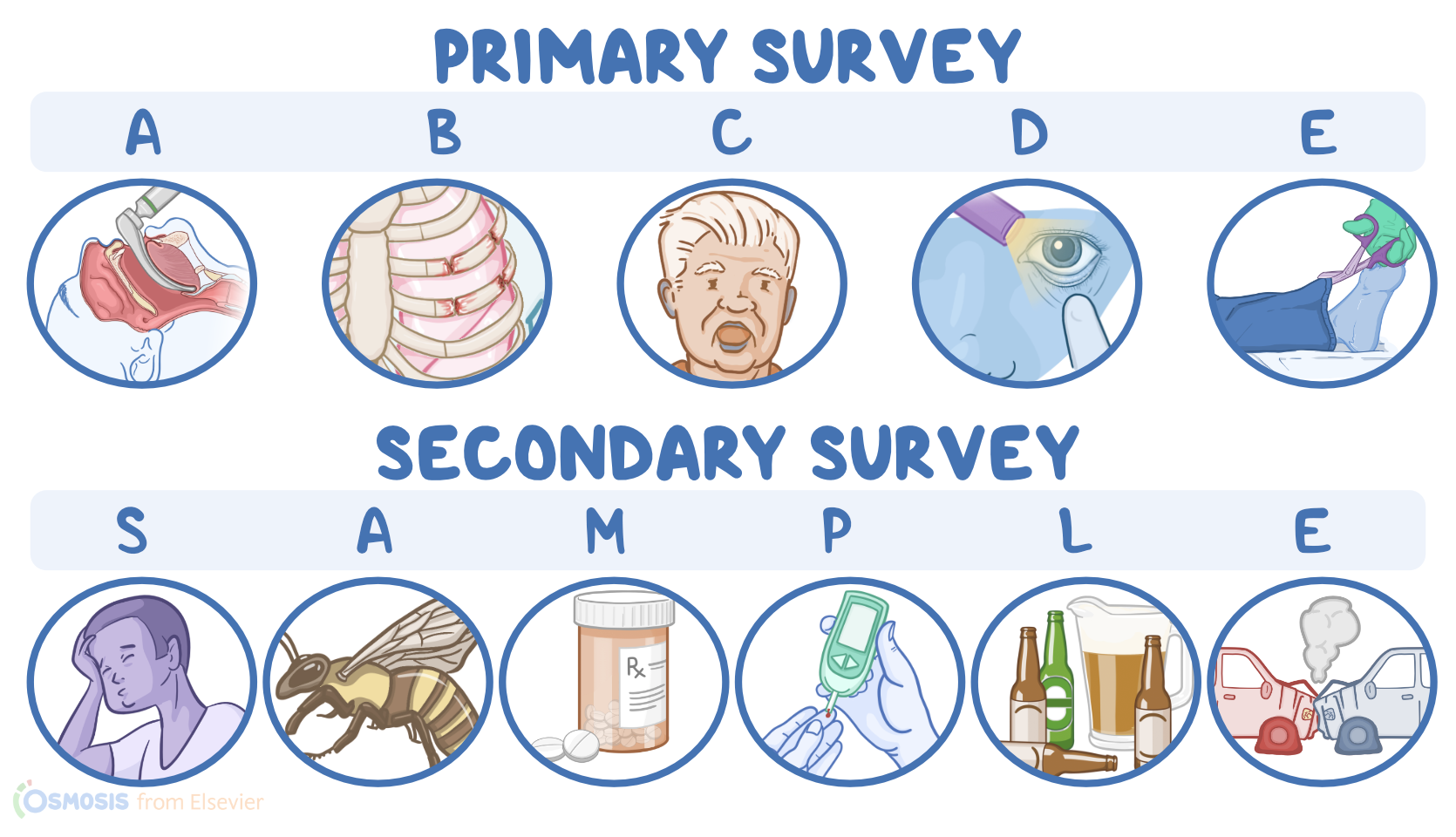
The triage process includes a primary survey, to identify emergent conditions, like hemorrhage or skull fractures, and manage them as they are identified; followed by a secondary survey, to identify urgent and nonurgent conditions and injuries, like a broken arm or leg wound.
Now the primary survey is the initial assessment of your trauma patient, that can be guided using the mnemonic ABCDE, which stands for Airway, Breathing, Circulation, Disability and Exposure.
Primary Survey0:41–4:24
Your primary survey begins when you first see your patient. If, during this time, you identify an obvious and significant external hemorrhage, your focus will shift from ABCDE to CABDE, meaning you should control the hemorrhage first before moving on with your assessment.
If no external hemorrhage is noted, you'll start your assessment with A, where you’ll assess alertness and airway patency.
To determine alertness, assess your patient’s level of consciousness using the mnemonic AVPU. A is for alert, V is for responsiveness to voice, P is for responsiveness to pain, and U is for unresponsiveness.
For airway patency, look for signs of a compromised airway, like gasping, or agonal breaths, dyspnea, and facial or neck trauma.
Be sure to identify airway obstructions, like secretions, emesis, an enlarged tongue, or foreign objects, like loose teeth or dentures.
For patients who are unable to keep their airway patent, prepare them for rapid sequence intubation. Also, if your patient is suspected of having a spinal cord injury, stabilize their cervical spine using a cervical collar or immobilization device.
Next, for B, you’ll assess breathing. Even with a patent airway, other problems can cause impaired ventilation and gas exchange, like broken ribs or flail chest, which happens when two or more contiguous ribs break in multiple places and detach from the sternum.
During this step, observe respiratory pattern, depth, and rate. Also auscultate lung sounds.
Note the color of their skin, mucous membranes, and nail beds for signs of cyanosis caused by decreased oxygenation. For patients with impaired breathing, give supplemental oxygen through a nonrebreather mask, provide rescue breaths using a bag-valve-mask with oxygen, or prepare them for intubation, as indicated.
If your patient’s lung sounds are absent, prepare them for chest tube insertion. Moving on to C, you’ll assess circulation and continue to control for hemorrhage, when present.
You’ll palpate their carotid and femoral pulses, and, if absent, immediately initiate CPR and advanced life support measures.
If pulses are found, assess the rhythm, quality and rate, and assess capillary refill. Next there’s D, where you’ll assess disability, which is a rapid assessment of neurologic status.
You can use your assessment data from your previous AVPU assessment, or use the Glasgow Coma Scale, or GCS, which evaluates eye-opening, verbal, and motor responses to determine level of consciousness.
After your patient is exposed, be sure to keep them warm, using warmed blankets or IV fluids, and provide for privacy. Okay, after your patient is stabilized, you'll complete a secondary survey, which is a comprehensive assessment to identify and address all other injuries and medical issues that need intervention.
Secondary Survey4:24–7:10
Begin by performing a thorough history, which can be guided by the acronym SAMPLE: Symptoms associated with illness or injury, Allergies, Medications, Past health history, Last oral intake, and Events leading up to the illness or injury.
If your patient can’t speak, you’ll obtain information from family, friends, and bystanders, as needed. Next, you’ll perform a head-to-toe physical assessment.
Begin by inspecting your patient’s head, neck, and face for signs of trauma, like bruising behind the ears known as the Battle sign, which may indicate a basilar skull fracture.
Assess their eyes, ears, nose, and mouth for any abnormalities, like clear drainage, which could indicate a cerebrospinal fluid leak.
Then palpate their head for skull depressions, crepitus, and tenderness. Be sure to note any neck stiffness or distended neck veins and inspect for tracheal deviation.
Moving on to the chest, assess the chest wall for movement and note any substernal or intercostal retractions during inspiration.
Next, palpate their chest for crepitus or subcutaneous emphysema, which can happen with pneumothorax. Then, obtain diagnostic tests, like ECG or chest X-ray.
Inspect their abdomen and flanks for signs of trauma, like bruises or puncture wounds. Auscultate bowel sounds, and palpate for guarding, rigidity, rebound tenderness, and masses.
Then, gently palpate the pelvis, being careful not to rock the pelvis if fracture is suspected. After that, inspect the upper and lower extremities for signs of external injuries, deformities, and restrictions to movement, sensation and strength, being sure to compare side-to-side.
Lastly, continue to re-evaluate your patient’s condition frequently. Alright, as a quick recap...
Review7:10–7:34
The role of the ED nurse is to identify and respond to patients with potentially life-threatening conditions using a standardized triage process.
The triage process includes a primary survey, to identify and manage life-threatening conditions, followed by a secondary survey, to identify all other conditions
| CARE OF A PATIENT IN THE EMERGENCY DEPARTMENT | ||
| KEY POINTS | NOTES | |
| DEFINITION |
| |
| PRIMARY SURVEY |
| |
| SECONDARY SURVEY |
| |
- "Lewis's medical-surgical nursing: Assessment and management of clinical problems (12th ed.)" Elsevier (2022)
- "Medical-surgical nursing: Concepts for interprofessional and collaborative care (10th ed.)" Elsevier (2021)
- "Lewis’s medical-surgical nursing in Canada: Assessment and management of clinical problems (5th ed.)" Elsevier (2023)
No notes for this video yet
Try adding a note below