Case study - Acute pancreatitis: Nursing
Introduction0:00–0:29
Nurse Gerdie works on a medical-surgical unit and is caring for Leo a 47-year-old male who was recently admitted for acute pancreatitis secondary to alcohol use.
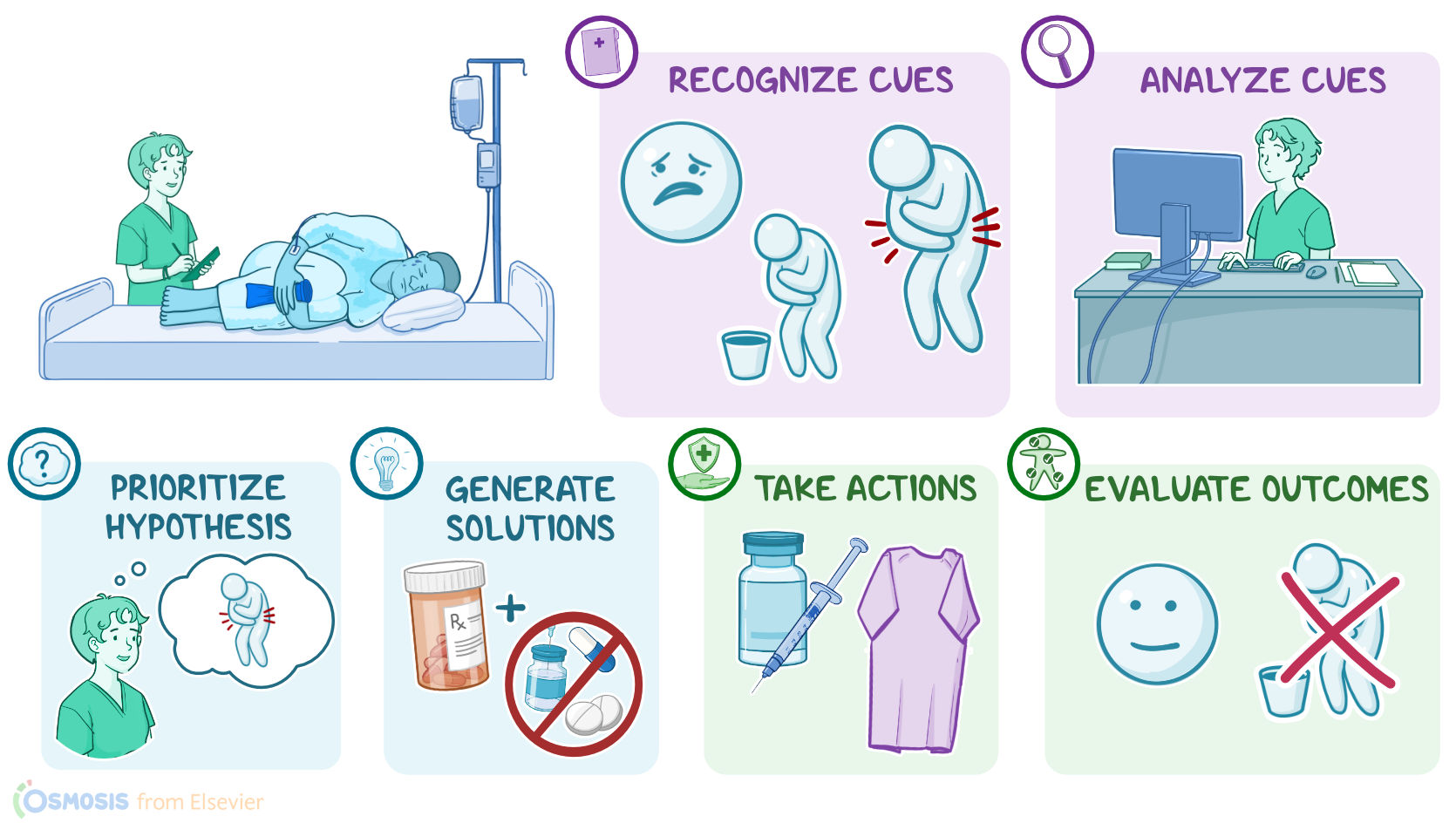
After settling Leo in his room, Nurse Gerdie goes through the steps of the Clinical Judgment Measurement Model to make clinical decisions about Leo's care by recognizing and analyzing cues, prioritizing hypotheses, generating solutions, taking action, and evaluating outcomes.
First, Nurse Gerdie recognizes important cues, including Leo’s vital signs, which include blood pressure 145/90 mmHg, heart rate 88 beats per minute, and respirations 18 breaths per minute.
Recognizing and Analyzing Cues0:29–1:40
Nurse Gerdie notices Leo is diaphoretic, his gown is damp, and he’s lying in the fetal position clutching an empty emesis bag.
She also sees that he has IV fluids infusing in his right forearm. Nurse Gerdie: Hi Leo, it looks like you're not feeling well.
What's your pain level right now? Leo: It feels like I can’t lie down on my back or get comfortable at all.
And I’m so nauseated. Nurse Gerdie: I understand, I’m going to help you feel more comfortable.
Next, Nurse Gerdie analyzes these cues. She reviews the electronic health record, or EHR, and notes that Leo’s prescriptions include hydromorphone IV every 3 hours as needed, and his last dose was given two and a half hours ago in the emergency department; and ondansetron IV for nausea, but he hasn’t yet received a dose.
She recognizes that Leo needs effective pain and nausea management to improve his comfort. Now, using the information she's gathered, Nurse Gerdie chooses a priority hypothesis of impaired comfort.
Prioritizing Hypotheses, Generating Solutions, and Taking Action1:40–2:47
Then she generates solutions to address Leo’s pain and nausea that will include pharmacologic and nonpharmacologic interventions.
Nurse Gerdie establishes the expected outcome that after intervening, Leo will report increased comfort within one hour.
Nurse Gerdie then takes action to implement these solutions. She recognizes he cannot have his next dose of IV hydromorphone for another 30 minutes, so in the meantime, she administers the prescribed ondansetron according to the principles of safe medication administration.
She also brings a new patient gown for him and helps him change out of the damp one. After she’s finished, Leo is now due for his hydromorphone.
Nurse Gerdie: Okay Leo, I’ve got your pain medication, which is the same one you received in the emergency department. Leo: Great, thank you.
It really helped me before. Nurse Gerdie administers the hydromorphone according to the principles of safe medication administration.
She then dims the lights, covers him with a warm blanket, and places his call light within reach. Thirty minutes later, Nurse Gerdie re-enters Leo’s room to evaluate the outcome of her actions.
Evaluating Outcomes2:47–3:23
She reassesses Leo’s pain and takes his vital signs. His blood pressure is now 126/82 mmHg, heart rate 70 beats per minute, respirations 16 breaths per minute.
He appears more comfortable and is sitting up in bed eating ice chips. Nurse Gerdie: How are you feeling now, Leo?
Leo: Much better. The pain is still there at a 3 out of 10, but the medication you gave me really helped with the nausea.
I feel much more comfortable. Alright, as a quick recap...Nurse Gerdie recognized and analyzed cues related to Leo’s impaired comfort, prioritized hypotheses, and generated solutions to address this problem.
Review3:23–3:46
Nurse Gerdie then implemented pharmacologic and nonpharmacologic measures to address Leo’s impaired comfort, and evaluated Leo’s outcomes, comparing them to the expected outcome.
Since Leo’s comfort increased, Nurse Gerdie determined the plan of
| CASE STUDY - ACUTE PANCREATITIS | ||
| KEY POINTS | NOTES | |
| INTRODUCTION |
| |
| RECOGNIZING AND ANALYZING CUES |
| |
| PRIORITIZING HYPOTHESES, GENERATING SOLUTIONS, AND TAKING ACTIONS |
| |
| EVALUATING OUTCOMES |
| |
- "Lewis's medical-surgical nursing: Assessment and management of clinical problems. (12th ed.)" Elsevier (2022)
- "Medical-surgical nursing: Concepts for interprofessional and collaborative care. (10th ed.)" Elsevier (2021)
- "Lewis’s medical-surgical nursing in Canada: Assessment and management of clinical problems. (5th ed.)" Elsevier (2023)
No notes for this video yet
Try adding a note below