Case study - Burn: Nursing
Introduction0:00–0:33
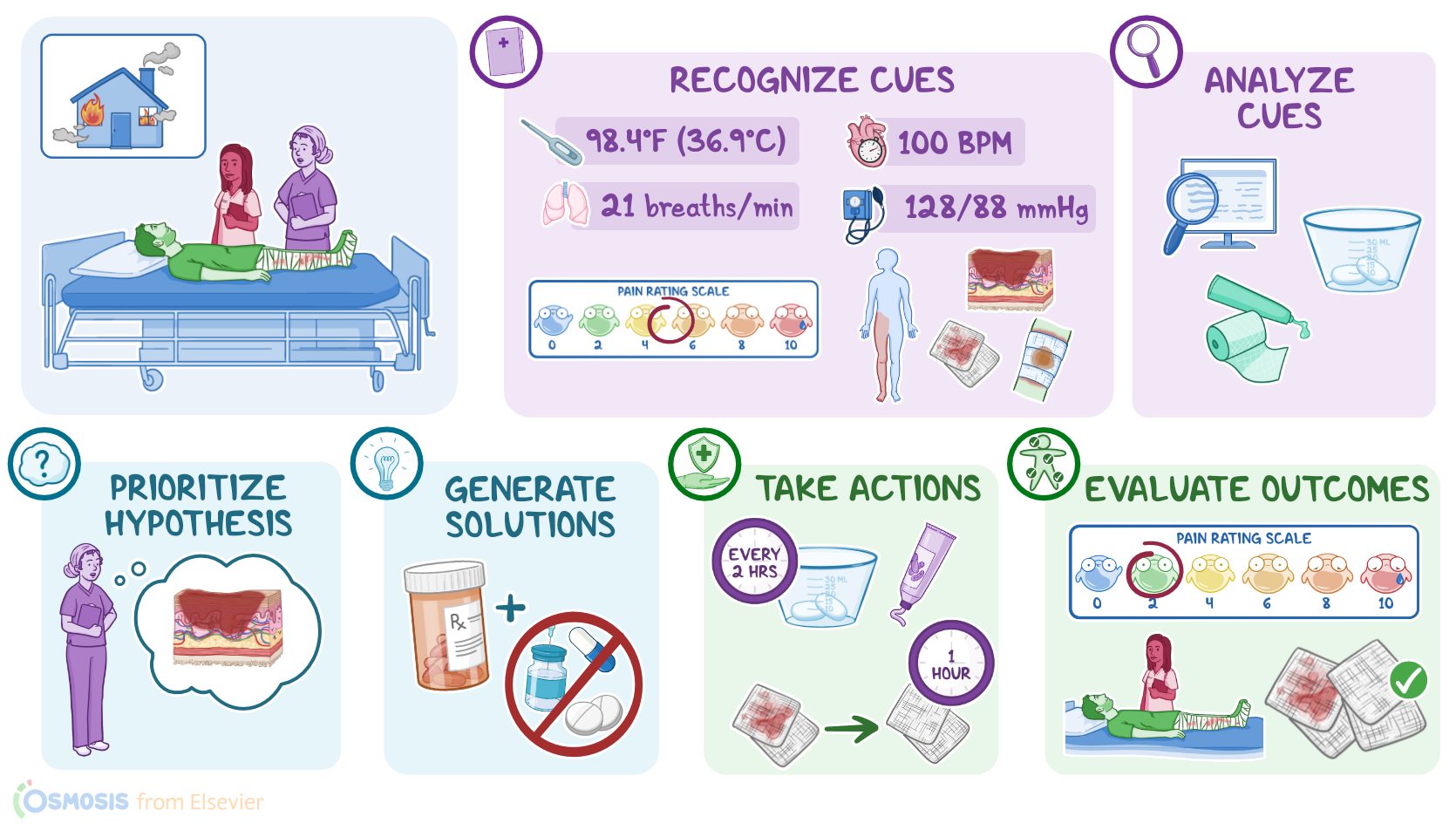
Nurse. Kamala works in a rehabilitation center and is caring for Raoul, a 42 year old who was admitted following a thermal burn in a house fire.
In collaboration with the registered nurse, RN Amy nurse, Kamala goes through the steps of the clinical judgment measurement model to make clinical decisions about Raul's care by recognizing and analyzing cues, prioritizing hypotheses, generating solutions, taking action and evaluating outcomes.
First, nurse, Kamala recognizes important cues including Raoul's vital signs which include temperature, 98.4 °F or 36.9 °C, heart rate 100 BPM, respirations, 21 breaths per minute and BP 128/88 millimeters of mercury.
Recognizing and Analyzing Cues0:33–1:49
Nurse Kamala notes that Raoul has partial and full thickness burns on his right lower extremity extending up to his lower abdomen.
The dressings over Raoul's burns have a small amount of serosanguinous drainage and the surrounding skin is reddened. She also notices that he appears uncomfortable and restless nurse, Kamala analyzes these cues.
She reviews Raul's electronic health record or E hr and notes in order for sterile dressing changes, she also sees that he's prescribed medication for pain management and he received his last dose four hours ago.
She knows that dressing changes will facilitate healing and untreated pain can make dressing changes difficult to tolerate.
Nurse. Kamala realizes that Raoul needs effective pain management.
So the prescribed wound care can be performed for his burns. Now, using the information she's gathered along with Raoul's medical history.
Prioritizing Hypotheses, Generating Solutions, and Taking Action1:49–4:01
Nurse, Kamala reports her findings to RN Amy and they choose a priority hypothesis of impaired skin integrity. Then they generate solutions to address Raoul's impaired skin integrity using non pharmacologic and pharmacologic interventions.
And they established the expected outcome that Raoul's pain will be at a tolerable level to undergo all scheduled dressing changes.
Nurse Kamala then takes action to implement these solutions. She knows that it's been four hours since Raul's last dose of pain medication and it's time to change his dressings.
Nurse. Kamala says Raul, it's time to change the dressings on your wounds before we begin.
I'd like to make sure your pain is tolerable. Can you rate your current pain level from 0 to 10?
And what you consider to be a tolerable level? Raul replies, my pain level is five out of 10 along my leg.
I can usually tolerate a pain level of like three out of 10. So I'd really like to have some pain medication before the dressing change.
Yes. Your health care provider has ordered pain medication every two hours and you can receive another dose to help you with your pain during the dressing change.
Ok, thank you. Nurse Kamala prepares the dose of pain medication and re enter Raoul's room.
She proceeds to administer his prescribed po pain medication using safe medication administration principles. Nurse Kamala then informs Raoul that she'll return in one hour to complete the dressing change once the medication has taken effect.
When nurse Kamala returns, she asks Raoul to rate his pain. He states that his pain is now a three out of 10.
Nurse Kamala repositions Raoul and allows him time to rest while she documents her interventions. A few days later, nurse Kamala is reassigned Raoul as her patient.
Evaluating Outcomes4:01–4:33
She enters his room to evaluate the outcome of her actions. She asks how Raoul is feeling and if his pain is tolerable for his scheduled dressing change today, Raoul states that his pain is currently a two out of 10 and that he's willing to have nurse Kamala change his dressing.
Raoul also reports that physical therapy and occupational therapy have been working with him daily and that he's looking forward to being discharged with home health care later in the week.
All right, it's a quick recap. Nurse Kamala recognized and analyzed cues related to Raoul's impaired skin integrity and in collaboration with RN Amy prioritized hypotheses and generated solutions to address this problem.
Review4:33–5:04
Nurse Kamala and RN Amy then implemented pharmacologic and non pharmacologic interventions and evaluated Raul's outcomes and compared them to the expected outcome since Raoul's pain was managed and he tolerated dressing changes.
They determined the plan of care was successful.
| CASE STUDY - BURN | ||
| KEY POINTS | MY NOTES | |
| INTRODUCTION |
| |
| RECOGNIZING AND ANALYZING CUES |
| |
| PRIORITIZING HYPOTHESES, GENERATING SOLUTIONS, AND TAKING ACTION |
| |
| EVALUATING OUTCOMES |
| |
- "Adult health nursing. (9th ed.). " Elsevier. ISBN: 9780323826143 (2023)
- "Medical-surgical nursing. (8th ed.). " Elsevier. ISBN: 9780323828451 (2023)
- "Medical-surgical nursing: Concepts and practice. (5th ed.)." Elsevier. ISBN: 9780323811866 (2023)
No notes for this video yet
Try adding a note below