Case study - Dementia: Nursing
Introduction0:00–0:33
Nurse Darian works on an inpatient orthopedic floor and is caring for Rosemary, an 84-year-old female with a history of Alzheimer disease who was admitted for a hip fracture.
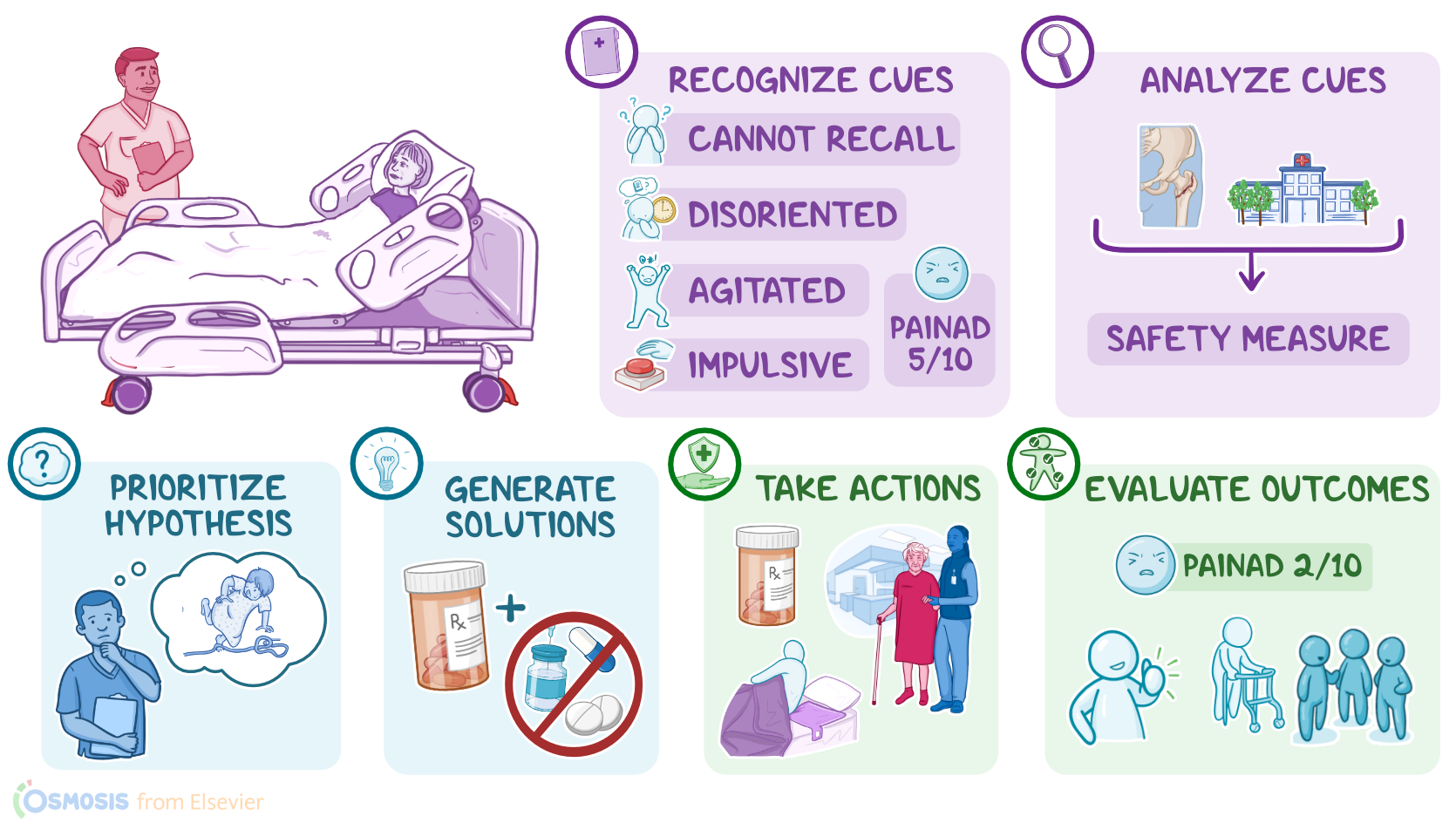
After settling Rosemary in her room, Nurse Darian goes through the steps of the Clinical Judgment Measurement Model to make clinical decisions about Rosemary’s care by recognizing and analyzing cues, prioritizing hypotheses, generating solutions, taking action, and evaluating outcomes.
First, Nurse Darian recognizes important cues, including Rosemary’s inability to recall her daughter’s name, and disorientation to date and time.
Recognizing and Analyzing Cues0:33–2:31
He also notices that Rosemary becomes agitated when asked several questions in a row; and as the evening progresses, she becomes more impulsive, and tries to get out of bed on her own.
Next, Nurse Darian analyzes these cues. He recalls that Rosemary’s dementia can be exacerbated by illness, such as her hip fracture, and changes to her familiar environment, and he realizes Rosemary needs effective safety management.
After reviewing her electronic health record, or EHR, he enters Rosemary’s room. Nurse Darian: Hi Rosemary, my name is Nurse Darian.
I was your nurse yesterday and I'll be your nurse again today. Rosemary: I've never met you.
Nurse Darian: That’s okay, Rosemary. Are you having any pain right now?
Rosemary: Why does everyone have so many questions all the time? Nurse Darian notes that Rosemary begins to sit up in bed and tries to swing her legs to the side of the bed to stand up.
The two siderails by Rosemary’s head are up, as well as one siderail by her feet. She then moves towards the open space in the bed to exit, so Nurse Darian moves to prevent her from getting up on her own.
Nurse Darian: Careful there. Let’s get you comfortable and back in bed safely Rosemary.
We can put your favorite show on the television. Rosemary: Okay.
Nurse Darian assists Rosemary back into bed and ensures her bed alarm is turned on. He notes that Rosemary’s room is at the end of the hallway near the stairwell, making it difficult for nursing staff to get to her quickly if her bed alarm goes off.
He also notices that she groans and tenses up with movement. Since Rosemary is unable to verbalize her pain, Nurse Darian uses the Pain Assessment in Advanced Dementia Scale, also known as PAINAD, to assess her pain which he determines is 5 out of 10.
Now, using the information he's gathered, Nurse Darian chooses a priority hypothesis of risk for injury. Then, he generates solutions to address Rosemary’s risk for injury including pharmacologic and nonpharmacological interventions; and he establishes the expected outcome that after intervening, Rosemary will not fall or injure herself during the shift.
Prioritizing Hypotheses, Generating Solutions, and Taking Action2:31–2:55
Nurse Darian then takes action to implement these solutions. He recognizes that Rosemary’s pain can cause increased agitation, so he administers her prescribed pain medication after using safe medication administration principles.
Evaluating Outcomes2:55–4:18
He also knows that moving Rosemary’s room closer to the nurse’s station can help staff accommodate her needs and account for her safety more effectively.
So, Nurse Darian collaborates with the charge nurse to move her room closer to the nursing station. The charge nurse approves the room change and, during Rosemary’s evening walk with the physical therapist, they move Rosemary’s belongings to her new room.
Once she’s settled in the new room, Nurse Darian ensures that Rosemary’s bed alarm is on and turns the television on to her favorite show while she eats her dinner.
An hour later, Nurse Darian hears Rosemary’s bed alarm go off. He re-enters the room to find her trying to get out of bed.
Rosemary: I don’t want to be cooped up in there anymore! I want to be near other people.
Nurse Darian then assists Rosemary to a reclining chair and moves it to the hallway directly outside the nurse's station.
He reassesses her pain, which he determines is 2 out of 10. Then, he recalls from her progress notes that Rosemary used to work as an artist, so he asks if she’d like to do some drawing.
Rosemary eagerly agrees and spends the remaining time of Darian’s shift safely drawing in her chair. Alright, as a quick recap...Nurse Darian recognized and analyzed cues related to Rosemary’s risk of injury and prioritized hypotheses and generated solutions to address this problem.
Review4:18–4:48
Nurse Darian then took action by implementing pharmacologic and nonpharmacologic measures to address Rosemary’s risk for injury and evaluated her outcomes, comparing them to the expected outcomes.
Since Rosemary remained safe during the shift, Nurse Darian determined that the plan of care was successful.
| CASE STUDY - DEMENTIA | ||
| KEY POINTS | NOTES | |
| INTRODUCTION |
| |
| RECOGNIZING AND ANALYZING CUES |
| |
| PRIORITIZING HYPOTHESES, GENERATING SOLUTIONS, AND TAKING ACTIONS |
| |
| EVALUATING OUTCOMES |
| |
- "Lewis's medical-surgical nursing: Assessment and management of clinical problems. (12th ed.)" Elsevier (2022)
- "Medical-surgical nursing: Concepts for interprofessional and collaborative care. (10th ed.)" Elsevier (2021)
- "Lewis’s medical-surgical nursing in Canada: Assessment and management of clinical problems. (5th ed.)" Elsevier (2023)
No notes for this video yet
Try adding a note below