Case study - Epilepsy: Nursing
Introduction0:00–0:13
Nurse Karla works on an inpatient neurology unit and is caring for Nisha, a 24-year-old female with a history of generalized onset tonic-clonic seizures.
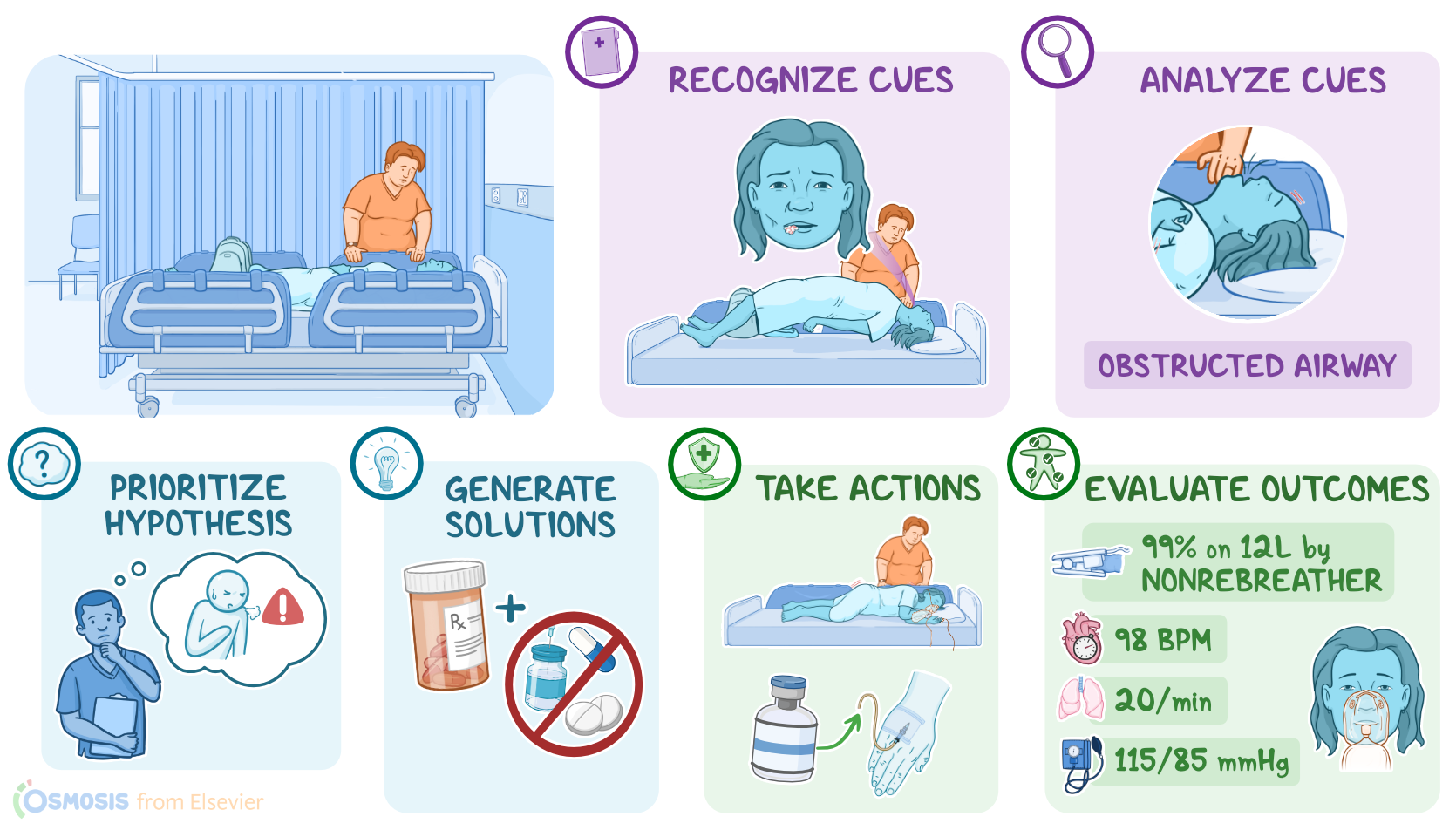
After settling Nisha in her room, Nurse Karla goes through the steps of the Clinical Judgment Measurement Model to make clinical decisions about Nisha’s care by recognizing and analyzing cues, prioritizing hypotheses, generating solutions, taking action, and evaluating outcomes.
Recognizing and Analyzing Cues0:13–1:56
First, Nurse Karla recognizes important cues. As she reviews the electronic health record, or EHR, Karla notes Nisha is on seizure precautions and has an order for lorazepam IV push for seizures, per protocol.
As she enters Nisha’s room, she finds Nisha lying supine on her bed. Nisha: I don’t feel right.
I feel like I’m going to have a seizure. Nurse Karla: Okay Nisha, I’ll stay with you.
Then, Nisha’s body begins cycling through periods of intermittent jerking movements and muscle tightening. Her breathing is sporadic, and she alternates between rapid breathing and apnea.
Then, she protects Nisha from injury by ensuring there are no objects in Nisha’s bed that could hurt her during the seizure.
Next, Nurse Karla analyzes these cues. Nurse Karla realizes that during tonic-clonic seizures, the airway can become obstructed, and she recognizes Nisha needs effective airway management.
Now, using the information she's gathered, Nurse Karla chooses a priority hypothesis of impaired respiratory function. Then, she generates solutions to address Nisha’s impaired respiratory function, including pharmacologic and nonpharmacologic interventions; and she establishes the expected outcome that after intervening, Nisha will maintain a patent airway.
Prioritizing Hypotheses, Generating Solutions, and Taking Action1:56–3:04
Nurse Karla then takes action to implement these solutions. While she waits for the emergency team to arrive, she turns Nisha on her side to help keep her airway patent and allow drainage of any secretions to prevent aspiration.
When the emergency team arrives, she instructs one of the nurses to administer the prescribed lorazepam IV push, per protocol.
She keeps Nisha on her side, applies 100% oxygen by nonrebreather mask, initiates continuous pulse oximetry, while noting the time the seizure activity stopped.
After the seizure, Nurse Karla evaluates the outcome of her actions. She checks Nisha’s vital signs, which are blood pressure 115/85 mmHg, heart rate 98 beats per minute, oxygen saturation of 99 percent on 12 liters by nonrebreather, and respirations 20 breaths per minute.
Evaluating Outcomes3:04–3:35
She also notes Nisha’s breathing is stabilized with a normal depth and rhythm and she opens her eyes when her name is spoken.
Alright, as a quick recap...Nurse Karla recognized and analyzed cues related to Nisha’s seizure, prioritized hypotheses, and generated solutions to address this problem.
Review3:35–4:04
Nurse Karla then implemented pharmacologic and nonpharmacologic measures to address Nisha’s impaired respiratory function, and evaluated Nisha’s outcomes, comparing them to the expected outcomes.
Since Nisha’s was able to maintain a patent airway, Nurse Karla determined that the plan of care was successful.
| CASE STUDY - EPILEPSY | ||
| KEY POINTS | NOTES | |
| INTRODUCTION |
| |
| RECOGNIZING AND ANALYZING CUES |
| |
| PRIORITIZING HYPOTHESES, GENERATING SOLUTIONS, AND TAKING ACTIONS |
| |
| EVALUATING OUTCOMES |
| |
- "Lewis's medical-surgical nursing: Assessment and management of clinical problems. (12th ed.)" Elsevier (2022)
- " Medical-surgical nursing: Concepts for interprofessional and collaborative care. (10th ed.)" Elsevier (2021)
- "Lewis’s medical-surgical nursing in Canada: Assessment and management of clinical problems. (5th ed.)" Elsevier (2023)
No notes for this video yet
Try adding a note below