Case study - Hypertension: Nursing
Introduction0:00–0:28
Nurse Tom works at a primary care clinic and is caring for Mahlik, a 62-year-old patient who is being seen for a wellness check.
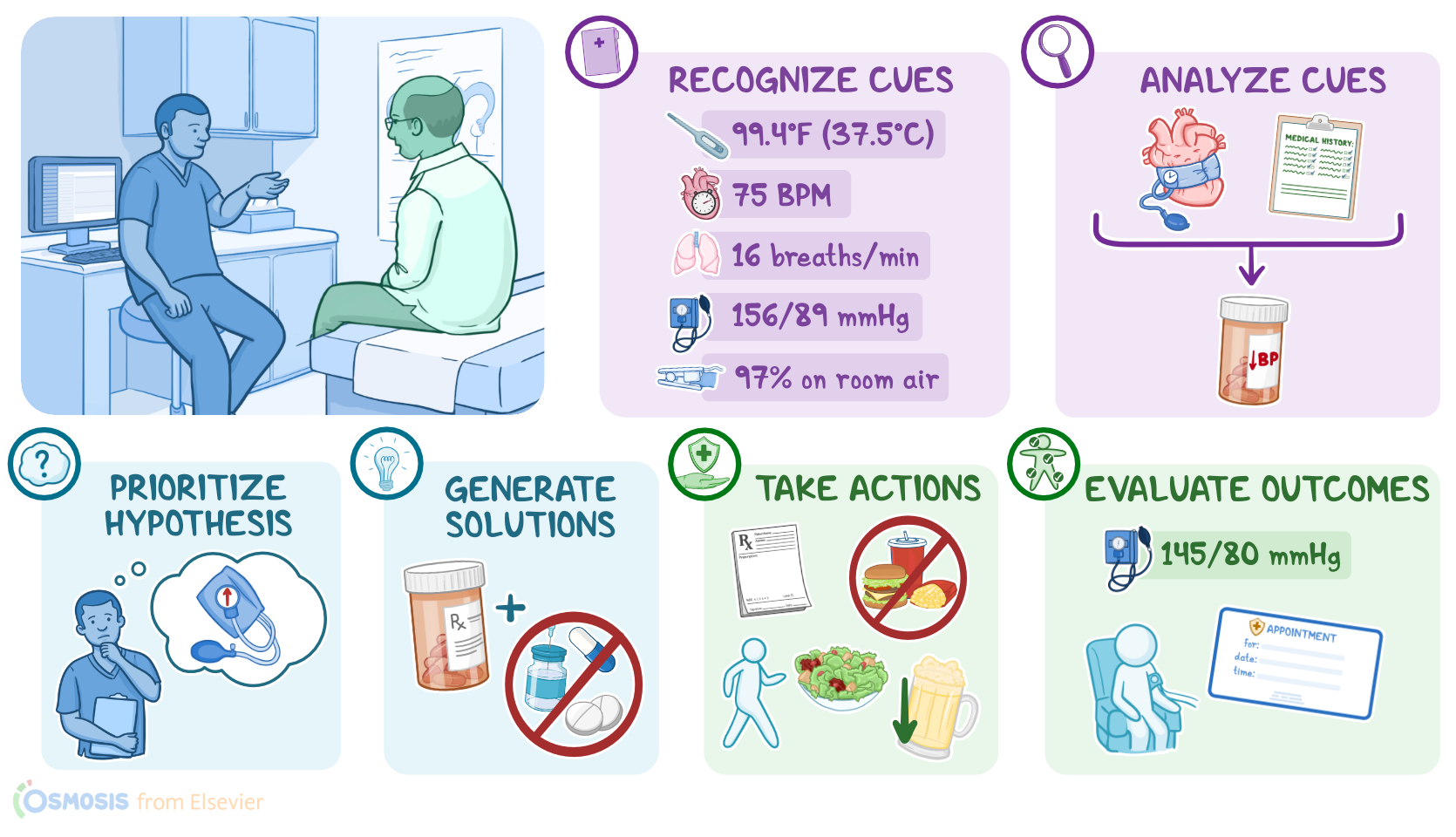
After settling Mahlik in the exam room, Nurse Tom goes through the steps of the Clinical Judgment Measurement Model to make clinical decisions about Mahlik’s care by recognizing and analyzing cues, prioritizing hypotheses, generating solutions, taking action, and evaluating outcomes.
First, Nurse Tom recognizes important cues, including temperature 99.4 F or 37.5 C, pulse 75 beats per minute; respirations 16 breaths per minute; blood pressure of 156/89 mmHg, and oxygen saturation 97% on room air.
Recognizing and Analyzing Cues0:28–2:04
Do any of your family members have high blood pressure? Mahlik: My dad and older brother do.
My job is stressful, so maybe that’s contributing. I’ve checked my blood pressure at the drug store, and it’s been high, but with work, I haven’t had time to come in and have it checked.
Nurse Tom: Stress can contribute to high blood pressure, and family members with high blood pressure can increase your likelihood of having it too.
What foods do you usually eat? Mahlik: I mostly eat fast food because I’m always on the go.
I drink maybe 1 to 2 beers a week on average, and honestly, I don’t exercise as much as I should. I’m just so busy with work.
Nurse Tom analyzes these cues. He reviews the electronic health record, or EHR, and notes Mahlik’s body mass index, or BMI, is 28 kg/m2.
Nurse Tom alerts the health care provider to Mahlik’s blood pressure and history. They diagnose Mahlik with stage 1 primary hypertension and prescribe an oral antihypertensive medication.
Nurse Tom realizes Mahlik needs effective blood pressure management. Using the information gathered along with Mahlik’s history, Nurse Tom chooses a priority hypothesis of elevated blood pressure.
Prioritizing Hypotheses, Generating Solutions, and Taking Action2:04–3:42
He then generates solutions to address Mahlik’s blood pressure including pharmacologic and nonpharmacologic interventions and establishes the expected outcome that after intervening, Mahlik’s blood pressure will be 130/80 mmHg or below at his next follow-up appointment.
Then, Nurse Tom takes action to implement these solutions. Nurse Tom: Your health care provider has prescribed a medication called losartan, an angiotensin receptor blocker, which will help lower your blood pressure.
Mahlik: Okay. Following safe medication administration principles, Nurse Tom administers losartan as prescribed, and teaches Mahlik about how to manage his hypertension.
Nurse Tom: Now, along with taking your medication, there are some other ways you can help lower your blood pressure. You should try to get at least two and a half hours a week of moderate exercise, like walking.
You don’t drink very much, so continue including alcohol in moderation, though eliminating it can be more helpful. You should also try to avoid foods high in sodium, like fast food.
And I can start by going for a walk a few times a week. Nurse Tom: Those are great ideas!
Next, Nurse Tom teaches Mahlik about his new medication, and demonstrates how to measure his blood pressure at home. He obtains a home blood pressure machine for Mahlik and makes an appointment for Mahlik to return to the clinic in one week.
One week later, Mahlik returns for his follow-up appointment, and Nurse Tom evaluates the outcome of his actions. He measures Mahlik’s blood pressure, which is 145/80 mmHg.
Evaluating Outcomes3:42–4:16
Although Mahlik’s blood pressure is improving, Nurse Tom recognizes the expected outcome hasn’t been met. Nurse Tom: Your blood pressure is improving, but it’s still a little elevated.
That’s okay! It can take several weeks for blood pressure medication to take effect.
Just be sure to continue to measure your blood pressure at home, like we discussed, and return here for another blood pressure check in one week.
Alright, as a quick recap…Nurse Tom recognized and analyzed cues related to Mahlik’s newly diagnosed hypertension and prioritized hypotheses and generated solutions to address this problem.
Review4:16–4:40
Nurse Tom then implemented pharmacologic and nonpharmacologic blood pressure management interventions and compared them to the expected outcome.
Since Mahlik’s blood pressure remained above 130/80 mmHg following interventions, Nurse Tom
| CASE STUDY - HYPERTENSION | ||
| KEY POINTS | NOTES | |
| INTRODUCTION |
| |
| RECOGNIZING AND ANALYZING CUES |
| |
| PRIORITIZING HYPOTHESES, GENERATING SOLUTIONS, AND TAKING ACTION |
| |
| EVALUATING OUTCOMES |
| |
- "Lewis's medical-surgical nursing: Assessment and management of clinical problems. (12th ed.)" Elsevier (2022)
- "Medical-surgical nursing: Concepts for interprofessional and collaborative care. (10th ed.)" Elsevier (2021)
No notes for this video yet
Try adding a note below