Case study - Hypertension: Nursing

1,185views

Case study - Hypertension: Nursing

Exam 1 Fall 2024 Pathophysiology Pre Nursing

Exam 1 Fall 2024 Pathophysiology Pre Nursing

Systemic lupus erythematosus (SLE): Nursing
Toxic stress: Information for patients and families (The Primary School)
Metaplasia and dysplasia
Hypoxia
Necrosis and apoptosis
Case study - Pressure injury: Nursing
Body fluid compartments
Electrolyte balance - Overview: Nursing
Physiology of pain: Nursing
Complete blood count (CBC) - White blood cells (WBC) and differential: Nursing
Hypersensitivity reactions - Type I: Nursing
Hypersensitivity reactions - Type II: Nursing
Hypersensitivity reactions - Type III: Nursing
Hypersensitivity reactions - Type IV: Nursing
Case study - Healthcare-associated infection (HAI): Nursing
Anemia - Iron-deficiency: Nursing
Sickle cell disease: Nursing process (ADPIE)
Arterial embolism: Nursing
Autoimmunity: Nursing
Cardiac biomarkers - Troponin: Nursing
Case study - Acute coronary syndrome (ACS): Nursing
Shock - Cardiogenic: Nursing
Case study - Hypertension: Nursing
Hypertension: Nursing process (ADPIE)
Hypertriglyceridemia
Raynaud phenomenon: Nursing
Buerger disease: Nursing
Free radicals and cellular injury
Ischemia
Inflammation
Metabolic acidosis
Respiratory acidosis
Respiratory alkalosis
Metabolic alkalosis
Hyponatremia
Hypernatremia
Hyperkalemia
Normal heart sounds
Influenza: Nursing
The flu vaccine: Information for patients and families
Guillain-Barré syndrome: Nursing
Human immunodeficiency virus (HIV) and acquired immunodeficiency syndrome (AIDS): Nursing
Inflammatory process: Nursing
Fever: Nursing
Wound healing
Cortisol
Peripheral venous disease (PVD): Nursing process (ADPIE)
Immunodeficiency disorders - Primary: Nursing
Case study - Wound infection: Nursing
Meningitis: Nursing process (ADPIE)
Escherichia coli
Thrombocytopenia: Nursing
Case-control study
Enterobacter
Neutropenia: Nursing
Shock - Septic: Nursing
Candida
Staphylococcus aureus
Methicillin-resistant Staphylococcus aureus (MRSA): Nursing process (ADPIE)
Impetigo: Nursing
Rhinovirus
Lymphoma - Hodgkin and non-Hodgkin: Nursing
Multiple myeloma: Nursing
Anemia of chronic disease: Year of the Zebra
Shock - Hypovolemic: Nursing
Skin cancer - Basal cell carcinoma, squamous cell carcinoma, and melanoma: Nursing
Peripheral arterial disease (PAD): Nursing process (ADPIE)
Lyme disease: Nursing process (ADPIE)
Leukemia: Nursing process (ADPIE)
Hemophilia: Nursing process (ADPIE)
Stroke: Nursing process (ADPIE)
Candidiasis: Nursing process (ADPIE)
Anaphylaxis: Nursing process (ADPIE)
Chickenpox (Varicella): Nursing process (ADPIE)

Notes

CASE STUDY - HYPERTENSION

KEY POINTS
NOTES
INTRODUCTION
  • Primary care clinic
  • 62-year-old 
  • Wellness check

RECOGNIZING AND ANALYZING CUES
  • Recognize cues
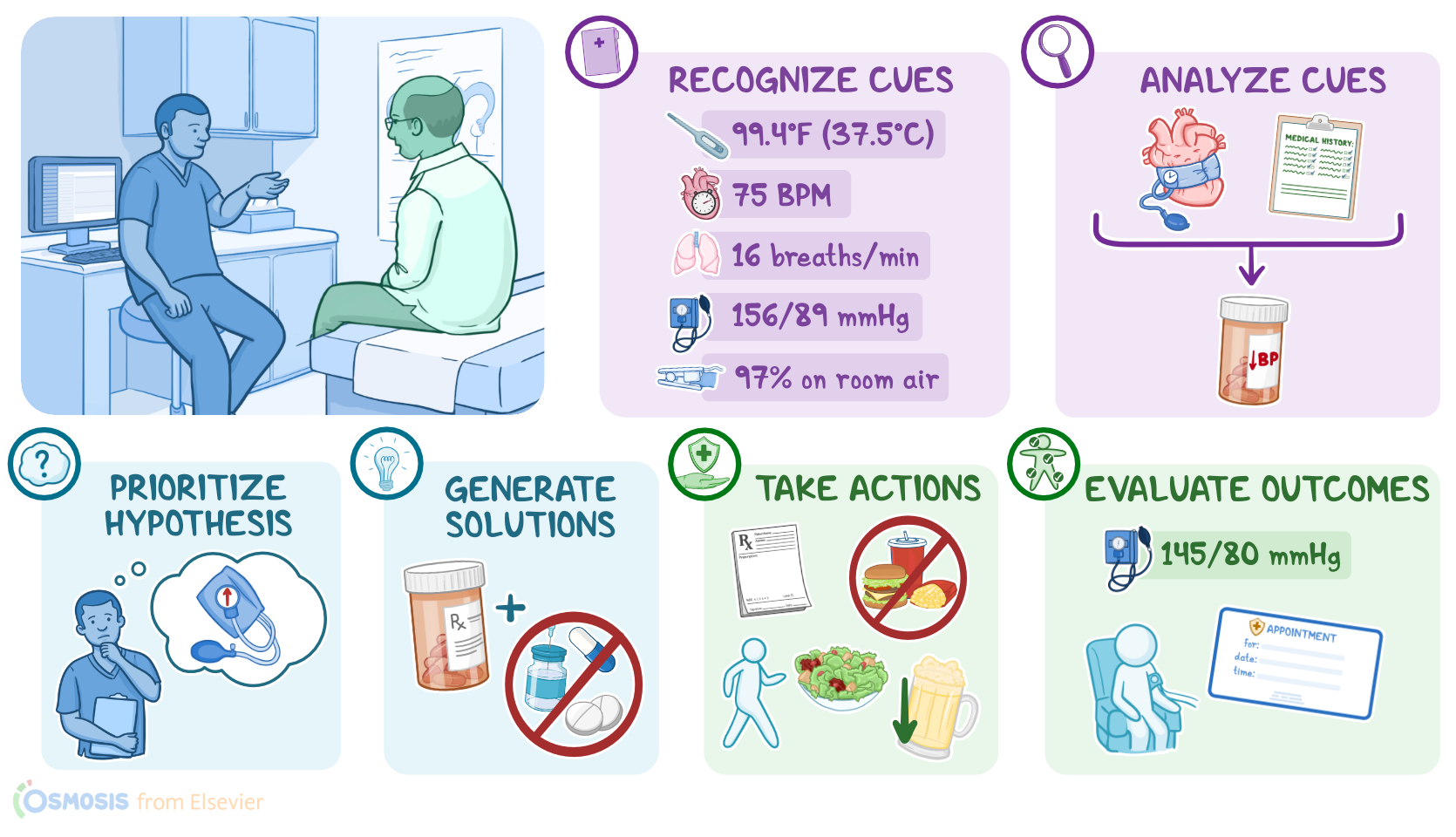
    • Temperature: 99.4 F (37.5 C)
    • Heart rate: 75
    • Respirations: 16
    • Blood pressure: 156/89 mmHg
    • Oxygen saturation: 97% room air
    • Family history hypertension
    • Fast food frequently
    • 1-2 beers/week
    • Minimal exercise
  • Analyze cues
    • Body mass index: 28 kg/m2
    • Diagnosed with stage 1 primary hypertension
    • Prescribed oral antihypertensive

PRIORITIZING HYPOTHESES, GENERATING SOLUTIONS, AND TAKING ACTION
  • Priority hypothesis
    • Elevated blood pressure
  • Generate solutions
    • Blood pressure will be 130/80 mmHg or below at next follow-up appointment
  • Take action
    • Administers medication as prescribed
    • Teaches about new prescription, exercise, alcohol use, diet, and measuring blood pressure

EVALUATING OUTCOMES
  • Blood pressure: 145/80 mmHg
  • Outcome unmet

Transcript

Watch video only

Nurse Tom works at a primary care clinic and is caring for Mahlik, a 62-year-old patient who is being seen for a wellness check. After settling Mahlik in the exam room, Nurse Tom goes through the steps of the Clinical Judgment Measurement Model to make clinical decisions about Mahlik’s care by recognizing and analyzing cues, prioritizing hypotheses, generating solutions, taking action, and evaluating outcomes

First, Nurse Tom recognizes important cues, including temperature 99.4 F or 37.5 C, pulse 75 beats per minute; respirations 16 breaths per minute; blood pressure of 156/89 mmHg, and oxygen saturation 97% on room air.  

Next, Nurse Tom asks Mahlik about his history.  

Nurse Tom: Do you usually have high blood pressure? Do any of your family members have high blood pressure? 

Mahlik: My dad and older brother do. My job is stressful, so maybe that’s contributing. I’ve checked my blood pressure at the drug store, and it’s been high, but with work, I haven’t had time to come in and have it checked. 

Nurse Tom: Stress can contribute to high blood pressure, and family members with high blood pressure can increase your likelihood of having it too. What foods do you usually eat? 

Mahlik: I mostly eat fast food because I’m always on the go.  

Nurse Tom: Can you tell me about how often you smoke, drink alcohol, and exercise? 

Mahlik: I don’t smoke, never have. I drink maybe 1 to 2 beers a week on average, and honestly, I don’t exercise as much as I should. I’m just so busy with work.  

Nurse Tom analyzes these cues. He reviews the electronic health record, or EHR, and notes Mahlik’s body mass index, or BMI, is 28 kg/m2. Nurse Tom alerts the health care provider to Mahlik’s blood pressure and history. They diagnose Mahlik with stage 1 primary hypertension and prescribe an oral antihypertensive medication. Nurse Tom realizes Mahlik needs effective blood pressure management

Using the information gathered along with Mahlik’s history, Nurse Tom chooses a priority hypothesis of elevated blood pressure. He then generates solutions to address Mahlik’s blood pressure including pharmacologic and nonpharmacologic interventions and establishes the expected outcome that after intervening, Mahlik’s blood pressure will be 130/80 mmHg or below at his next follow-up appointment.  

Sources

  1. "Lewis's medical-surgical nursing: Assessment and management of clinical problems. (12th ed.)" Elsevier (2022)
  2. "Medical-surgical nursing: Concepts for interprofessional and collaborative care. (10th ed.)" Elsevier (2021)